Investors’ Lens: Decoding How They Scrutinize Your Cost Projections
Key Takeaways
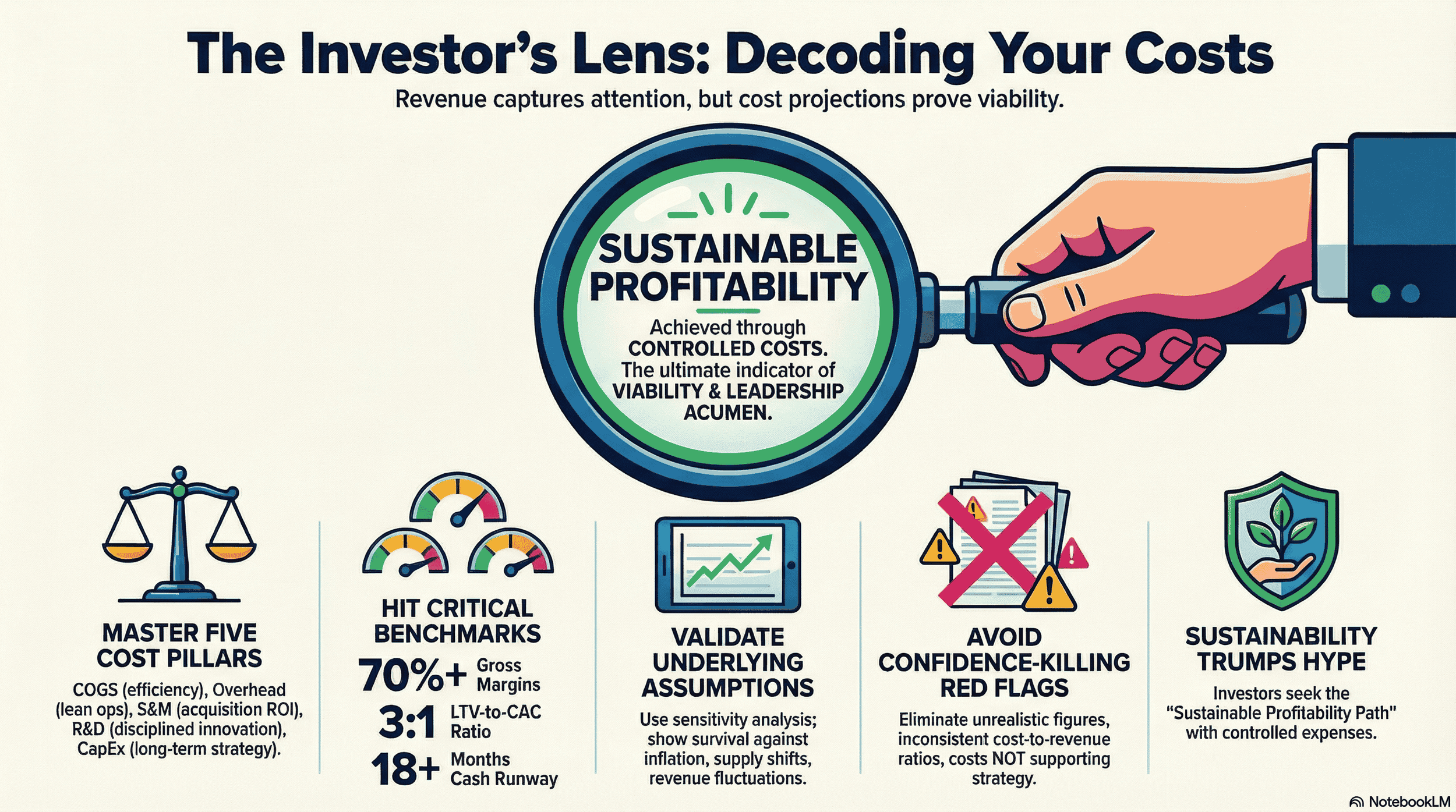
Cost projections are a critical deal-breaker: While revenue forecasts capture initial attention, investors meticulously scrutinize your cost projections as the primary indicator of operational efficiency, financial discipline, and long-term business viability.
Sustainable profitability trumps revenue hype: Investors seek businesses that demonstrate a clear path to profitability through controlled costs, not just impressive revenue growth. High revenue with higher expenses signals an unsustainable business model.
Your costs reflect your business acumen: Detailed, well-researched cost projections demonstrate strategic thinking and operational understanding. They signal to investors that you've moved beyond optimism to rigorously assess the resources required to execute your vision.
Investors analyze five critical cost pillars: Cost of Goods Sold (COGS) reveals operational efficiency and gross margin potential; operational overhead shows lean operations; sales and marketing expenses demonstrate customer acquisition efficiency; R&D costs indicate disciplined innovation; and capital expenditures reflect long-term investment strategy.
Assumptions matter more than numbers: Investors probe the underlying assumptions behind every cost figure. Validated cost drivers, sensitivity analysis showing performance under different scenarios, and contingency planning for unexpected events are essential for credibility.
Common red flags destroy investor confidence: Unrealistic or unsubstantiated figures, inconsistent cost-to-revenue relationships, neglecting market and regulatory realities, insufficient cash flow planning, and costs disconnected from business strategy all trigger immediate investor concern.
Key metrics investors demand: A Customer Acquisition Cost (CAC) that declines over time, an LTV-to-CAC ratio of at least 3:1, gross margins of 70% or higher for venture-backed companies, and at least 18 months of runway post-fundraise are critical benchmarks.
Transparency builds trust: Provide granular expense breakdowns, document all assumptions with sources, explain your forecasting methodology, and clearly link every major cost to strategic objectives that drive business outcomes.
Multiple forecasting methods strengthen credibility: Employ bottom-up and top-down approaches, use industry benchmarks, conduct scenario planning for best-case and worst-case situations, and demonstrate how your model responds to various market conditions.
Cost projections are strategic storytelling: Transform your projections from dry numbers into a compelling narrative that shows how every dollar spent drives sustainable growth, competitive advantage, and the journey toward profitability—ultimately building investor confidence in your leadership capability.
Why Your Cost Projections Are the Silent Deal-Breaker
In the high-stakes arena of startup funding, a compelling vision and impressive revenue forecasts often capture initial attention. However, beneath the surface of ambition lies a fundamental investor concern that can make or break a deal: your cost projections.
While founders may understandably focus on growth potential, investors are meticulously dissecting the operational realities and financial discipline reflected in your projected expenses. This isn't about stifling innovation; it's about validating the long-term viability and capital efficiency of your business. A misstep in forecasting costs, or a lack of clarity in presenting them, can signal a fundamental misunderstanding of the business, ultimately leading to a lost investment opportunity.
This article will delve deep into the investor's perspective, revealing precisely how they scrutinize your cost projections, what signals they look for, and how you can present your financial narrative with the robustness and transparency that breeds confidence.
Beyond Revenue Hype: The Investor's Obsession with Sustainable Profitability
The allure of rapidly escalating revenue is undeniable. It paints a picture of market traction and future success. However, for seasoned investors, revenue alone is a superficial metric. Their ultimate goal is sustainable profitability and a robust return on their investment. This is where cost projections become paramount. Investors understand that high revenue with even higher expenses is a recipe for disaster. They scrutinize your projected expenses not merely as line items, but as indicators of operational efficiency, strategic planning, and management's grasp of the business’s true cost drivers.
A company that consistently demonstrates a clear understanding and control over its costs, even in its nascent stages, signals a mature and well-managed business. This insight is crucial. Investors are not just betting on your idea; they are betting on your ability to execute it profitably. Your projected income statements and cash flow statements, when viewed through the lens of cost, reveal whether your revenue growth is sustainable or if it's a precarious ascent built on an unstable financial foundation. The benefits of meticulously projecting costs extend beyond appeasing investors; they provide you, the founder, with an invaluable roadmap for managing your business effectively and ensuring its long-term survival.
Your Cost Projections as a Testament to Business Acumen
Your cost projections are far more than a mere requirement for your business plan; they are a direct reflection of your business acumen. When investors review your financial forecasting, they are looking for evidence of your understanding of the intricate workings of your company. They want to see that you have considered not just the potential for income, but also the granular details of the resources required to generate that income. This includes a realistic assessment of operational costs, marketing spend, personnel, research and development, and capital expenditures.
A well-thought-out cost structure, supported by defensible assumptions, demonstrates that you have a deep appreciation for the operational realities of your industry. It shows that you've moved beyond optimistic assumptions and have engaged in rigorous financial forecasting. Investors interpret this diligence as a sign of responsible leadership, a crucial trait for any business they back. The ability to articulate how each expense contributes to the overall business strategy and revenue generation is a powerful signal of your strategic thinking. Conversely, vague or unsubstantiated cost figures can raise immediate red flags, suggesting a lack of preparedness or an incomplete understanding of the business's financial model.
What This Article Will Uncover: Navigating Investor Scrutiny
This article aims to demystify the investor's rigorous examination of your cost projections. We will move beyond the surface-level discussion of financial statements to explore the underlying motivations and analytical frameworks investors employ. You will gain an insider's perspective on precisely what they are looking for, the specific questions they ask, and the common pitfalls that can derail your investment prospects.
We will deconstruct the key cost pillars investors scrutinize, illuminate the critical role of your underlying assumptions, and identify the unmistakable red flags that trigger investor concern. Ultimately, you will be equipped with actionable strategies to build robust, transparent, and investor-convincing cost projections that solidify your position as a capable and trustworthy business leader.
Investors analyze the relationship between revenue and costs to determine if a business is on a sustainable path to profitability or simply burning cash at an unsustainable rate.
The Investor's Mindset: What Drives Their Scrutiny of Costs
Understanding the investor's perspective is the first step in mastering your cost projections. Investors are fundamentally risk-averse. Their primary objective is to preserve and grow capital, meaning they are intensely focused on mitigating potential losses and maximizing returns. This inherent caution drives their meticulous scrutiny of every aspect of your business plan, with cost projections sitting at the forefront of their risk assessment.
From Optimism to Reality: The Quest for Realistic Financials
Founders often approach financial forecasting with a healthy dose of optimism, which is crucial for driving vision and innovation. However, investors seek a grounded reality check. They are wary of overly aggressive, unsubstantiated projections that paint an unrealistic picture. Your forecasted revenue might be ambitious, but your projected expenses must reflect the true cost of achieving that revenue. Investors look for financial forecasts that are ambitious yet pragmatic, demonstrating an understanding of market dynamics, operational challenges, and the inherent costs associated with scaling a business. This realistic approach to financial projections is not a sign of low ambition but of mature business planning.
Risk Mitigation: Protecting Capital and Ensuring Business Viability
For investors, understanding your cost structure is a primary method of risk mitigation. They want to know how their investment will be used and how effectively it will be deployed to generate returns. High burn rates, inefficient spending, or unexpected cost overruns can quickly deplete capital, jeopardizing the entire investment.
Your projected cash flow statement is critical here, showing how your company will manage its outgoing expenses relative to its incoming revenue. Investors scrutinize these projections to ensure the company has sufficient runway – the amount of time it can operate before running out of cash. A robust cost projection, therefore, is not just about financial numbers; it's about demonstrating your commitment to capital preservation and the long-term viability of the business.
Pro tip: At Allied Venture Partners, one of our requirements for investing in a startup is for the company to have at least 18 months of runway in the bank post-fundraise. This ensures the founders can shift their focus from fundraising to running the company without worrying about running out of cash in the near term.
Understanding Your Business Model's Underlying Efficiency and Scalability
The way you project your costs offers profound insights into the efficiency and scalability of your business model. Investors analyze your expenses to understand how your business operates.
Are your operational costs lean and optimized?
Can your cost of goods sold (COGS) decrease as you scale, or will it remain a significant burden?
Do your sales and marketing expenses translate into profitable customer acquisition?
These questions help investors assess whether your business is built for sustainable growth. A business model that relies on disproportionately high or fixed costs, even with high revenue, may not be scalable or attractive for investment. Investors seek companies that can achieve economies of scale, meaning their costs grow at a slower rate than their revenue.
Pro tip: At Allied Venture Partners, one of the key metrics we look at when deciding to invest is Gross Margin. As venture capital investors, we prefer to invest in businesses with 70% or higher gross margins.
The Link Between Cost Management and Future Company Performance
There is a direct and undeniable link between effective cost management, as reflected in your projections, and the future performance of your company. Investors view a company with disciplined cost controls as one that is likely to be more resilient during economic downturns, better positioned to achieve profitability, and more capable of reinvesting in growth. Your financial forecasts are a predictor of future performance, and the cost projections within them are a key determinant of that prediction. A history of prudent financial management, or well-reasoned projections for future cost control, builds investor confidence that the company will achieve its financial milestones and deliver on its promises.
Deconstructing Your Cost Pillars: Areas of Deep Investor Scrutiny
Investors don't just glance at a total expense figure; they meticulously dissect each major cost category. Understanding what they look for within each pillar is crucial for presenting a convincing financial narrative.
Cost of Goods Sold (COGS): The Core of Operational Efficiency
The Cost of Goods Sold (COGS) represents the direct costs attributable to the production or purchase of the goods sold by a company. For investors, COGS is a critical indicator of operational efficiency. They will scrutinize your projected COGS to understand:
Variable vs. Fixed Costs: Are your COGS primarily variable (changing with production volume) or are there significant fixed components? Investors prefer variable COGS that scale proportionally with revenue, as fixed COGS can become a burden if sales falter.
Supplier Relationships and Pricing: Your projections implicitly reveal your assumptions about raw material costs, manufacturing expenses, and supplier pricing. Investors will question if these assumptions are realistic and if there's potential for price increases that could impact your margins. They might ask about your negotiation power and contingency plans for supply chain disruptions.
Margin Impact: The relationship between COGS and revenue directly determines your gross profit margin. Investors analyze this margin to assess the inherent profitability of your core offering. A declining gross margin, even with increasing revenue, is a significant red flag.
Scalability: How does your projected COGS scale as your business grows? Do you anticipate bulk discounts from suppliers, or will costs per unit remain stubbornly high?
Operational & Overhead Costs: Unpacking the Engine Room
Operational and overhead costs (often referred to as Selling, General, and Administrative expenses, or SG&A) are the expenses incurred to run the business that are not directly tied to the production of goods or services. Investors view these as the "engine room" of your company and will delve into:
Necessity and Justification: Are these expenses essential for running the business and achieving your strategic objectives? Investors are looking for lean operations. They will question the size of your team relative to revenue, the necessity of certain office spaces, and the cost of administrative functions.
Headcount and Productivity: The number of employees and their associated costs (salaries, benefits, taxes) are a major component of overhead. Investors will often calculate headcount-to-revenue ratios and compare them to industry benchmarks. They want to see that your team is productive and that your personnel costs are managed efficiently.
Cost Control Measures: What systems do you have in place to control these expenses? Are there regular budget reviews? Are there opportunities for outsourcing non-core functions to reduce overhead?
Impact on Net Profitability: While COGS affects gross profit, overhead directly impacts your net profit. Investors want to see a clear path to profitability, which requires managing these costs effectively.
Sales & Marketing Expenses: Fueling Growth Without Burning Capital
Sales and marketing (S&M) expenses are investments made to acquire customers and generate revenue. Investors scrutinize these costs with a focus on return on investment (ROI) and capital efficiency. Key questions include:
Customer Acquisition Cost (CAC): What is your projected CAC? This is the total cost of sales and marketing efforts divided by the number of new customers acquired. Investors want to see a CAC that is sustainable and allows for profitable customer relationships.
Lifetime Value (LTV): How does your projected CAC compare to the expected Lifetime Value (LTV) of a customer? The LTV is the total revenue a customer is expected to generate over their relationship with your company. A healthy business model requires LTV to be significantly higher than CAC.
Marketing Channel Effectiveness: Which channels are you investing in, and what are their projected returns? Investors want to see data-driven marketing strategies, not just broad-stroke spending. They will question assumptions about conversion rates and the scalability of your customer acquisition channels.
Burn Rate Impact: High S&M spending can significantly increase your burn rate. Investors will assess if your marketing strategy is aligned with your cash runway and if the growth it generates justifies the expenditure.
Pro tip: Most venture capitalists, including us at Allied Venture Partners, prefer that a startup have the following sales and marketing KPI benchmarks when deciding to invest:
Continuously declining CAC
An LTV-to-CAC ratio of at least 3:1
A Burn Multiple below 2x (to learn more about Burn Multiple, try our free Burn Multiple Calculator).
Research & Development (R&D) Costs: Innovation vs. Expenditure
R&D costs represent investments in innovation, product development, and future growth. While essential for many companies, investors view these expenditures through a lens of potential return and disciplined execution. They will ask:
Alignment with Strategy: How do your R&D costs align with your overall business strategy and market opportunities? Investors want to see that R&D is focused on areas with significant market potential and a clear path to commercialization.
Projected ROI: What is the expected return on your R&D investments? While not always quantifiable in the short term, investors want to see a clear thesis for how these investments will lead to future revenue or competitive advantage.
Discipline and Phasing: Is your R&D spending phased logically, tied to milestones, and subject to review? Uncontrolled or speculative R&D spending can be a significant drain on resources. Investors look for a disciplined approach to innovation.
Market Validation: Are your R&D efforts informed by market needs and customer feedback? Investing heavily in features or products that the market doesn't want is a high-risk proposition.
Capital Expenditure (CapEx) & Project Costs: Assessing Long-Term Investment
Capital expenditures (CapEx) are investments in physical assets that will be used for more than one year, such as property, plant, or equipment. Project costs refer to specific, often one-time, expenditures for initiatives like developing a new facility or launching a major product line. Investors scrutinize these by considering:
Necessity for Growth: Is this CapEx essential for your company's growth and operational capability? Investors need to understand why these large expenditures are required at this stage.
Payback Period and ROI: What is the expected payback period for these investments? How will they contribute to future revenue or cost savings? Investors seek tangible returns on significant capital outlays.
Realism of Estimates: Are your CapEx and project cost estimates realistic and well-researched? Overly optimistic cost estimates for major projects can signal a lack of experience or due diligence.
Impact on Cash Flow: Large CapEx can significantly impact your cash flow. Investors will assess if you have adequately planned for these outlays and if they align with your projected cash generation.
The Criticality of Assumptions: Where Investors Poke Holes in Your Costs
The numbers in your financial forecast are only as reliable as the assumptions upon which they are built. For investors, the real work begins when they start questioning your underlying assumptions about costs. This is where they can either gain confidence in your projections or find reasons to doubt your entire financial model.
Validating Your Underlying Cost Drivers: Beyond Best Guesses
Investors want to see that your cost projections are grounded in reality, not just best guesses. This means demonstrating you have rigorously validated your cost drivers. This validation can come from various sources:
Market Research: For raw materials, supplier costs, or service pricing, market research provides objective data. Have you obtained quotes from multiple vendors? Have you researched industry-standard pricing for services?
Historical Data: If your company has been operating for some time, historical expense data is invaluable. Investors will compare your projections to past performance, looking for logical explanations for any deviations.
Industry Benchmarks: Understanding typical cost structures and ratios within your industry can lend credibility to your projections. While not a substitute for specific analysis, benchmarks provide context.
Expert Consultation: Have you consulted with industry experts, accountants, or legal professionals to inform your cost estimates, particularly for complex areas like taxes, compliance, or specialized equipment?
Sensitivity Analysis: Stress-Testing Your Cost Structure
A sophisticated investor will look beyond a single set of projections. They will want to see how your costs – and therefore your profitability and cash flow – would perform under various scenarios. This is where sensitivity analysis becomes crucial. You should be prepared to discuss:
Inflationary Pressures: How would a 5% or 10% increase in the cost of key inputs (raw materials, energy, labor) affect your COGS and overhead?
Supply Chain Disruptions: What are the cost implications if a key supplier faces issues, or if shipping costs skyrocket?
Revenue Fluctuations: How do your costs behave if revenue is 10% lower than projected in a given quarter or year? Are there fixed costs that would remain, impacting profitability?
Interest Rate Changes: For companies with debt or significant planned borrowing, how do rising interest rates affect your financing costs?
Demonstrating that you have modelled these scenarios shows a proactive and comprehensive understanding of potential risks and your company's resilience.
Contingency Planning: Accounting for the Unexpected
No business plan is perfect, and unexpected events are inevitable. Investors want to see that you have accounted for these contingencies in your cost projections. This doesn't necessarily mean padding every line item, but rather showing a thoughtful approach to risk.
Buffer Allocation: Have you allocated a reasonable contingency fund for unforeseen expenses or minor cost overruns? This demonstrates foresight without appearing overly conservative.
Risk Identification: Can you articulate the most significant potential cost risks your company faces and how you plan to mitigate them?
Flexibility: How adaptable is your cost structure to unexpected challenges? Can you quickly scale back non-essential spending if necessary?
By showing that you've considered the "what ifs," you build trust and demonstrate that your financial projections are not a rigid forecast but a flexible plan for navigating business realities.
Red Flags: What Makes Investors Sweat About Your Cost Projections
Certain patterns and omissions in your cost projections are immediate deal-breakers for investors, signaling a lack of rigor, transparency, or a fundamental misunderstanding of the business.
Unrealistic or Unsubstantiated Figures: The Danger of Optimism Bias
This is perhaps the most common red flag. Investors often encounter founders who present cost figures that are simply too good to be true. This can stem from optimism bias, where founders underestimate expenses because they are focused on the upside. Examples include:
Projecting negligible increases in personnel costs over several years.
Assuming material costs will remain flat or decrease significantly without a clear justification (e.g., bulk discounts that don't align with projected volume).
Underestimating the true cost of customer acquisition or retention.
Miscalculating gross margins and gross margins at scale.
Without solid evidence and clear reasoning, these optimistic figures invite skepticism and raise questions about the founder's grasp of operational realities.
Inconsistent Cost-to-Revenue Relationships: A Signal of Trouble
Investors meticulously analyze the relationship between your projected costs and your projected revenue. Inconsistencies are major red flags. For instance:
COGS not scaling with revenue: If your projected COGS doesn't increase proportionally as revenue grows, it suggests an error in your assumptions or a flawed understanding of your production process. For example, projecting zero increase in raw material costs while anticipating a tenfold increase in sales.
Overhead ballooning disproportionately: If your overhead costs are projected to grow much faster than your revenue, it signals inefficiency and a potential lack of scalability.
Marketing spend yielding diminishing returns: If your marketing spend increases significantly but the projected customer acquisition or revenue growth doesn't keep pace, investors will question the effectiveness of your strategy.
Neglecting External Market & Regulatory Realities
A critical aspect of projecting costs is understanding the external environment. Failure to account for market trends and regulatory changes is a significant oversight.
Inflationary Pressures: Not factoring in potential inflation for key inputs or operational expenses.
Competitive Pricing: Underestimating how competitive pressures might force pricing adjustments, impacting your revenue and potentially requiring cost efficiencies.
Regulatory Compliance: Overlooking the costs associated with new regulations, certifications, or legal requirements that may come into effect.
Supply Chain Volatility: Ignoring the potential for disruptions and cost increases in your supply chain, especially in the current global climate.
Insufficient Cash Flow Planning for Cost Outlays
Projecting profit is one thing; projecting cash flow is another. Investors are acutely aware that a company can be profitable on paper but still fail due to a lack of cash to meet its immediate obligations. Red flags include:
Mismatch in timing: Projecting significant revenue in a quarter but not adequately accounting for the cash outlay required for the associated costs occurring earlier.
Underestimating working capital needs: Failing to project the cash needed for inventory, accounts receivable collection periods, and other working capital requirements.
Inadequate runway projections: Showing a cash balance that quickly dwindles without clear plans for further funding or revenue generation to cover upcoming expenses.
Lack of Clear Link Between Costs and Business Strategy
Every significant cost in your projection should have a clear, articulated link to your overall business strategy. If costs appear arbitrary or disconnected from your stated goals, investors will be concerned.
Unexplained large expenses: A substantial increase in a particular cost category without a clear explanation of why it's necessary for growth or operations.
Costs not supporting revenue generation: Investing heavily in areas that do not demonstrably contribute to revenue growth or customer acquisition.
Disconnect between marketing spend and sales forecasts: A disconnect between the aggressive marketing investment and the conservative sales projections.
Building Investor Confidence: Strategies for Robust Cost Projections
Presenting cost projections that instill confidence requires more than just accurate numbers; it demands transparency, logical reasoning, and a strategic narrative.
Granularity and Transparency: Show Your Work
Investors appreciate it when you "show your work." This means providing a granular breakdown of your costs and being transparent about the sources of your data.
Detailed Expense Schedules: Instead of simply listing "Operations," provide a detailed breakdown: salaries, rent, utilities, software subscriptions, travel, etc.
Document Your Assumptions: Clearly articulate the assumptions underpinning each cost line item. For example, "Assumed average salary for a junior developer based on three recruitment agency quotes in Q1."
Sourcing of Data: Be prepared to show where your cost data comes from. This might include vendor quotes, market research reports, historical invoices, or industry benchmarks.
Clear Methodology: Explain the methodology used for your financial forecasting. Did you use bottom-up, top-down, or a combination?
Transparency builds trust. When investors can follow your logic and see the evidence behind your figures, they are more likely to believe your projections.
Linking Costs Directly to Your Overall Business Strategy
Each cost should serve a strategic purpose that directly supports your company's mission, vision, and growth objectives.
Strategic Alignment: Clearly articulate how each major cost category contributes to achieving your key performance indicators (KPIs) and strategic milestones. For example, "Our projected R&D spend is focused on developing Feature X, which market research indicates will attract a new customer segment, increasing our addressable market by Y%."
Resource Allocation: Frame your cost projections as a deliberate allocation of resources to achieve specific business outcomes. This demonstrates strategic planning and a clear understanding of priorities.
ROI Justification: For significant expenditures, particularly in sales, marketing, and R&D, be prepared to justify the expected return on investment.
Employing Diverse and Justifiable Forecasting Methods
Relying on a single forecasting method can be risky. Employing multiple approaches and explaining your rationale can significantly bolster your credibility.
Bottom-Up Forecasting: Building projections from granular, individual operational elements (e.g., estimating the cost of hiring each employee, or of each marketing campaign).
Top-Down Forecasting: Starting with overall market size and market share to derive revenue, then estimating the costs required to achieve that share.
Benchmarking: Using industry averages and historical data from similar companies as a reference point.
Scenario Planning: As discussed earlier, presenting best-case, worst-case, and most-likely scenarios for your costs demonstrates thoroughness.
When presenting your financial forecasts, explain why you chose particular methods and how they complement each other.
Scenario Planning for Cost Overruns
While contingency planning is important, investors also want to see your proactive approach to managing potential cost overruns. This can involve presenting scenarios that illustrate:
The impact of a 10% increase across operational expenses.
The financial implications of a key supplier doubling their prices.
The effect of a delay in project completion on associated costs.
By demonstrating your ability to model and respond to these challenges, you show preparedness and a deep understanding of operational risks.
Clear and Concise Communication: Telling the Story Behind the Numbers
Numbers alone can be dry and unconvincing. Your cost projections should be part of a compelling narrative that explains the journey of your business.
Focus on Narrative: Weave your cost projections into the broader story of your business plan. Explain the "why" behind the spending.
Visual Aids: Utilize charts and graphs to illustrate key cost trends, relationships (e.g., CAC vs. LTV), and the impact of scenarios. Well-designed financial dashboards can be incredibly powerful.
Confidence and Clarity: Present your projections with confidence, but be ready to answer challenging questions. Clarity in communication builds trust.
Summary: Mastering the Cost Narrative
In the intricate dance of securing investment, your cost projections are not mere footnotes to your revenue ambitions; they are foundational pillars upon which investor confidence is built. Investors scrutinize these figures with a keen eye for operational efficiency, risk mitigation, and the fundamental viability of your business model. They are not simply looking at numbers; they are assessing your acumen, your foresight, and your discipline.
By moving beyond optimistic hype and delving into the granular details of your projected expenses – from Cost of Goods Sold to operational overhead, sales and marketing, R&D, and capital expenditures – you demonstrate a comprehensive understanding of your business’s financial realities. Validating your assumptions, employing sensitivity analysis, and planning for contingencies are not optional extras; they are essential steps in crafting projections that withstand investor scrutiny. Identifying and avoiding common red flags, such as unrealistic figures or inconsistent cost-to-revenue relationships, is paramount.
Ultimately, building robust and transparent projections is about storytelling. It's about clearly articulating the strategic purpose behind every dollar spent, demonstrating how your investments will drive sustainable growth and profitability. By embracing granularity, linking costs directly to your business strategy, employing justifiable forecasting methods, and communicating your financial narrative with clarity and confidence, you transform your projections from a potential hurdle into a powerful testament to your company’s strength and your leadership’s capability. Mastering this narrative is not just about securing an investment; it's about paving the way for a resilient and prosperous future for your business.
Frequently Asked Questions About Cost Projections and Financial Forecasting
General Cost Projection Questions
Why are cost projections so important to investors?
Cost projections are critical because they reveal your understanding of operational realities and financial discipline. Investors use your forecast to assess whether your business can achieve sustainable profitability. Your financials demonstrate not just where money will be spent, but how efficiently you'll deploy capital. The benefits of detailed cost projections extend beyond investor confidence—they provide a roadmap for managing cash reserves, maintaining adequate runway, and ensuring long-term business performance.
What's the difference between a financial forecast and pro forma statements?
A financial forecast encompasses all forward-looking projections of your financials, including income statements, balance sheets, and cash flow statements. Pro forma statements (or pro formas) are a specific type of forecast that shows projected financials under certain assumptions or scenarios. Pro forma statements help stakeholders understand how specific business decisions or market conditions might impact future results. Both are essential components of the forecasting process.
How do investors evaluate the relationship between costs and revenue in my forecast?
Investors analyze your profit and loss statement to examine cost-to-revenue relationships. They look for consistency—ensuring your COGS scales proportionally with revenue growth, that your profit margin remains healthy, and that overhead doesn't balloon disproportionately. They'll calculate key ratios and compare them to industry spending benchmarks. Any disconnect between projected costs and revenue growth is a red flag that suggests flawed assumptions in your financials.
Forecasting Methods and Techniques
What forecasting methods should I use for cost projections?
The most credible approach combines multiple forecasting methods. Bottom-up forecasting builds projections from granular operational elements. Top-down forecasting starts with market share assumptions and works backward. Quantitative forecasts using time-series analysis, moving average calculations, and linear regression provide data-driven projections. Regression modeling and regression analysis help identify relationships between variables. Qualitative forecasting incorporates expert opinions and market trends. Using diverse methods in your forecasting process demonstrates thoroughness to investors.
How should I account for seasonality in my cost forecast?
Seasonality must be reflected in your financials by projecting higher costs during peak periods and lower costs during slower seasons. Use time-series analysis to identify historical patterns, then apply these trends to your forecast. Factor in seasonal inventory needs, temporary staffing costs, and fluctuations in operational expenses. Your income statements should show these variations month-by-month rather than assuming flat costs throughout the year. This demonstrates understanding of your business cycle to stakeholders.
What's the formula for calculating key cost metrics investors care about?
Several formulas are essential. Customer Acquisition Cost (CAC) formula: Total Sales & Marketing Expenses ÷ Number of New Customers. The benefit-cost ratio formula: Total Benefits ÷ Total Costs. Break-even point formula: Fixed Costs ÷ (Price per Unit - Variable Cost per Unit). Gross profit margin formula: (Revenue - COGS) ÷ Revenue. When preparing your forecast, ensure these metrics trend favorably. A cost-benefit analysis using these formulas helps justify expenditures in your financials.
Should I use spreadsheet templates or dedicated forecasting software?
It depends on complexity. For early-stage startups, an Excel spreadsheet or Google Sheets with well-structured financial forecast templates may suffice. As you scale, consider dedicated platforms like Smartsheets for collaboration, or advanced software systems like Prophix, Anaplan, or Fathom for sophisticated scenario modeling. These tools streamline the forecasting process, automate calculations, and make it easier to update your financials as market conditions change. Many bankers and stakeholders prefer professionally formatted outputs from established platforms.
Specific Cost Categories
How should I forecast my Cost of Goods Sold (COGS)?
Your COGS forecast should separate direct costs (materials, labor, manufacturing) from indirect costs. Start by determining your cost per unit at current production levels, then project how this changes with scale. Consider bulk purchase discounts, supplier pricing trends, and production efficiencies. Your financials should show COGS as a percentage of revenue (gross margin) improving as you scale. Factor in market conditions that might affect raw material prices. Use regression analysis to identify historical relationships between production volume and costs.
What indirect costs do investors scrutinize most carefully?
Investors examine overhead expenses like rent, utilities, insurance, administrative salaries, and software subscriptions. These indirect costs should be justified as necessary for operations. Your forecast should show these expenses growing slower than revenue—demonstrating operational leverage. Present your financials with clear breakdowns of each category. Consider sensitivity analysis showing how your break-even projection changes if indirect costs rise by 10-15%. This demonstrates you've considered the feasibility of your cost structure under different scenarios.
How should R&D costs be projected in my financials?
R&D projections should be tied to specific project scope, deliverables, and dates. Break down costs by phase—research, development, testing, and iteration. Link each R&D investment to expected outcomes: new features, product launches, or competitive advantages. Calculate the net present value (NPV) of R&D projects using appropriate discount rates. Your forecast should show how R&D spending drives future revenue growth. Include qualitative forecasting elements like expert opinions on technical feasibility and market trends that justify the investment.
Risk Management and Scenario Planning
How do I incorporate risk into my cost forecast?
Build contingency buffers into your financials—typically 5-10% for unexpected costs. Conduct sensitivity analysis showing how your forecast changes under different scenarios: 10% cost inflation, supply chain disruptions, or revenue shortfalls. Model regulatory risks and compliance costs that might emerge. Present best-case, base-case, and worst-case scenarios. Calculate your break-even point under each scenario. This demonstrates to stakeholders that you've considered opportunity cost and can adapt your cost structure to changing market conditions.
What market conditions should I factor into my cost projections?
Your forecast must account for inflationary pressures, interest rate trends affecting any line of credit or capital investment, competitive dynamics that might force price adjustments, and supply chain volatility. Research market trends in your industry spending—are costs rising or falling? Consider how customer demand fluctuations impact your cost structure. Use regression modeling to understand how external factors historically affected costs. Your financials should include footnotes explaining key market conditions assumptions and their impact on the forecast.
How do I ensure my cash flow forecast aligns with cost projections?
Your cash flow statement must reflect the timing of actual cash outflows, not just when expenses are recognized. Account for payment terms with suppliers, payroll dates, and capital expenditure timing. Project cash inflows from revenue collection and compare against outgoing expenses. Calculate your monthly cash reserves to ensure adequate runway. The forecasting process should reconcile your income statements, balance sheets, and cash flow statements. Misalignment between these financials is a major red flag for investors and bankers.
Strategic Planning and Decision-Making
How do I link cost projections to business strategy?
Every significant cost in your forecast should support a strategic objective. When projecting marketing spend, show how it drives demand generation and customer acquisition. Link R&D costs to product roadmap milestones that capture market share. Connect hiring plans to business performance goals. Your financials should tell a strategic story—not just present numbers. Use cost-benefit analysis to prioritize investments. This content demonstrates to stakeholders that your spending decisions are intentional and will drive customer satisfaction and competitive advantage.
What's the role of cost projections in decision-making?
Cost forecasts are essential for strategic decision-making across the organization. They determine the feasibility of new initiatives, guide budgeting and forecasting cycles, inform pricing strategies, and help calculate opportunity cost when choosing between projects. Your financials enable scenario planning—showing what happens if you invest in Option A versus Option B. The forecast helps you identify your cost-benefit ratio for different strategies and determine where to allocate limited resources for maximum business performance.
How often should I update my cost forecast?
Update your forecast at least quarterly, or monthly if you're in a high-growth or volatile phase. Each update should incorporate actual results to date and revise future projections based on new market conditions, trend analysis, and lessons learned. The forecasting process should be continuous—not a one-time exercise. Regular updates keep stakeholders informed, help with budgeting and forecasting accuracy, and allow you to spot concerning trends early. Document what changed from the previous forecast date and explain the drivers of variance in your financials.
Investor-Specific Concerns
What cost-related red flags make investors nervous?
Key red flags include unrealistic projections that ignore market conditions, COGS not scaling with revenue, overhead growing faster than sales, inconsistent cost-to-revenue relationships in your profit and loss statement, and neglecting to account for regulatory risks. Investors also worry when they see inadequate cash reserves relative to burn rate, missing contingency planning, or a break-even projection that keeps getting pushed further out. Ensure your financials address these concerns proactively with realistic assumptions and thorough financial analysis.
How do investors evaluate my CAC and LTV projections?
Investors scrutinize the LTV-to-CAC ratio in your forecast—they prefer at least 3:1. They'll verify that your CAC projections (sales and marketing costs divided by new customers) are realistic based on your demand generation strategy and market trends. They'll question your LTV assumptions about customer retention, revenue per customer, and profit margin. Use regression analysis of historical data if available, or benchmark against similar companies. Your financials should show CAC declining over time as you achieve efficiencies and scale. The benefits of demonstrating a sustainable CAC include higher valuations and easier fundraising.
What financial metrics should I calculate for my cost projections?
Essential metrics include gross margin (revenue minus COGS divided by revenue), operating margin, burn rate, runway (cash reserves divided by monthly burn), CAC, LTV, the benefit-cost ratio for major investments, and break-even analysis. Calculate your Burn Multiple (net burn divided by net new revenue) if you're growing. Use the net present value formula for evaluating capital investments with appropriate discount rates. These metrics should appear throughout your financials and forecast, helping stakeholders quickly assess business performance and the feasibility of your plan.