Key Takeaways: Follow-On Investments for Angel Investors
Follow-on investments are where wealth is built. The initial seed check is just the beginning — true returns come from maintaining ownership as your winners scale through Series A, Series B, and beyond. Without follow-on capital, your equity stake gets diluted precisely when company value explodes.
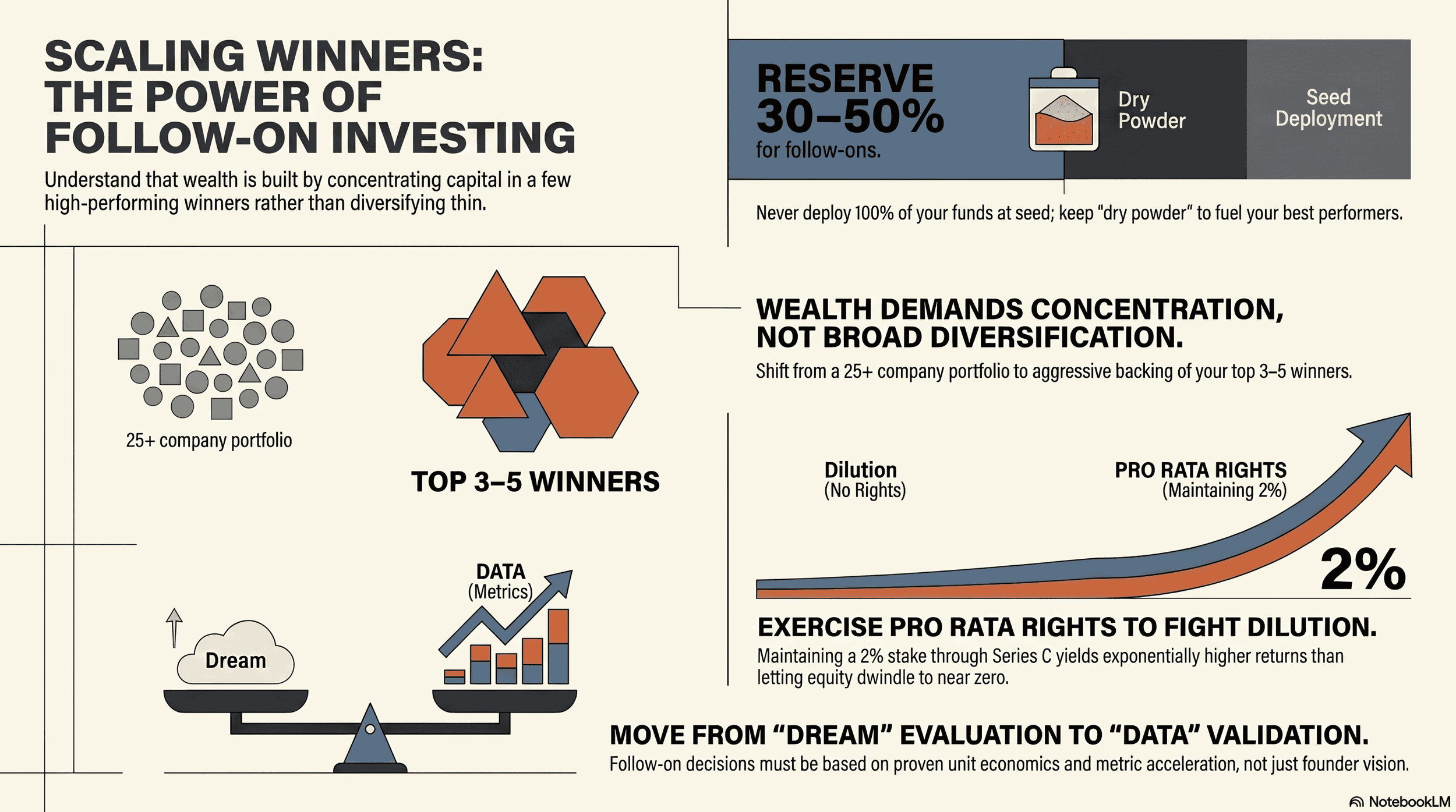
The Power Law demands concentration, not diversification. While early-stage portfolios require diversification across 25-30+ seed stage startups, wealth generation comes from identifying your 3-5 winners and concentrating follow-on capital behind them. A small fraction of companies will generate the vast majority of returns.
Pro rata rights are non-negotiable — secure them at seed stage. These contractual rights allow angel investors to participate in future funding rounds and maintain ownership percentage. Without pro rata rights negotiated during initial seed funding, venture capitalists leading later rounds can exclude you entirely, regardless of your early support.
Information asymmetry makes follow-ons safer than new deals. As an existing investor, you possess unique insights into founder execution, company culture, and business model viability that outsiders lack. Doubling down on a company with proven product-market fit is often lower risk than backing an unproven seed-stage startup.
Reserve 30-50% of your capital for follow-on opportunities. Never deploy 100% of your allocated investment capital in initial seed funding. Disciplined capital allocation means keeping dry powder available to exercise pro rata rights when your best portfolio companies raise their next rounds.
Apply a rigorous decision framework — not all companies deserve follow-ons. Evaluate metric acceleration, unit economics, founder resilience through hard months, expanding market opportunity, and whether the go-to-market engine is ready to consume additional capital productively. Avoid the sunk-cost fallacy of rescuing underperformers.
Validate the new lead investor and terms carefully. Series A and Series B term sheets can significantly impact your existing protections. Top-tier venture capital funds bring institutional rigor and exit networks; unknown VC firms may signal trouble. Always review how new terms affect your ownership structure and pro rata rights for future rounds.
Leverage SPVs and syndicate platforms when capital is limited. If you lack sufficient capital for a large follow-on round, organize Special Purpose Vehicles to pool resources with other angel investors. This maintains your ownership position while demonstrating continued founder support and providing valuable deal flow to your network.
Shift from dream evaluation to data validation. Seed stage investments bet on founder expertise and market potential; follow-on investments require evidence of execution. Review financial projections against actual performance, assess whether the minimum viable product has evolved into a scalable business model, and confirm that growth is organic rather than hype-driven.
The goal is ruthless concentration on winners, not portfolio rescue. Your job isn't to ensure every portfolio company survives, it's to identify the early-stage companies with exceptional traction and fuel them aggressively through subsequent funding stages. The winners are already in your portfolio; ensure you own enough of them when they reach the finish line.
Introduction: Beyond the Initial Check
The most painful realization for an angel investor is not the loss of a startup that failed; it is the "anti-portfolio" — the list of companies you supported early on, only to let your ownership evaporate when they exploded into massive success. Many investors view the seed check as the end of their work, but the reality is that the real wealth-building phase often happens in the subsequent funding rounds. This guide moves beyond the mechanics of pro-rata rights to explore the strategic art of scaling winners through follow-on investments.
Moving from "Spray and Pray" to Strategic Concentration
Early-stage angel investing is inherently speculative. Many investors adopt a "spray and pray" approach, hoping that one of their dozens of bets will return the fund. However, as your portfolio matures, the "spray and pray" mindset becomes a liability. True wealth is generated by identifying your winners early and concentrating your capital behind them. By shifting from a passive participant to a strategic partner, you move from merely hoping for an exit to actively fueling a rocket ship. Concentration allows you to gain more meaningful exposure to the companies with the highest probability of success.
The Power Law: Why Portfolio Winners Drive Total Returns
The venture asset class is defined by the Power Law: a small fraction of startups in a portfolio will generate the vast majority of returns. If your best performer succeeds, your initial seed investment will eventually be diluted by subsequent institutional rounds. Without follow-on investments, your ownership stake shrinks just as the company’s value rises. To capture the full upside of the Power Law, you must double down on those rare "outlier" companies that demonstrate exceptional growth, rather than spreading your remaining capital thinly across underperforming assets.
Defining Your Follow-On Investment Strategy in the Early-Stage Lifecycle
A follow-on investment is any capital committed to a portfolio company after your initial seed check. In the lifecycle of a startup, these opportunities usually arise during bridge rounds, bridge-to-Series-A, or the institutional Series A round itself. While the initial investment was based on founder quality and the promise of a vision, the follow-on investment is based on empirical data, market traction, and validated business models. Understanding when to deploy this capital is the most critical skill for a professional angel investor.
The Math of Ownership: Understanding Dilution and Pro Rata Rights
How Dilution Affects Your Equity Distribution Over Time
The mathematical impact of dilution on your equity stake over time, illustrating the stark difference between exercising pro-rata rights and letting your ownership shrink during subsequent funding rounds.
Dilution is the inevitable byproduct of scaling a startup. As founders raise capital from professional VCs, they issue new shares, which mathematically reduces the percentage of the company you own. If you fail to exercise your pro-rata rights, your initial 2% stake could easily dwindle to a negligible fraction by the time the company reaches a liquidity event or IPO. Understanding how dilution works is essential; you aren’t just fighting for percentages, but for the right to maintain your relative influence and financial upside.
The Importance of Negotiating Pro Rata Rights in the Seed Round
Pro-rata rights are the most potent tool in an angel’s arsenal. They grant you the right to participate in future funding rounds to maintain your percentage of ownership. You must negotiate these rights during the seed round before the company is hot and the cap table is crowded. Without these contractual safeguards, you may be excluded from the round by aggressive lead investors who want to hog the allocation for their own funds. Secure your seat early, and you hold the leverage to double down when the company begins to thrive.
Cap Table Hygiene: How Follow-Ons Protect Your Ownership Percentage
Cap table hygiene refers to the deliberate management of who owns what in the company. A messy cap table, crowded with too many small, non-contributing investors, can make it difficult for founders to raise institutional capital. By exercising your follow-on rights, you demonstrate long-term commitment to the founders. This builds trust and positions you as a "value-add" investor who is willing to support the company through its most challenging scaling phases, rather than just being a passenger during the good times.
To learn more about how you can add value to portfolio companies as an angel investor, read our complete guide: How Angel Investors Support Early-Stage Startups.
The Strategic "Why": Why Doubling Down is Often Safer Than Starting Fresh
De-risking the Investment: Information Asymmetry as Your Edge
As an early investor, you possess a distinct information advantage over new institutional investors. You have a direct line to the founders, you know the culture, read the updates, and you have seen the "ugly" side of the business that doesn't appear in a polished pitch deck. This information asymmetry allows you to evaluate the risk of a follow-on investment with a level of clarity that outsiders lack. You aren't just betting on a PowerPoint; you are betting on a track record of execution you have witnessed firsthand.
The Cost of Inaction: The Anti-Portfolio and Missing the Growth Curve
The "anti-portfolio" consists of the massive winners you could have owned more of but didn't. When a startup hits its stride, the risk profile changes drastically. It is often safer to invest in a company that has already found product-market fit than to search for a new, unproven seed deal. The cost of inaction is not just the lost opportunity to earn more; it is the missed chance to maximize the return on the capital already deployed.
Portfolio Construction: Balancing Diversification with Concentration
Diversification is a hedge against ignorance; concentration is a strategy for winners. A well-constructed angel portfolio should start with diversification to mitigate the high failure rate of early-stage startups. However, as the winners emerge, you must pivot. Follow-on investments serve as the mechanism to rebalance your portfolio, focusing your "dry powder" on companies that provide evidence of market leadership.
Identifying the Winners: A Decision Framework for Conviction
Metric Acceleration: Evaluating Product-Market Fit and Unit Economics
At the Series A level, the story must be backed by numbers. Look for "hockey stick" growth in key metrics: monthly recurring revenue, customer acquisition cost (CAC) versus lifetime value (LTV), and churn rates. If the unit economics are improving as the company scales, you have proof that the engine is working. Follow-on investment should only occur when the metrics signal that the business model is not just viable, but highly scalable.
Founder DNA: Assessing Leadership Resilience Through the Hard Months
The "hard months" are the periods where everything goes wrong. As an existing investor, you have seen how the founders handle pressure. Do they pivot with data-driven intent, or do they panic? Do they maintain transparent communication with their cap table, or do they retreat? A follow-on investment is ultimately a bet on the founders’ ability to navigate the transition from a startup to a scalable organization.
Market Dynamics: Identifying Expanding Moats and Scalability
A startup with great traction in a small, static market is a limited opportunity. A follow-on candidate must demonstrate that its total addressable market is expanding or that its competitive moat is deepening. Ask yourself: Is this company creating a brand, a network effect, or a technological lock-in that will be difficult for competitors to displace over the next five years?
The Go-To-Market Strategy: Is the Engine Ready for More Fuel?
Before you sign the check, verify that the company has a repeatable go-to-market engine. If they have cracked the code on customer acquisition, additional capital will act as rocket fuel. If they are still struggling with sales cycles or product delivery, your capital will merely delay the inevitable. Ensure the business is ready to consume the capital productively rather than inefficiently.
The Investor’s Scorecard: A Qualitative Checklist for Follow-Ons
The Three Green Lights: Team, Traction, and Terms
Team: Have the founders successfully recruited top-tier talent during the growth phase?
Traction: Is the growth trajectory outpacing the industry average for this sector?
Terms: Are the new terms fair, or are they punishing the existing cap table with excessive liquidation preferences or pay-to-play provisions? Is valuation rising in-line with traction? If all three lights are green, the decision to invest becomes significantly easier.
Signal vs. Noise: Distinguishing Between Market Hype and True Growth
The market is often noisy, filled with vanity metrics that masquerade as growth. As an experienced investor, you must filter out the hype. Is the growth driven by sustainable organic demand, or is it merely the result of unsustainable marketing spend? True growth is sticky; hype is ephemeral. Always look for the qualitative signals that point to deep-rooted customer loyalty.
Validating the Series A Lead: The Role of Top-Tier VC Firms
The lead investor in a Series A round sets the tone for the future of the company. A reputable lead investor provides not just capital, but institutional rigor, board-level support, and the network necessary for a future exit. If the new lead is a tier-one firm, it is a strong validation signal. If the lead is unknown or has a history of poor governance, proceed with extreme caution.
Tactical Execution: How to Participate When Capital is Limited
Capital Allocation: Reserving Dry Powder in Your Initial Investment Thesis
Smart angel investing requires disciplined capital allocation. Never deploy 100% of your allocated funds for a company in the seed round. Reserve 30-50% of your investment capacity as dry powder for follow-on rounds. This creates a psychological buffer; you won't be scrambling for cash when the company suddenly reaches its next milestone and needs your support to maintain your ownership.
Leveraging SPVs (Special Purpose Vehicles) and Syndicate Platforms
If you don't have the individual capital to cover a large follow-on, don't walk away. Use syndicate platforms (like us at Allied Venture Partners) or form an SPV to pull in other investors. By acting as the lead of a small, organized group, you can maintain your influence and ownership while allowing your network to participate in the growth. This demonstrates to the founders that you are still a helpful, proactive partner.
Partnering with Angel Networks and Accelerators to Fill the Round
Collaboration is a superpower in venture capital. If a company is struggling to close a round, coordinate with other angel networks that were involved early on. By pooling your resources and presenting a unified front, you can help the company secure the necessary funding while protecting your own stakes from excessive dilution.
Keep in mind that as an early-stage investor, your role isn't to ensure the survival of every portfolio company. Avoid falling into the sunk-cost fallacy and be prepared to decline a follow-on investment if the supporting metrics aren't compelling.
Navigating the Mechanics of Follow-On Rounds
Understanding the Term Sheet: New Rights vs. Existing Protections
Every new funding round involves a new term sheet. Pay close attention to how your existing rights interact with new investor rights. Are you being "crammed down" or forced into unfavorable liquidation preferences? Always consult legal counsel or a professional advisor if the terms of the new round deviate significantly from industry standards or infringe upon your original agreement.
The Series A Transition: Moving from Individual Relationships to Institutional Rigor
The transition from seed to Series A is as much about culture as it is about finance. The company is moving from a scrappy, founder-led startup to a more formal, board-driven organization. As an investor, you must adapt to this. You are no longer just an advisor; you are part of a larger, more structured governance machine. Respect the professionalization of the business and align your expectations with the new institutional pace.
Due Diligence in Subsequent Rounds: What Has Changed Since the Seed?
Due diligence at the seed stage is about the dream; due diligence at the Series A stage is about the reality. You must shift your focus from "Can these people build it?" to "Are they building it efficiently?" Review the company's financial audits, check the revised cap table, and speak with the new lead investor. Ensure that the milestones you expected at the seed round have been met or clearly surpassed.
Conclusion: Follow-On Investments in Early-Stage Startups
Follow-on investing is the ultimate test of an angel investor’s conviction and discipline. It is the bridge between being a casual participant and a builder of wealth. By focusing on the Power Law, maintaining rigorous cap table hygiene, and applying a data-driven framework for your follow-on decisions, you shift from playing a game of chance to playing a game of skill.
Remember: the goal is not to rescue every startup in your portfolio. It is to ruthlessly concentrate your resources on the winners. When you identify the right companies — those with the traction, the team, and the market potential — the best thing you can do is continue to fuel them. Keep your pro-rata rights, stay involved, and be ready to deploy capital when the data confirms your initial thesis. By mastering the cycle of the follow-on, you turn the volatility of early-stage investing into a structured, scalable engine for long-term returns. The winners are already in your portfolio; your job is to ensure you own enough of them when they reach the finish line.
Frequently Asked Questions: Follow-On Investments for Angel Investors
General Follow-On Investment Questions
What are follow-on investments and why are they important for angel investors?
Follow-on investments are additional capital commitments made by angel investors to portfolio companies after the initial seed funding round. They're critical for angel investors because they allow you to maintain meaningful ownership stakes as companies scale through subsequent funding stages. Without follow-on investments during early-stage rounds, Series B, and later rounds, your initial equity position gets diluted significantly, meaning you capture less of the upside when winners emerge from your portfolio.
How do follow-on investments differ from the initial seed stage investment?
Your initial seed stage investment is based primarily on founder expertise, vision, and market opportunity, often before the company has a proven business model or minimum viable product. Follow-on investments, however, are data-driven decisions based on validated traction, unit economics, and demonstrated product-market fit. At the seed stage, you're betting on potential; in follow-on rounds, you're doubling down on evidence of execution and scalability within the venture ecosystem.
When should angel investors consider making follow-on investments?
Angel investors should consider follow-on investments when portfolio companies demonstrate metric acceleration, proven unit economics, and readiness to scale their business model. Key trigger points include bridge rounds, bridge-to-Series-A, Series A, and Series B financing events. The investment process should involve evaluating whether the company has maintained or exceeded the growth trajectory anticipated during seed-stage investing, whether the go-to-market engine is functioning efficiently, and whether the new funding terms protect your pro rata rights and existing ownership structure.
Pro Rata Rights and Ownership Protection
What are pro rata rights and why must angel investors negotiate them at the seed stage?
Pro rata rights grant angel investors the contractual ability to participate in future funding stages proportionally to maintain their percentage ownership. These rights must be negotiated during seed funding because once venture capitalists lead institutional rounds, they often control allocation and may exclude early investors. Without pro rata rights secured at the seed stage, angel investors lose leverage to participate in Series B and later rounds when companies demonstrate strong financial projections and market potential. This protection is essential for managing your ownership structure across the company's lifecycle.
How does dilution affect angel investment returns over multiple funding stages?
Dilution occurs when companies issue new shares during subsequent funding stages, mathematically reducing your ownership percentage. For example, an initial 2% stake at the seed stage can shrink to less than 1% by Series B if you don't exercise pro rata rights. This means that even if a company increases in value 50x, your actual return may be disappointing because your slice of the pie has shrunk dramatically. Angel investors who maintain their ownership through follow-on investments in early-stage rounds capture exponentially more value from successful exits.
How do follow-on investments protect my position on the cap table?
Follow-on investments demonstrate long-term commitment to founders and maintain your relevance in the company structure. By exercising your pro rata rights, you signal that you're a value-add partner rather than a passive participant. This positions you favorably when VC firms evaluate the cap table during due diligence. A clean ownership structure with committed early backers who continue to angel invest alongside institutional capital makes the company more attractive for Series B and later funding stages, while simultaneously protecting your economic interest.
Strategic Decision-Making for Follow-Ons
How do I identify which portfolio companies deserve follow-on investment?
Use a systematic decision framework evaluating three core dimensions: team execution through difficult periods, metric acceleration proving the business model works at scale, and expanding market opportunity. Look for companies that have successfully navigated the "hard months," recruited industry leaders, and demonstrated repeatable customer acquisition. Review their financial projections against actual performance, assess whether their product differentiation is defensible, and validate that the go-to-market strategy can productively consume additional capital. Companies graduating from accelerator programs like Y Combinator or securing leads from top-tier VC firms provide strong validation signals.
Should angel investors make follow-on investments in every portfolio company?
No. Strategic concentration on winners generates superior returns compared to spreading capital thinly across underperforming assets. Angel investing operates under Power Law dynamics where a small number of companies generate the majority of returns. Rather than rescuing struggling companies through bridge rounds, focus follow-on capital on early-stage companies demonstrating exceptional traction. Avoid the sunk-cost fallacy—declining to participate in a follow-on round is sometimes the right decision when the business plan hasn't materialized or the business model shows fundamental flaws.
How do I balance portfolio diversification with concentration through follow-ons?
Begin with diversification at the seed stage across 15-30+ seed stage startups to mitigate the high failure rate inherent to seed-stage investing. As winners emerge over 18-36 months, pivot toward concentration by allocating follow-on capital to your top 3-5 performers. This means reserving 30-50% of your total investment capacity as dry powder for follow-on investments rather than deploying everything in initial seed funding. This strategy allows you to rebalance your portfolio across funding stages toward companies with validated market potential while maintaining appropriate geographic diversification and exposure across the venture ecosystem.
Practical Execution and Capital Management
How much capital should angel investors reserve for follow-on investments?
Reserve 30-50% of your total allocated capital for follow-on opportunities when structuring your initial investment vehicle or personal angel investment strategy. For example, if you plan to invest $500,000 total in angel investing, deploy only $250,000-$350,000 in initial seed stage commitments, keeping $150,000-$250,000 available for follow-ons. This disciplined capital allocation ensures you have dry powder available when your best companies raise their Series A or Series B rounds, allowing you to maintain meaningful ownership without scrambling for liquidity when opportunities arise.
What if I don't have enough capital to participate in a large follow-on round?
Use syndicate platforms or create Special Purpose Vehicles (SPVs) to pool capital from your network of other angel investors. By organizing an SPV, you can maintain your position and demonstrate continued support to founders while providing deal flow opportunities to your network. Many angel networks and platforms facilitate this process, allowing you to act as the lead coordinator. This approach is particularly valuable during Series B rounds where check sizes often exceed individual angel investors' capacity but where maintaining ownership remains strategically important.
How do I evaluate follow-on investment opportunities when deal flow increases?
Prioritize follow-on investments in existing portfolio winners over new seed stage opportunities once you've identified companies with validated traction. Your information asymmetry as an existing investor—understanding the culture, product differentiation, and execution capability—provides significant advantages over backing new early-stage companies. Focus on companies that institutional venture capitalists are validating through competitive rounds at fair valuations. Screen new deal flow from demo days and accelerator programs, but allocate the majority of available capital to exercising pro rata rights in companies already proving their investment thesis.
Term Sheet and Legal Considerations
What should angel investors watch for in Series A and Series B term sheets?
Carefully review how new investment terms affect your existing protections, including liquidation preferences, anti-dilution provisions, and pro rata rights for future rounds. Watch for "cram down" scenarios where new venture capitalists impose unfavorable terms on the existing ownership structure. Examine whether the new lead is a reputable venture capital fund with a track record of supporting portfolio companies to exit. Review all legal documents with qualified counsel, especially provisions affecting your ability to participate in subsequent funding stages or protecting your intellectual property rights in any contributed work or expertise.
How does the investment process differ between seed funding and Series A follow-ons?
Seed funding due diligence focuses on founder potential, business plan credibility, and market opportunity size. Series A investment negotiation shifts toward data validation: reviewing financial projections against actual performance, examining the product roadmap and minimum viable product evolution, analyzing unit economics and customer acquisition efficiency, and assessing whether the company structure supports institutional governance. You move from evaluating dreams to evaluating execution. Engage with the new lead investor to understand their investment thesis and ensure alignment with your perspective on the company's market potential.
What role do legal documents play in protecting follow-on investment rights?
Legal documents establish your contractual rights to participate in future funding stages through pro rata provisions. These documents also define information rights, board observation privileges, and protective provisions that ensure you maintain visibility into company performance across funding stages. Without proper legal documentation of pro rata rights at the seed stage, you have no guaranteed access to Series B or later rounds. Always ensure your initial seed funding agreements include explicit language regarding follow-on participation rights and consult legal counsel before signing term sheets for any funding round.
Market Dynamics and Timing
How do market cycles affect follow-on investment strategy for angel investors?
During bull market cycles when valuations are elevated and startup funding is abundant, follow-on rounds may price at aggressive multiples that don't align with fundamental progress. Angel investors should maintain discipline around valuation even when exercising pro rata rights—overpaying in overheated markets destroys returns. Conversely, during bear market cycles, high-quality early-stage companies may struggle to raise Series B rounds at fair terms, creating opportunities for angel investors with dry powder to increase ownership at attractive valuations. Always evaluate follow-on opportunities relative to the current market cycle and the company's actual progress against financial projections.
How do follow-on investments fit within the broader venture ecosystem?
Follow-on investments bridge the gap between seed funds and institutional venture capital funds. Angel investors who strategically deploy follow-on capital fill a critical function: providing bridge financing when companies need additional runway before Series A, supporting pro rata participation when VC firms set minimum check sizes, and signaling continued conviction to institutional investors evaluating the company. This positions angel networks as valuable partners to both founders (providing flexible capital) and venture capitalists (demonstrating existing investor support) across multiple funding stages.
What signals indicate a company is ready for Series B and my follow-on participation?
Companies ready for Series B typically demonstrate sustained metric acceleration, efficient capital deployment from Series A, and proven ability to scale the business model profitably. Look for evidence that the company has expanded into adjacent markets or deepened its competitive moat, recruited executive talent and industry leaders to professionalize operations, and achieved the financial projections outlined during Series A. The presence of multiple venture capitalists competing to lead Series B at escalating valuations provides strong external validation. Your follow-on angel investment at Series B should focus on maintaining meaningful ownership in confirmed winners rather than attempting to establish initial positions.
Advanced Follow-On Strategies
How should angel investors approach follow-on investments in companies that have pivoted their business plan?
Evaluate pivots based on whether they represent data-driven adaptation or desperate course correction. Strong companies pivot when market feedback indicates larger market opportunity in an adjacent space or when customer demand reveals superior product differentiation angles. Weak pivots happen when the original business model fundamentally failed and founders are searching for alternatives. Review whether the pivot leverages existing intellectual property, customer relationships, and team strengths. Successful pivots often emerge from pre-seed funding or early seed stage, while pivots during Series A fundraising raise concerns about founder expertise and strategic clarity.
What role do demo days and accelerator programs like Y Combinator play in follow-on strategy?
Demo days from Y Combinator and similar accelerator programs provide concentrated deal flow of seed stage startups, but they're less relevant for follow-on investment decisions. Your follow-on capital should focus on existing portfolio companies demonstrating traction, not new opportunities from demo days—unless you've reserved specific capital for new seed investments. However, if a portfolio company graduated from Y Combinator or similar programs, their stamp of approval often accelerates subsequent fundraising, making your follow-on investment in early-stage rounds more attractive as institutional seed funds and VC firms compete for allocation.
How do follow-on investments impact my relationship with venture capitalists and other angel investors?
Consistently exercising pro rata rights builds your reputation as a serious, committed investor within the venture ecosystem. Venture capitalists leading Series A and Series B rounds appreciate when early angel investors continue supporting companies, as it demonstrates validation and reduces the risk perception. This can lead to co-investment opportunities in other deals within VC firms' portfolios. Similarly, coordinating follow-on investments with other angel investors through your network strengthens relationships and creates proprietary deal flow as those investors reciprocate by inviting you into their opportunities across different funding stages and market cycles.
Disclaimer: This article is provided for general informational and educational purposes only and does not constitute legal, financial, investment, tax, or professional advice of any kind. Allied Venture Partners LLC makes no representations or warranties regarding the accuracy, completeness, or currentness of this information, which is subject to change without notice. To the fullest extent permitted by law, Allied Venture Partners LLC, its affiliates, officers, directors, employees, and agents expressly disclaim all liability for any direct, indirect, incidental, consequential, special, or punitive damages arising from your use of or reliance on this content, including but not limited to any securities offerings, capital raises, regulatory compliance issues, enforcement actions, financial losses, or business damages. Securities laws are complex, fact-specific, and vary by jurisdiction. You are solely responsible for ensuring compliance with all applicable federal and state securities laws and should consult with qualified legal counsel, financial advisors, and tax professionals licensed in your jurisdiction before making any decisions or taking any actions based on this information. By accessing or using this article, you acknowledge that you have read and understood this disclaimer, assume all risks associated with your use of this information, and agree to indemnify and hold harmless Allied Venture Partners LLC from any claims arising from your use of this content.