Am I Ready to Fundraise? Assessing Investor Readiness for Startup Founders
Key Takeaways
Ditch the Calendar: Raising money based purely on runway months (e.g., "we need 18 months of cash") signals an operational sinkhole to investors; raise based on quantitative milestones instead.
Run the POCD Audit: Evaluate your readiness across People (clean cap table, no deadweight equity), Opportunity (venture-scale market), Context (macro tailwinds), and Deal (balancing economics vs. control).
Focus on Value Inflection: Frame your raise around purchasing 18–24 months of runway to eliminate specific risks (Market, Technical, GTM) and reach the next valuation tier.
Build Lines, Not Dots: Start building relationships with investors early by sharing consistent monthly progress to turn early "no's" into data-backed execution records.
Build Real Leverage: Capital efficiency and non-dilutive funding (grants or revenue) give you a strong BATNA, allowing you to walk away from predatory investor terms.
Most startup founders launch a new fundraising round because a calendar forces their hand. The cash balance is dipping, the runway reads six months or less, and the default strategy becomes: "We need to raise $1.5M to give us 18 months of burn."
This approach (The Calendar Trap) is one of the most common reasons early-stage raises fail or result in predatory terms. Venture capital is not a reward for past survival, nor is it a utility bill designed to keep the lights on. When you pitch time instead of progress, sophisticated investors see an operational sinkhole rather than a high-growth opportunity.
The Fundamental Mindset Shift
To attract institutional capital, founders must shift from calendar-based fundraising to milestone-based capital allocation.
Investors view venture capital as a series of call options. They inject cash to purchase the time required for a founding team to de-risk a specific hypothesis, whether that is proving a repeatable enterprise sales motion, achieving regulatory approval, or scaling unit economics.
The Calendar Approach:"We need $1.5M to cover 18 months of runway."
The Value-Inflection Approach:"We are deploying $1.5M over 18 months to scale from $10k to $100k MRR, proving our repeatable enterprise sales motion and eliminating core market risk."
If you hit that value-inflecting metric, the option is exercised, the company’s valuation leaps, and you unlock the right to raise the next block of capital on significantly better terms. If you miss it, the option expires, leaving the business facing a flat round, a down-round, or insolvency.
The Core Takeaway
You aren't ready to raise when your bank account demands it; you are ready when your operational narrative dictates it.
Thesis: A founder is genuinely ready to fundraise only when they have the right team and organizational structure in place, and can articulate the precise 18–24 month milestones that will systematically de-risk the business and unlock the next tier of valuation.
1) The Framework: Applying POCD to Determine Investor Readiness
Before stepping into the fundraising arena, founders need an objective framework to assess whether their startup can withstand institutional scrutiny. The POCD Framework, which evaluates the alignment between People, Opportunity, Context, and Deal, serves as a diagnostic tool to determine whether a business is truly investment-ready.
People: Execution Capability and Governance
Investors bet on execution, domain expertise, and operational structure. The primary question under this pillar is straightforward: Is this the absolute best team to build and scale this company?
Domain Expertise: Do the founders possess deep, asymmetric insight into the problem space?
Operational Structure: Are roles clearly defined, and is there a functional hierarchy that can execute without friction?
Red Flag Warning: The Danger of Inactive Equity
Clean equity structure is as critical as team capability. A common deal-breaker for VCs is deadweight equity on the cap table, such as an early co-founder who departed with a significant equity percentage because no formal vesting schedule was implemented at incorporation. Institutional investors will refuse to invest if their capital risks enriching or being blocked by an inactive stakeholder. Co-founder alignment and reverse vesting schedules are non-negotiable prerequisites before launching a raise.
Opportunity: Scalability and Venture Realities
Venture capital operates on a power-law distribution, where funds rely on a tiny fraction of investments to return the entire fund. As a result, the business model must support massive, venture-scale upside.
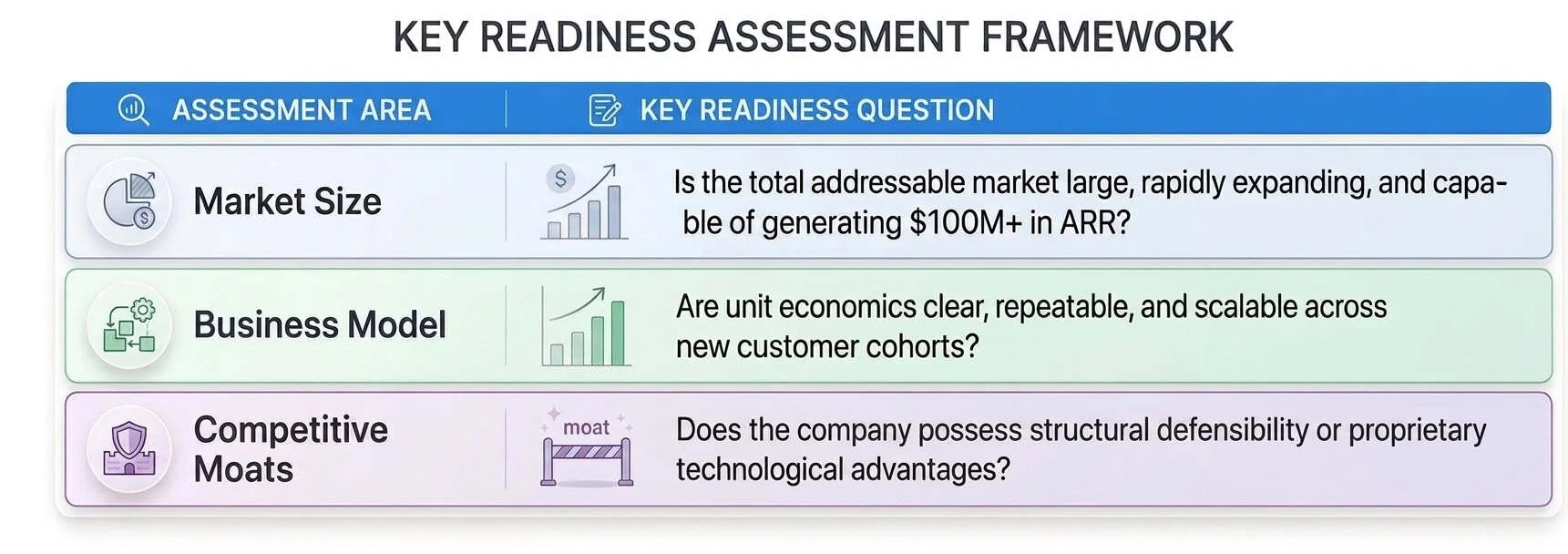
Assessing market size, business model, and competitive advantage or unique differentiation.
Context: Macro Factors and Market Timing
Context encompasses external dynamics outside management’s direct control. Investors evaluate whether industry conditions provide natural tailwinds or structural headwinds.
Macro Shifts: Are broader economic trends, industry adjustments, or capital market conditions supporting this business model?
Regulatory Landscape: Have recent legislative changes opened new market opportunities or introduced major compliance risks?
Technological Waves: Is there a platform shift or emerging technological standard driving rapid customer adoption?
Deal: Balancing Economics and Control
The final component of readiness is the deal itself (i.e., understanding how capital will be integrated into the business). Every venture transaction revolves around a core balance between two structural levers:
Economics: Who gets the financial upside, how liquidity preferences are structured, and how dilution impacts ownership.
Control: Who makes strategic decisions, how board seats are allocated, and which investor veto powers govern future actions.
Founders are ready for a deal when they stop looking solely at headline valuation and start evaluating how contractual terms impact governance and terminal economics
2) The Milestone Rule: Defining Operational Benchmarks
Once you have audited your business through the POCD framework, you must translate your capital needs into precise operational targets. The most effective founders don't ask for money to extend runway; they raise capital to purchase execution time for specific risk-reduction milestones.
De-Risking over Duration
Venture capital is expensive, highly dilutive equity fuel. Its sole purpose is to buy 18 to 24 months of focused runway to systematically test and eliminate key business risks:
Market Risk: Proving that customers actually want the product and will pay for it.
Execution/Technical Risk: Proving the tech scales efficiently without massive overhead or operational failure.
Go-To-Market Risk: Proving you can acquire customers predictably with scalable unit economics.
Each milestone you hit removes a layer of perceived risk, which fundamentally shifts your valuation upward for the next round.
The Value Milestone Blueprint
To signal investor readiness, strip out all time-based burn rhetoric from your pitch. Replace vague duration language with the following:
Value Milestone Blueprint:
"We are investing $X over Y months to achieve Z metric, which proves to our next investor that we have eliminated [Market / Technical / Team] risk."
Example of a Weak Pitch:
"We need $1.5M for 18 months of runway."
Example of a StrongPitch:
"We’re raising $1.5M to hire three engineers, complete our enterprise platform, and scale from 10 POCs to 50 paying customers, which will get us to $100k MRR within 18 months."
By framing your raise around concrete metrics (e.g., reaching key revenue thresholds, securing regulatory approvals, or shipping critical platform features), you demonstrate strong capital stewardship.
Building a "Line" vs. a "Dot"
Investors rarely write checks after a single meeting (i.e., a "Dot"). They invest when they observe a founder’s performance across multiple touchpoints over time, forming a "Line" that trends up and to the right.
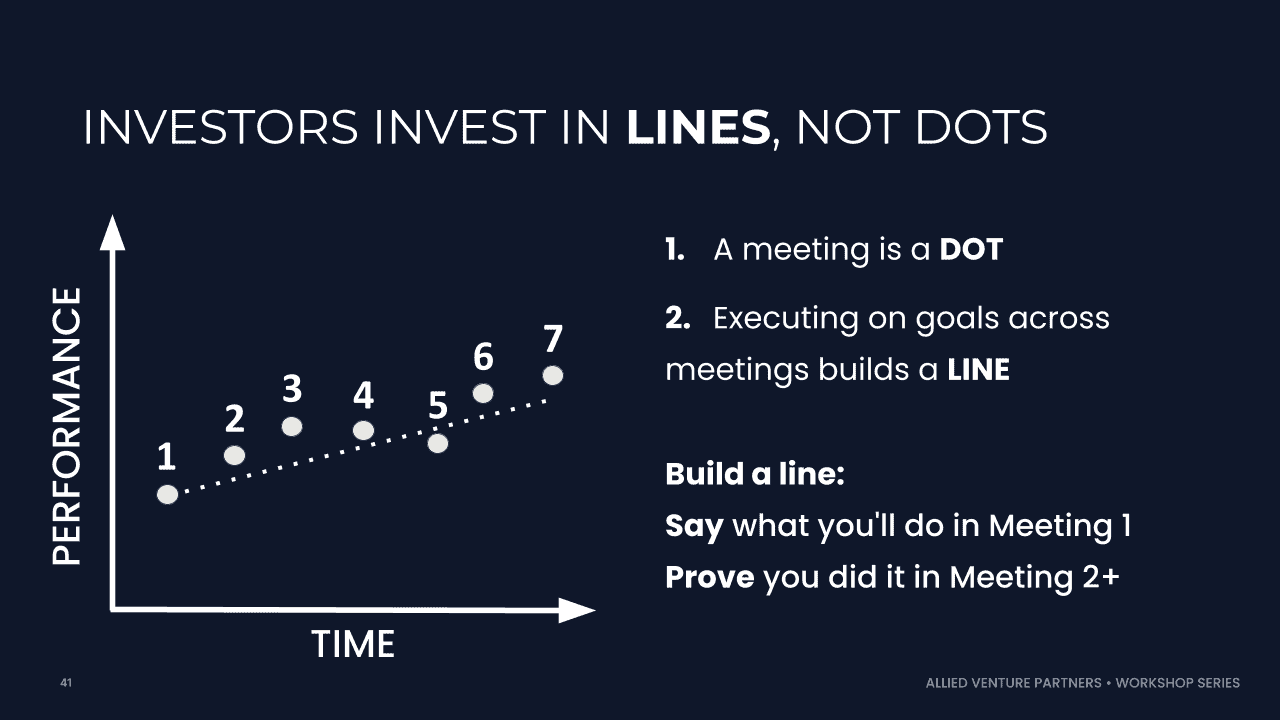
Example Timeline:
Meeting 1 (Setting the Line): Share your operational targets for the next quarter, even if you are not actively fundraising yet.
Monthly Updates: Send brief updates showing progress toward those exact operational targets.
Meeting 2 (Proving the Line): Reconnect having achieved or surpassed your stated goals.
By starting conversations early and sharing consistent updates, you convert cold pitches into data-backed execution narratives that give institutional investors the conviction to write a check.
3) Knowing When to Start Talking to Investors
One of the biggest mistakes founders make is waiting until they urgently need capital to start reaching out to investors. Active fundraising under time pressure strips away your leverage and leads to suboptimal deal terms. Knowing when to engage capital sources is just as strategic as knowing how to pitch them.
Building Relationships Before You Need Money
The best time to speak with a VC is when you are not asking for a check. Early interactions should be framed as relationship-building touchpoints, allowing you to establish context long before launching a formal, time-bound raise.
Moreover, when an investor tells you that you are "too early" or passes on your current stage, treat it as an open-door opportunity rather than a dead end:
The Defensive Reaction:"If we hit that metric, we won't even need your capital!"
The Strategic Reaction:"Understood. We appreciate the benchmark. Can we add you to our monthly update list so you can track our progress toward that target over the next two quarters?"
By adding willing investors to a clean, monthly updates list, you convert a single "No" into a long-term execution record. When you formally open your round months later, those same investors aren't evaluating a cold deck; they are validating a team that consistently delivers on its promises.
Recognizing Leverage and Building a Strong BATNA
In venture negotiations, real leverage comes down to your BATNA (Best Alternative to a Negotiated Agreement). A founder who must close a round to survive next month has zero leverage and will absorb harsh terms, aggressive liquidation preferences, or valuation cuts.
Concurrently, a founder who can walk away from bad terms operates from a position of power.
High Capital Need + Zero Alternatives = Strong Investor Control & Low Pricing
Capital Efficient + Non-Dilutive Funding = Strong Founder Leverage & Clean Terms
You build a strong BATNA through two primary levers:
Capital Efficiency: Operating with low burn and clear unit economics so your current cash lasts longer, extending your runway organically.
Alternative Funding Streams: Securing non-dilutive government grants, market-development subsidies, or customer revenue to fund operations.
When you hold non-dilutive capital or approach cash-flow positivity, institutional investment stops being a survival requirement and becomes an option for accelerated growth. That shift in dynamic completely transforms board seat discussions, valuation caps, and structural negotiations in your favor.
4) Summary & Actionable Audit Checklist
Fundraising is an enterprise sales process, and launching a round before your startup is operationalized wastes precious time and market attention. Before opening your outreach funnel and reaching out to target investors, run your company through this 4-point readiness audit:
The Investor Readiness Audit
1. TEAM & STRUCTURE CLEAN?
Are co-founder roles clearly established with formal reverse-vesting schedules?
Is your cap table free of deadweight equity or unvested departures?
2. MILESTONES DEFINED?
Have you replaced duration metrics (e.g., "18 months of cash") with quantified targets?
Can you state the exact value-inflection milestone your round will unlock?
3. RISK SYSTEMATICALLY MAPPED?
Have you isolated the specific Market, Technical, or GTM risks this round eliminates?
Are your unit economics and target customer profiles clear and validated?
4. GOVERNANCE & BATNA READY?
Are you prepared to manage board relationships and navigate Economics vs. Control?
Do you have non-dilutive runway, revenue, or capital efficiency to walk away from bad terms?
The Bottom Line
If you checked every box on this audit, you aren't just looking for money; you are offering investors a de-risked asset with a clear execution roadmap.
Raising capital shouldn't be a desperate attempt to survive the calendar. Define your milestones, ensure a clean corporate structure, build your investor pipeline early, and run your raise from a position of absolute operational strength.
Frequently Asked Questions (FAQ)
What is venture capital, and how does it work for early-stage startups?
Venture capital is a form of private equity financing where institutional investors—known as venture capital firms—provide venture capital funding to high-growth startups in exchange for equity (ownership). Unlike traditional bank loans, venture capital is not debt that must be repaid on a fixed schedule. Instead, VCs buy into your company's upside, looking for asymmetric returns driven by rapid scaling and value-inflecting milestones.
How do I know if I'm ready to fundraise from investors?
Evaluating your investor readiness comes down to your execution capability and operational narrative, not just the number of months on your calendar. You are ready to fundraise when:
You have a clean corporate structure and an aligned execution team without unresolved cap table issues.
You can articulate the precise 18–24 month operational milestones you will hit to de-risk the business.
You understand the target market size, unit economics, and competitive moats required to deliver venture-scale returns.
How do I get funding for a startup if I am pre-revenue?
Securing business startup funding before generating significant revenue requires proving that you are systematically eliminating other core risks—such as technical, regulatory, or market demand risks. Pre-revenue founders can successfully raise capital by using unpriced instruments like SAFEs or Convertible Notes, leveraging non-dilutive government grants, and demonstrating strong early signals like waitlists, pilot agreements, or deep domain expertise.
What are the main startup funding stages?
While every company moves at its own pace, startup funding stages generally follow a structured trajectory:
Pre-Seed / Angel: Initial capital used to build a prototype, conduct early customer discovery, and establish the core team.
Seed: Funding used to validate product-market fit, prove scalable unit economics, and test go-to-market channels.
Series A: Capital injected to scale an established sales motion, expand product lines, and grow market share.
Series B & Beyond: Growth-stage equity used to dominate a market, expand internationally, or optimize for a major liquidity event.
Should I raise money using SAFEs, Convertible Notes, or Priced Equity?
The optimal financing vehicle depends on your current data clarity and operational speed:
SAFEs: Best for speed and cost efficiency at the pre-seed or seed stage, though you must carefully monitor valuation caps to prevent cap table overhang.
Convertible Notes: Useful when investors want downside debt protections like interest rates and maturity dates alongside conversion rights.
Priced Equity: Gold standard for institutional clarity, establishing formal share pricing and board governance, but comes with higher legal costs and closing timelines.