Pre-Money vs. Post-Money Option Pools: A Founder’s Guide to Avoiding Dilution
Key Takeaways
Valuation is a vanity metric; dilution is what actually determines your outcome. A high headline valuation paired with an aggressive option pool or liquidation preference can leave founders with a smaller effective stake than a lower, cleaner term sheet.
The "Option Pool Shuffle" shifts dilution onto founders by design. When investors require a pre-money option pool, the founder absorbs 100% of that dilution before the investor's check is even calculated. A post-money pool splits that cost between both parties.
Always evaluate your cap table on a fully diluted basis. Counting only issued shares hides the real impact of options, SAFEs, and convertible instruments on your actual ownership percentage.
A 10% pool is common, not mandatory. Replace "industry standard" as your negotiating anchor with a bottoms-up hiring plan. List actual planned hires, seniority, and equity grants to justify the pool size your company genuinely needs.
Tactical levers exist to minimize upfront dilution: a "just-in-time" pool that grows with actual hiring milestones, and a negotiated "sweep" that returns unallocated pool shares to existing shareholders before the next round.
Post-money SAFEs (the Y Combinator standard) bring welcome clarity to early-stage ownership math, but stacking multiple SAFEs with different caps and discounts can still create unanticipated dilution at the Series A if left untracked.
Watch the "silent killers" beyond the option pool: participating liquidation preferences and full-ratchet anti-dilution provisions can quietly erode founder economics even when the headline valuation looks strong.
Modern cap table discipline is essential infrastructure, not optional. Platforms like AngelList, Carta, or Pulley allow founders to model scenarios in advance and negotiate from data rather than reacting to term sheet language in real time.
Every founder eventually faces the cap table moment: the precise point during a fundraising round when they realize the equity math on the term sheet doesn't align with their initial projections. You start with a vision of disruption, but as you move from the seed stage to Series A, the reality of dilution begins to erode your ownership. Often, the culprit isn't the primary investment amount itself, but the hidden mechanics of the option pool.
Navigating this landscape requires more than just a calculator; it demands a deep understanding of how investors structure deals to minimize their risk while maximizing their stake. This guide explores the strategic nuances of pre-money vs. post-money option pools, providing you with the tactical roadmap to protect your stake and align effectively with investors.
Beyond the Valuation: Why Dilution is the Real Metric that Matters
Why Valuation is Often a "Vanity Metric" for Early-Stage Founders
In the startup ecosystem, headlines often fixate on the "valuation" of a funding round. Founders frequently view a high valuation as a badge of honor, a public validation of their progress. However, valuation is often a vanity metric that obscures the deeper, more impactful reality of your equity position. A high valuation at the cost of aggressive liquidation preferences or massive, unallocated option pools can leave a founder with a much smaller piece of a larger pie. True success isn't about the headline number; it is about the ownership percentage you retain and the control you exert as you scale toward an exit.
The Long-term Impact of Dilution on Founder Control and Exit Proceeds
Dilution is the tax paid for growth, but it is a tax that compounds. Every time you issue new shares for an investment or a hiring spree, your relative ownership percentage shifts. If you fail to account for the "ghost dilution" from your option pool, you may find your voting power slipping faster than anticipated. Over multiple funding rounds, this dilution can jeopardize your ability to make key decisions or lead the company according to your original vision. Protecting your ownership is not merely about personal wealth; it is about maintaining the influence necessary to drive the company’s long-term success.
Understanding the Players: Valuation vs. The Option Pool
Defining Pre-Money vs. Post-Money Valuation
The fundamental distinction in any negotiation is whether the investment amount is calculated based on the pre-money valuation or the post-money valuation. Pre-money valuation is the worth of your company before the new capital is injected. Post-money valuation is the pre-money valuation plus the new investment. Understanding this distinction is vital because the size of the option pool is typically calculated off one of these two numbers, dramatically impacting who bears the cost of the dilution.
What is an Employee Stock Option Pool (ESOP) and Why Do Investors Demand It?
An ESOP is a portion of your company's equity reserved for future employees. Investors demand this pool upfront because they want to ensure that if they invest, there is enough room to hire key talent without immediately diluting their own shares again. They view the pool as a cost of doing business. However, the negotiation lies in determining exactly how big that pool should be and at what stage of the valuation the dilution is calculated.
The Concept of "Fully Diluted" Shares: Your Real Scorecard
Your cap table must be viewed on a fully diluted basis. This means including all issued shares, all outstanding options, and any convertible instruments like SAFEs or convertible notes. Many founders make the mistake of looking only at issued shares, failing to realize that their ownership percentage is lower than they believe once you account for the entire pool of potential equity.
The "Option Pool Shuffle": How Investors Shift the Dilution Burden
The Mechanics of the Shuffle: Why Investors Insist on a Pre-Money Pool
When investors request a "pre-money option pool," they are effectively asking you to create a pool of shares before they invest. Because this pool is created before the investment, it counts toward the pre-money valuation. Effectively, the founder bears 100% of the dilution caused by this pool. The investor’s ownership remains protected because the pool comes out of your pocket, not theirs.
How the Pre-Money Pool Decreases Your Effective Post-Money Valuation
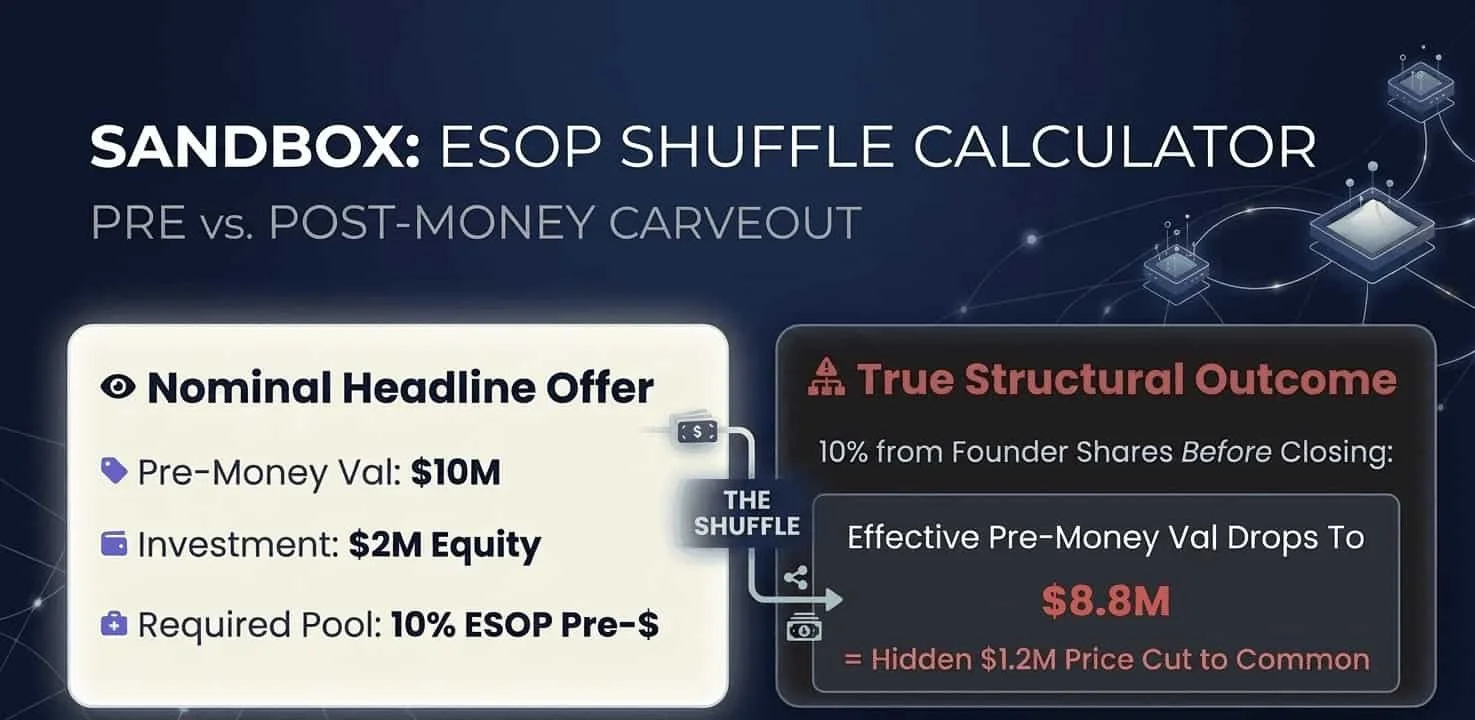
By forcing the option pool into the pre-money stage, the investor artificially lowers the share price they pay. This is the "Option Pool Shuffle." If you have a $10 million pre-money valuation and the investor requires a 10% option pool, you are effectively diluting yourself by that 10% before the investor even signs the check. Your actual, realized valuation is significantly lower than the headline number.
The fundamental equation of startup fundraising: Post-money valuation is your pre-money valuation plus the new capital injected.
The Psychological Framing: Why "10% Pool" Sounds Fair but Often Isn't
Investors often frame a 10% pool as "standard practice." In reality, there is no legal requirement for a 10% pool. By relying on this "standard," investors can quickly convince founders that this dilution is unavoidable. As a founder, your job is to shift the conversation from what is "standard" to what is "operationally required" based on your actual hiring plan.
Pre-Money vs. Post-Money Option Pools: A Comparative Mathematical Breakdown
Scenario A: The Pre-Money Option Pool (Founder-Dilutive Model)
In this scenario, a company has 10 million shares outstanding. An investor wants to invest $2 million at a $10 million pre-money valuation and requires a 10% option pool. If the pool is pre-money, you issue 1 million new shares to the pool before the investment. The investor then receives their shares based on the lower post-investment share price, meaning you have absorbed the entirety of the 10% dilution.
Scenario B: The Post-Money Option Pool (Shared-Dilution Model)
In a post-money model, the option pool is created after the investment. The investor’s ownership percentage is calculated on the pre-money valuation without the pool first. Once the investment is made, the pool is carved out of the newly created total shares. This means the investor shares in the dilution caused by the pool, making it a much friendlier proposition for the founder.
Case Study: Comparing Two Term Sheets with the Same Headline Valuation
Imagine two term sheets: both offer a $10 million pre-money valuation for $2 million. Term Sheet A requires a 10% pre-money pool. Term Sheet B requires a 10% post-money pool. By modeling the math, you will see that Term Sheet B leaves you with a significantly higher percentage of your company. Founders who don't run these numbers often sign the deal that sounds "standard" rather than the deal that protects their equity.
Free Tool: Use this free Cap Table Modeling Tool to compare impact of a pre-money vs. post-money employee stock option pool (ESOP).
The SAFE Factor: How Post-Money SAFEs Changed the Fundraising Landscape
The Y Combinator Shift: Why Post-Money SAFEs are Now the Standard
Y Combinator’s transition to the "post-money SAFE" has standardized how early-stage capital is treated. Unlike older versions, the post-money SAFE provides clarity on the investor's percentage ownership, effectively eliminating the ambiguity that previously led to messy cap tables. This shift is a major win for founders, as it prevents the "hidden" dilution that occurred when multiple SAFEs converted at varying valuation caps.
Understanding the "Valuation Cap" as a Tool for Ownership Clarity
The valuation cap on a SAFE is a ceiling on the price at which the investment converts into equity. While it acts as a protection for the investor, it also provides you with a clear anchor for how much of your company you are giving away. When used correctly, it allows for clean, transparent fundraising without the need for complex, share-based negotiations at the seed stage.
The Risk of "Stacking" SAFEs: How Unintended Dilution Creeps in Before Series A
The danger in modern fundraising is "stacking" multiple SAFEs with different caps and discount rates. If you aren't using a cap table management platform to track these, you might find that when the Series A investor arrives, the conversion of these SAFEs results in more dilution than you anticipated, potentially pushing your ownership stake below the threshold you need to retain control.
Strategic Negotiation: How to Limit Dilution from Option Pools
Moving Beyond "Standard" Percentages: Why 10-20% Isn't Mandatory
Never accept a 10% pool simply because a VC says it is the "industry norm." Negotiation is about justification. If you are a three-person team planning to hire three key executives in the next 18 months, calculate exactly how many shares those hires will need. If the math shows you only need 8%, negotiate for an 8% pool. Be prepared to explain your hiring plan in detail to the investor.
The Bottoms-Up Hiring Plan: Using Data to Negotiate the Pool Size
Build a detailed spreadsheet that lists every hire you plan to make, their seniority, and the expected equity grant for each role. This "bottoms-up" model is your most powerful negotiation tool. When you present this to an investor, you aren't arguing about percentages; you are presenting a data-backed operational budget. It is much harder for an investor to demand a 20% pool when you have a 10% plan that is clearly defined.
The "Just-in-Time" Pool Increase: Matching the Pool to the Real Hiring Cycle
Instead of issuing the entire option pool at once, negotiate for a "just-in-time" approach. Suggest that you start with a smaller pool and agree to increase it only when certain hiring milestones are met. This allows you to preserve your equity until the moment you actually need to spend it on talent, effectively minimizing the upfront dilution.
Negotiating the "Unallocated" Pool Treatment in Future Rounds
One of the most effective strategies is to negotiate that any "unallocated" options remaining in the pool at the time of your next round will be "swept" back into the cap table and divided pro-rata among existing shareholders. This prevents the investor from having a pool of shares that essentially serves as a future reserve for themselves at your expense.
Avoiding the "Silent Killers" of Founder Equity
Liquidation Preferences: When a High Valuation Doesn't Equal a Big Payout
A high valuation is meaningless if the investor has a "participating preferred" liquidation preference. This allows them to get their money back and share in the remaining proceeds as if they were common shareholders. Always advocate for a "non-participating" 1x preference to ensure your incentives remain aligned with the investor’s.
Complete Guide: Understanding Liquidation Preferences
Anti-Dilution Rights: Understanding Weighted Average vs. Full Ratchet
Investors often include anti-dilution provisions to protect themselves if you raise a down round in the future. A full ratchet is devastating to founder equity, as it resets the investor’s share price to the lower price, causing massive dilution. Always push for a broad-based weighted average provision, which is significantly more founder-friendly and common in competitive markets.
409A Valuations and the Reality of Equity Grant Pricing
Ensure you are staying on top of your 409A valuations. This is the IRS-compliant fair market value of your common stock. If your 409A value is significantly lower than your Series A price, you have a window to issue options at a lower price, which is advantageous for your employees. Ignoring these technical details can lead to tax complications and missed opportunities for talent retention.
Mastering the Cap Table: Tools and Discipline for the Long Game
In the modern startup era, spreadsheets are insufficient for tracking your ownership. Platforms like AngelList, Carta, or Pulley are no longer optional; they are essential infrastructure. These tools provide a real-time view of your cap table, allowing you to model various scenarios, track the conversion of SAFEs, and maintain absolute clarity on the impact of every grant.
Summary: Pre-Money vs. Post-Money Option Pools
The journey from a Seed stage startup to a successful exit is paved with thousands of small decisions, but few have as permanent an impact as your cap table management. The "Option Pool Shuffle" is a reminder that in the world of venture capital, the math is often stacked against the founder. However, by shifting your perspective from accepting terms to optimizing assets, you can take control of your destiny.
Your core takeaways should be:
First, always differentiate between economic dilution and voting control.
Second, use a bottoms-up hiring plan to defend your option pool size with data, not emotion.
Third, lean into post-money instruments like SAFEs to ensure mathematical clarity.
Finally, treat your cap table as a living, breathing document. Utilize modern software to maintain full transparency.
Dilution is the price of capital, but it should not be the cost of your future. By staying disciplined, questioning the "standard" narratives, and negotiating with a clear operational plan, you can protect your equity and remain the principal driver of your company’s success. The ultimate goal is to reach your liquidity event with your influence, your vision, and your ownership stake intact. Keep your math sharp, your data ready, and your long-term objectives at the forefront of every negotiation.
FAQ: Pre-Money vs. Post-Money Option Pools
What's the actual difference between a pre-money and post-money option pool?
A pre-money option pool is created before the investor's money comes in, so the pool is counted as part of the pre-money valuation — meaning the founder absorbs 100% of the dilution it causes. A post-money option pool is carved out after the investment, so the investor shares proportionally in the dilution alongside the founder. Same headline valuation, very different outcome for founder ownership.
Why do investors ask for a pre-money pool instead of a post-money one?
Because it protects their ownership stake at the founder's expense. When the pool is created pre-money, the investor's percentage is calculated on a company that already reflects the diluted share count, so their effective purchase price is lower, and their stake stays intact. It's a well-established negotiating position, which is exactly why founders need to understand it before agreeing to it.
Is a 10% option pool really "standard," like investors often say?
There's no legal requirement for any specific pool size (10% is common in practice, but "common" isn't the same as "required”). Replace the "standard practice" framing with a bottoms-up hiring plan: list your actual planned hires, their seniority, and expected equity grants, and let that data (not convention) determine the right pool size.
How do I build a bottom-up hiring plan to negotiate pool size?
Create a spreadsheet listing every role you plan to hire over the relevant period (typically 12–18 months), the seniority of each hire, and the equity grant you'd expect to offer at that level. Total those grants as a percentage of the cap table. If that comes out to 8% rather than 10%, you now have a data-backed case for negotiating the smaller pool.
What is a "just-in-time" pool increase, and how does it help?
Instead of issuing the full option pool upfront, you negotiate to start with a smaller pool and expand it only when specific hiring milestones are actually reached. This defers dilution until the equity is genuinely needed for talent, rather than diluting yourself upfront for hires that may not happen on the original timeline.
What happens to unallocated pool shares if they're not all granted before the next round?
Left unaddressed, unallocated shares can effectively sit as a reserve that benefits the investor rather than existing shareholders. Negotiate an unallocated pool sweep (i.e., an agreement that any unused pool shares at the time of the next round get redistributed pro-rata among existing shareholders, rather than persisting as a hidden investor advantage).
How did the shift to post-money SAFEs from Y Combinator change this dynamic?
Y Combinator's post-money SAFE gives founders upfront clarity on exactly what percentage of the company an investor's SAFE represents, which reduces the ambiguity that used to arise when multiple SAFEs with different terms converted at a priced round. It's a founder-friendly shift, but it doesn't eliminate the option pool shuffle — that negotiation still happens separately at the priced round.
What's the risk of "stacking" multiple SAFEs before a Series A?
Each SAFE typically carries its own valuation cap and discount rate. Without a cap table platform actively tracking how these convert, founders can significantly underestimate their total dilution once all outstanding SAFEs convert at the Series A — sometimes enough to push ownership below a threshold needed to retain meaningful control.
Besides the option pool, what other term sheet mechanics can quietly erode founder equity?
Two to watch closely: liquidation preferences, where a "participating preferred" structure lets investors take their money back and share in remaining proceeds (a non-participating 1x preference is friendlier to founders); and anti-dilution provisions, where a "full ratchet" clause is far more punishing in a down round than the more common "broad-based weighted average" structure.
Do I need cap table software, or is a spreadsheet good enough at the seed stage?
Yes. Spreadsheets fall short once SAFEs, option grants, and multiple rounds start compounding. Platforms like AngelList, Carta, or Pulley give a real-time, fully diluted view of ownership and let you model different scenarios before you're in a live negotiation — which is when modeling actually matters most.
Disclaimer: The information in this article is provided for general educational and informational purposes only and does not constitute legal, financial, tax, or investment advice. Cap table structures, option pool mechanics, SAFE terms, and dilution outcomes vary significantly based on jurisdiction, deal specifics, and individual company circumstances, and the illustrative examples and calculations discussed here should not be relied upon as a substitute for professional guidance. Allied Venture Partners is not a law firm or a registered investment advisor, and nothing in this article should be construed as a recommendation to enter into any specific transaction or term sheet structure. Founders should consult with a qualified startup attorney, accountant, and financial advisor before negotiating or finalizing any fundraising terms, including option pool sizing, SAFE terms, liquidation preferences, or anti-dilution provisions. Allied Venture Partners makes no representations or warranties as to the accuracy or completeness of the information provided and disclaims any liability for decisions made based on this content.