Capital Efficiency as a Competitive Advantage: How to Build a More Resilient Business
Key Takeaways
Capital efficiency has shifted from a defensive metric to a strategic weapon. In a higher-interest-rate environment, generating more output per dollar invested is now a primary driver of competitive resilience, not just a CFO-level concern.
Unit economics are the foundation. A healthy LTV/CAC ratio, a low Burn Multiple, and a Rule of 40 score above 40% together indicate whether growth is sustainable or simply being bought with capital.
Efficiency extends runway and creates optionality. Companies that manage burn and working capital carefully avoid being forced into fundraising at depressed valuations, and retain the flexibility to pivot or double down when competitors can't.
Amazon's negative Cash Conversion Cycle is the clearest model of "float" as a growth engine: Collecting from customers before paying suppliers effectively self-funds expansion without external capital.
A "Capital-First" culture starts outside the finance function. Revenue-per-employee discipline, AI-driven decoupling of growth from headcount, and cost-conscious engineering decisions all reinforce efficiency at the operational level.
The efficiency playbook changes by company stage: From finding product-market fit on limited capital (early stage), to managing working capital through hyper-growth (scaleup), to optimizing capital allocation across existing assets (maturity).
A 5-step audit offers a practical starting point: review CAC payback periods, rationalize the tech stack, assess inventory turnover and payables terms, benchmark revenue per employee, and stress-test cash flow forecasts against multiple runway scenarios.
The core principle: prioritize quality of growth over speed of growth. Companies that master capital efficiency avoid the "cash wall" and are positioned to lead once less-disciplined competitors are forced to retreat.
Rethinking Capital Efficiency: From "Expense Management" to "Strategic Weapon"
For years, the venture capital landscape was defined by a single, intoxicating mantra: "Growth at all costs." Startups measured success by the sheer volume of capital raised and the speed at which they could expand, regardless of the underlying economics. But the recent macroeconomic shift has brought a long-overdue reckoning. Today, the most resilient companies are those that have stopped viewing finance as a defensive necessity and started treating it as a strategic weapon. Capital efficiency is no longer just a metric for the CFO; it is the heartbeat of a sustainable business model.
Defining Efficiency in the Modern Business Landscape
At its core, capital efficiency is the ability to generate meaningful output (whether that is revenue, market share, or product innovation) for every dollar invested. In a high-interest environment, where the cost of capital has risen significantly, efficiency acts as a primary filter for survival. It requires a rigorous assessment of how effectively a company converts its assets and investment into long-term enterprise value.
The Shift from Growth-at-All-Costs to Profitable Scaling
The era of unlimited cheap funding is effectively over. For tech companies and startups alike, the pivot from aggressive, cash-burning growth to profitable scaling is mandatory. This shift isn't about austerity; it is about building a business that can sustain its own momentum. When you optimize for capital efficiency, you reduce your reliance on external funding rounds, thereby protecting your valuation and maintaining control over your strategic direction.
Why Efficiency is the Ultimate Moat in High-Interest Environments
When competitors are forced to downsize because they have run out of runway, the efficient company remains standing. This resilience creates a profound competitive advantage. It allows you to invest in R&D or aggressive marketing during downturns when others are in a defensive shell. Efficiency creates the breathing room necessary to outlast the competition.
The Financial Core: Key Metrics That Indicate True Resilience
Beyond the Balance Sheet: Mastering Unit Economics (LTV/CAC)
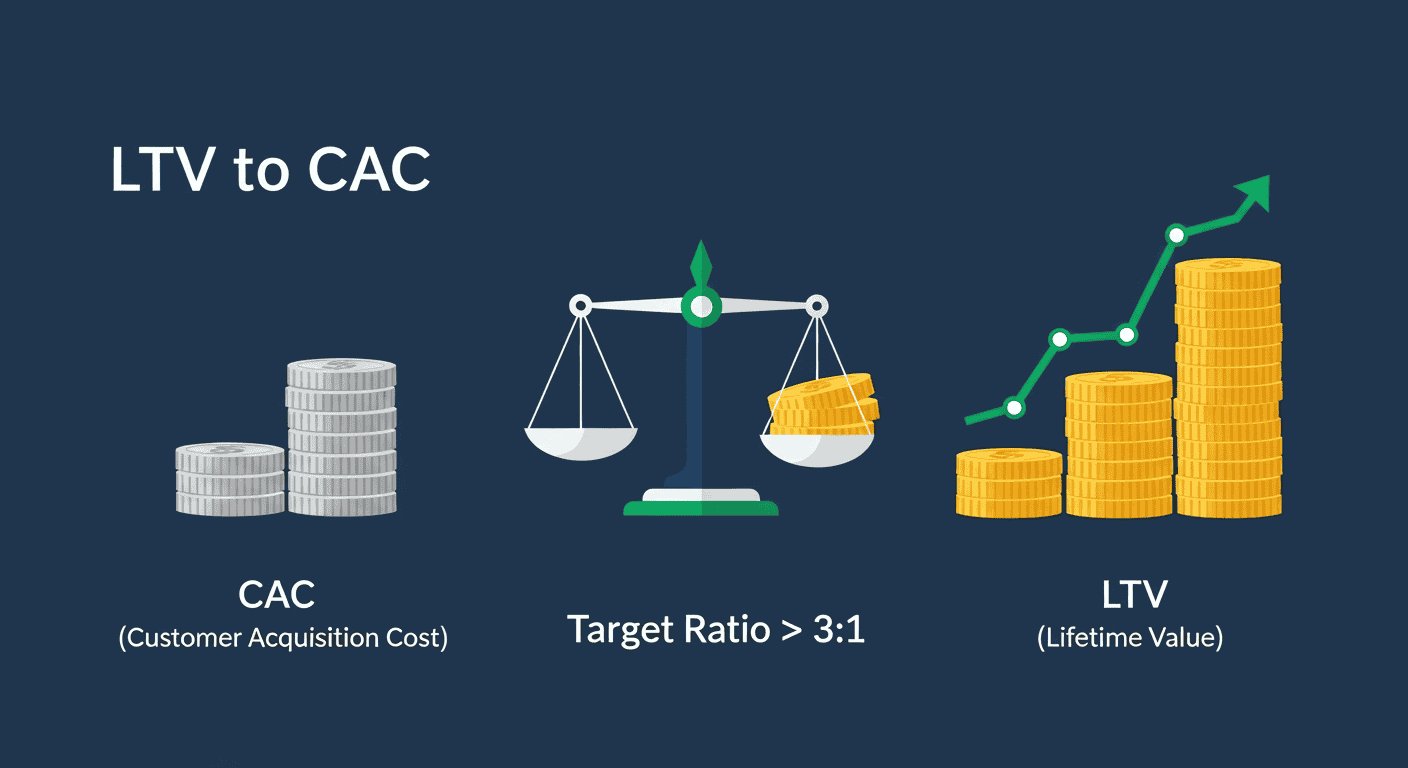
A healthy LTV/CAC ratio demonstrates that a company is generating significantly more value from customers than it costs to acquire them, proving the business model is scalable.
True efficiency starts with unit economics. The relationship between Lifetime Value (LTV) and Customer Acquisition Cost (CAC) provides the clearest view of whether your growth model is scalable or inherently flawed. If you are spending more to acquire a customer than you recover over their tenure, you are not scaling; you are essentially subsidizing your market share with venture capital.
The Burn Multiple: Measuring the Quality of Every Dollar Raised
The Burn Multiple is perhaps the most important metric for any startup. It measures how much cash you burn to generate one dollar of annual recurring revenue. A high burn multiple indicates that your growth is "expensive vanity" — i.e., you are buying growth rather than earning it. A low burn multiple, conversely, signals that you have a capital-efficient machine that can produce high returns on every dollar of capital raised.
To learn more about Burn Multiple, try our free Burn Multiple Calculator.
The Rule of 40: Balancing Aggressive Growth with Operational Health
The Rule of 40, which states that a company's combined growth rate and profit margin should exceed 40%, remains a gold standard for assessing the maturity of tech companies. It forces leadership to balance the desire for rapid expansion with the discipline of maintaining healthy operating margins. It is the perfect check against the impulse to over-invest in unsustainable growth.
To learn more about the Rule of 40, read our complete guide: Why Investors Value the Rule of 40 in SaaS Startups.
Understanding ROCE and GMROI for Asset-Heavy Industries
For businesses managing physical inventory or manufacturing, Return on Capital Employed (ROCE) and Gross Margin Return on Investment (GMROI) are vital. These metrics ensure that the capital tied up in inventory and logistics is generating sufficient profit. Without these, even a high-growth company can find itself "cash poor" while sitting on a warehouse full of stagnant stock.
Resilience as a Moat: How Efficiency Creates Competitive Advantage
Extending the Liquidity Runway to Outlast Market Volatility
A capital-efficient business naturally extends its own runway. By optimizing your burn rate and focusing on working capital, you ensure that you aren't forced into the market for new funding when valuations are depressed. Liquidity is the oxygen that keeps your business alive, and efficiency ensures that you use that oxygen as slowly as possible without sacrificing output.
The Power of "Float" and Cash Conversion Cycles: Strategic Lessons from Amazon
Amazon provides the definitive masterclass in capital efficiency through its management of the Cash Conversion Cycle (CCC). By collecting payment from customers before they pay their suppliers (i.e., creating a "float"), Amazon effectively funds its own growth using the money that would otherwise be tied up in payables. This allows them to scale at a speed that traditional, capital-heavy retailers simply cannot match. Every company should examine their own payables and receivable cycles to see where they can replicate this model.
Strategic Optionality: Using Efficiency to Pivot Faster than Competitors
When you manage your capital intelligently, you gain the ability to pivot. If a specific product line is underperforming, an efficient company has the cash reserves to shut it down and reallocate those resources toward a more promising opportunity. A company tethered to high-burn, inflexible operations, by contrast, is often trapped by its own overhead, unable to move until it is too late.
Avoiding the "Cash Wall": Risk Management and Liquidity Planning
The "cash wall" is the point where a company runs out of options. By consistently monitoring your liquidity and maintaining a cushion, you avoid the panic-driven decisions that often destroy value during market corrections. Proactive planning is the defining characteristic of a leadership team that treats resilience as a core competency.
Building a "Capital-First" Culture: Operationalizing Efficiency
Revenue per Employee: A North Star for Human Resource Allocation
One of the most effective ways to drive capital efficiency is to monitor revenue per employee. This metric discourages "vanity hiring" and forces managers to justify every new headcount. It promotes a culture where productivity, rather than team size, is the marker of a high-performing department.
Leveraging Automation and AI to Decouple Growth from Headcount
Technology has provided unprecedented tools to decouple revenue growth from manual labor. By integrating AI into customer service, sales, and product development, companies can scale operations without a proportional increase in costs. This shift is essential for maintaining margins as a company expands its market footprint.
Engineering and Product Discipline: Building for Cost-Efficiency from Day One
Efficiency must be baked into the product development process. Engineers should not only focus on feature velocity but also on the cost of supporting those features. When the product team understands that technical debt is a form of "financial debt," they become much more disciplined in their architectural choices.
Instilling Financial Literacy Beyond the CFO’s Office
Finally, efficiency is a cultural habit. When every department head understands how their specific decisions impact the burn rate and the company’s overall cash position, you create a self-correcting organization. Financial literacy training ensures that the "Capital-First" mindset permeates every level of the business.
Capital Efficiency Across the Business Lifecycle
The Pre-VC and Bootstrapped Stage: Prioritizing Early Product-Market Fit
For early-stage startups, efficiency is about survival. Your primary goal is to find product-market fit without exhausting your initial seed capital. In this phase, every dollar must be directed toward validating the core value proposition. Complex infrastructure and heavy overhead are luxuries that can kill a company in its infancy.
The Scaleup Phase: Managing Working Capital during Rapid Market Penetration
During the scaleup phase, the challenge shifts to managing cash flow while navigating hyper-growth. This is when working capital management (i.e., optimizing your inventory and payables) becomes critical. The risk here is that rapid growth masks underlying operational inefficiencies. You must maintain a strict grip on your burn rate even as you scale your marketing and sales efforts.
Mature Enterprises: Optimizing Capital Allocation and Dividend Capability
For mature enterprises, efficiency is about maximizing returns on existing assets. This involves constant portfolio review: cutting underperforming product lines, optimizing global supply chains, and evaluating whether capital should be reinvested or returned to shareholders. The focus shifts from survival to maximizing long-term shareholder value.
The Operational Levers of a Lean Business Model
Tech Stack Optimization: From Cloud Infrastructure to CRM Systems
Tech spend is often one of the largest hidden leaks in a modern company’s budget. As teams grow, it’s easy for cloud infrastructure, software subscriptions, CRM seats, analytics tools, and overlapping SaaS platforms to accumulate without regular oversight. What starts as a few essential tools can quickly become a bloated tech stack filled with idle cloud resources, duplicate functionality, and underutilized licenses.
Conducting a focused audit of your cloud infrastructure and software ecosystem can reveal immediate opportunities to reduce costs without slowing the business down. By shutting down unused resources, right-sizing plans, consolidating tools, and eliminating seats that no longer serve an active user or workflow, companies can free up meaningful capital. Rationalizing your tech stack is not about cutting capability; it is about removing waste so more of your budget can support growth, efficiency, and productivity.
Supply Chain Resilience: Managing Payables and Inventory Turnover
If your business holds physical goods, your inventory represents capital that is temporarily locked inside your operations. Every product sitting on a shelf carries a cost: storage, insurance, handling, depreciation, and the opportunity cost of cash that could be used elsewhere. Improving inventory turnover (i.e., the rate at which you sell and replace stock) is one of the most direct ways to strengthen cash flow. Faster turnover means less capital tied up in unsold goods, fewer write-downs, and more liquidity available for growth. When paired with smart payables management, the impact becomes even stronger. By aligning supplier payment terms with the timing of revenue realization, businesses can reduce cash flow pressure, preserve working capital, and build a meaningful liquidity advantage.
Automating Invoicing and Revenue Forecasting for Predictable Cash Flow
Cash flow unpredictability is one of the greatest threats to operational efficiency. When revenue timing is unclear, businesses are forced to make critical decisions with limited visibility (e.g., delaying investments, overcorrecting on expenses, or missing opportunities for growth). By automating invoicing processes and integrating AI into revenue forecasting, you create a clearer, more reliable view of future cash flow. This allows you to anticipate gaps, identify seasonal patterns, and make smarter decisions about when to spend, when to conserve, and where to allocate resources. Predictable cash flow is not just a financial advantage—it is the foundation of a high-velocity business that can move with confidence.
The 5-Step Capital Efficiency Audit: Identifying Hidden Resource Leakage
Step 1: Analyzing Customer Acquisition Cost (CAC) Payback Periods
Your first step should be an audit of your CAC payback period. How long does it take for a customer to pay back the cost of acquiring them? If this period exceeds your natural churn cycle, your business model is inherently fragile. Identify every channel that has a payback period outside of your target range and optimize or eliminate those spend categories immediately.
Step 2: Auditing Your Tech Stack for Idle Spend and Redundant Tools
Once acquisition costs are under control, turn to the tools funding that acquisition. Pull a full inventory of your cloud infrastructure, SaaS subscriptions, and CRM licenses, then cross-reference actual usage against what you're paying for. Idle cloud resources, duplicate tools performing the same function across departments, and "just in case" licenses purchased during a growth sprint are common culprits. This audit alone often surfaces meaningful savings without touching headcount or product roadmap.
Step 3: Reviewing Inventory Turnover and Payables Terms
For companies carrying physical inventory, the next step is examining how quickly stock converts to cash. Slow-moving inventory ties up capital that could otherwise fund growth, so compare your turnover rate against your industry benchmark and flag SKUs or product lines that are underperforming. At the same time, revisit your payables terms — are you paying suppliers faster than necessary given your own receivables timeline? Even modest renegotiation of payment windows can meaningfully improve your Cash Conversion Cycle.
Step 4: Benchmarking Revenue per Employee Against Headcount Growth
Next, assess whether headcount growth is outpacing revenue growth. Calculate revenue per employee over the last several quarters and look for a widening gap between the two trend lines — that gap is often a sign of "vanity hiring" or organizational bloat that crept in during a high-growth period. This step isn't about finding a target number to hit; it's about identifying which teams have scaled headcount without a corresponding scale in output, so leadership can ask the right questions before the next hiring round.
Step 5: Stress-Testing Cash Flow Forecasting and Runway Assumptions
The final step is a forward-looking one: pressure-test your cash flow forecasts against a range of scenarios, not just the base case. Automate invoicing and revenue tracking where possible to reduce forecasting blind spots, and model what happens to your runway under slower collections, delayed fundraising, or a downturn in new bookings. A capital efficiency audit that only evaluates the past twelve months is incomplete — the real value comes from knowing how much cushion you have before you'd hit a "cash wall," and adjusting spend today accordingly.
Summary: Capital Efficiency as a Competitive Advantage
Capital efficiency is far more than a set of accounting rules or a temporary fix for economic uncertainty; it is a fundamental pillar of modern business strategy. Companies that master the art of doing more with less do not just survive market volatility—they thrive in it. By focusing on metrics like the Burn Multiple, optimizing your Cash Conversion Cycle, and fostering a culture of financial literacy, you transform your company from a fragile entity dependent on constant external funding into a resilient, self-sustaining machine.
Building a "Capital-First" organization requires moving past the vanity of growth-at-all-costs. It demands the discipline to audit your tech stack, optimize your supply chain, and ruthlessly prioritize investments that deliver real, measurable returns. As you look ahead, remember that every dollar saved is a dollar of equity you preserve, and every process optimized is a competitive advantage that becomes increasingly difficult for rivals to replicate.
Start your journey today by conducting your first capital efficiency audit. Challenge your department heads to justify their resource allocations through the lens of productivity and revenue impact. When efficiency becomes a core value, you create a business that is not just built to last, but built to lead. Your ability to maintain liquidity and strategic optionality will ultimately determine who wins when the market resets. By prioritizing the quality of growth over the speed of growth, you ensure that your business remains in the driver's seat, ready to seize opportunities long after less-efficient competitors have hit their own "cash wall." The transition to an efficient, resilient model is the single most important strategic investment you can make this year.
FAQ: Capital Efficiency as a Competitive Advantage
What is capital efficiency, and why does it matter more now than during the last funding cycle?
Capital efficiency measures how much output (i.e., revenue, market share, or product innovation) a company generates for every dollar invested. It matters more today because higher interest rates have raised the cost of capital, making "growth at all costs" strategies far riskier. Companies that convert capital into enterprise value efficiently are better positioned to survive downturns and fund their own growth without relying on frequent external financing.
What is the Burn Multiple, and what counts as a "good" number?
The Burn Multiple measures how much cash a company burns to generate one dollar of net new annual recurring revenue (net burn divided by net new ARR). A low Burn Multiple signals efficient, high-quality growth; a high one suggests the company is buying growth rather than earning it. Benchmarks vary by stage and sector, so founders should track the trend over time and compare against peers at a similar ARR level rather than fixating on a single "good" number.
How is the Rule of 40 different from the Burn Multiple?
The Rule of 40 combines a company's growth rate and profit margin, with a combined score above 40% generally viewed as healthy. It's a broader health check on the balance between growth and profitability. The Burn Multiple is more granular — it isolates the cash cost of each dollar of new revenue. Used together, they give a fuller picture: the Rule of 40 shows whether growth and margin are balanced, while the Burn Multiple shows how efficiently that growth is being purchased.
Why does LTV/CAC matter if a company is still pre-revenue or early-stage?
Even before a company has meaningful scale, tracking early signals of Lifetime Value against Customer Acquisition Cost helps validate whether the business model can work at all. A weak or unclear LTV/CAC ratio early on is a signal to revisit pricing, retention, or acquisition channels before scaling spend — not a metric to defer until later.
What is the Cash Conversion Cycle, and how did Amazon use it as a growth strategy?
The Cash Conversion Cycle (CCC) measures the time between paying suppliers and collecting payment from customers. Amazon famously ran a negative CCC — collecting payment from customers before they pay their suppliers, creating a "float" that effectively funds its own growth using money that would otherwise be tied up in payables. Most companies won't replicate this exactly, but reviewing payment terms on both the payables and receivables side is a practical way to free up working capital.
Does capital efficiency mean cutting costs and slowing growth?
Not necessarily. The article frames it as a shift from indiscriminate spending to intentional spending — prioritizing investments with measurable returns over investments that simply increase burn. The goal is "profitable scaling" rather than austerity, so a capital-efficient company can still invest aggressively in R&D or marketing, particularly during downturns when less disciplined competitors are pulling back.
How does capital efficiency look different at each stage of a company's lifecycle?
At the pre-seed/bootstrapped stage, efficiency is about stretching limited capital to find product-market fit. During scaleup, the focus shifts to managing working capital and burn rate while growing quickly, since rapid growth can mask inefficiencies. At maturity, efficiency is about optimizing capital allocation across existing assets and deciding between reinvestment and shareholder returns. The underlying discipline is consistent, but the specific levers change with company stage.
Where should a founder start if they want to run their own capital efficiency audit?
The article recommends starting with the CAC payback period — how long it takes to recover the cost of acquiring a customer. If payback exceeds the natural customer churn cycle, that's an early warning sign. From there, a broader audit typically extends to tech stack spend, inventory or payables terms (for asset-heavy businesses), and revenue-per-employee trends, each of which surfaces a different form of hidden resource leakage.