Fundraising as Enterprise Sales: How to Build an Investor Funnel That Drives Urgency
Key Takeaways
Fundraising is an enterprise sales process, not a favor. Treating your equity as the product and VCs as customers shifts the power dynamic from supplicant to partner and puts you in control of the narrative.
Build an Ideal Investor Profile (IIP) before outreach. Targeting investors by sector focus, stage, check size, and recent activity ensures your pipeline is high-intent, not scattershot.
Batch your meetings to create a compression event. Running outreach in a tight window (not drip-fed over months) generates competitive tension and FOMO that pushes investors to move quickly.
Win the associate, not just the GP. Investment associates act as internal champions who shape the investment memo — treat them as partners, not gatekeepers to route around.
Track pipeline velocity like a sales funnel. Measuring conversion rates at each stage (first meeting → second meeting → term sheet) helps diagnose exactly where your narrative is leaking.
Treat due diligence as procurement, not inspection. A clean, organized data room and proactive disclosure of red flags accelerates trust and shortens the path to a signed term sheet.
Use your lead investor as an anchor tenant. Once a lead commits, remaining outreach shifts from persuasion to simply filling allocation, using their commitment as social proof.
Never let a "no" become permanent. Regular investor updates and traction milestones keep previously passed investors warm for future rounds.
The traditional narrative surrounding the fundraising process is often flawed. Many startup founders treat seeking investment as a begging mission, waiting for the "right" investor to take notice of their brilliance. This passive approach is the primary reason for long, drawn-out fundraises that sap company momentum. To succeed in a competitive capital market, you must flip the script: fundraising is not an exercise in humility — it is an enterprise sales campaign.
By treating your startup’s equity as the product and venture capitalists as enterprise customers, you can build a systematic, repeatable engine for growth. This article outlines how to move away from chaotic outreach and toward a disciplined funnel that manufactures urgency, streamlines due diligence, and drives high-conviction commitments.
The Mindset Shift: Why Fundraising is a High-Stakes Enterprise Sale
Moving from "Asking for Money" to "Closing a Deal"
The most effective founders operate like a VP of Sales. When you approach a fundraise as a sales process, the power dynamic shifts from supplicant to partner. You are not asking for a favor; you are offering a limited opportunity to own a piece of a high-growth asset. Every interaction, from the initial cold outreach to the final signature, should be measured by conversion metrics, pipeline velocity, and deal stage progression. This mental pivot eliminates the desperation that often leads to unfavorable terms and ensures that you remain in control of the narrative.
Equity as Your Product: Understanding the Investor’s Value Proposition
If your equity is the product, your "customer" is the VC. Just as an enterprise buyer has specific pain points (e.g., ROI, security, or compliance), investors have a specific investment thesis. They are looking for market size, defensibility, and team execution. Your job is to align your startup’s milestones with their specific mandate. When you pitch, you aren't just presenting a deck; you are performing a product demonstration. If your "product" doesn't solve their "problem" (i.e., the need to deploy capital into a winner), the deal will stall.
The Parallel Between Procurement and Due Diligence
In enterprise sales, the technical review and security procurement process is where deals go to die. In fundraising, this is your due diligence process. A disorganized data room is the equivalent of failing a security audit. By treating your due diligence materials as a "procurement package," you can proactively address potential red flags, thereby reducing friction and accelerating the path to a signed term sheet.
Architecting the Investor Funnel: Mapping the Stages of a Fundraise Campaign
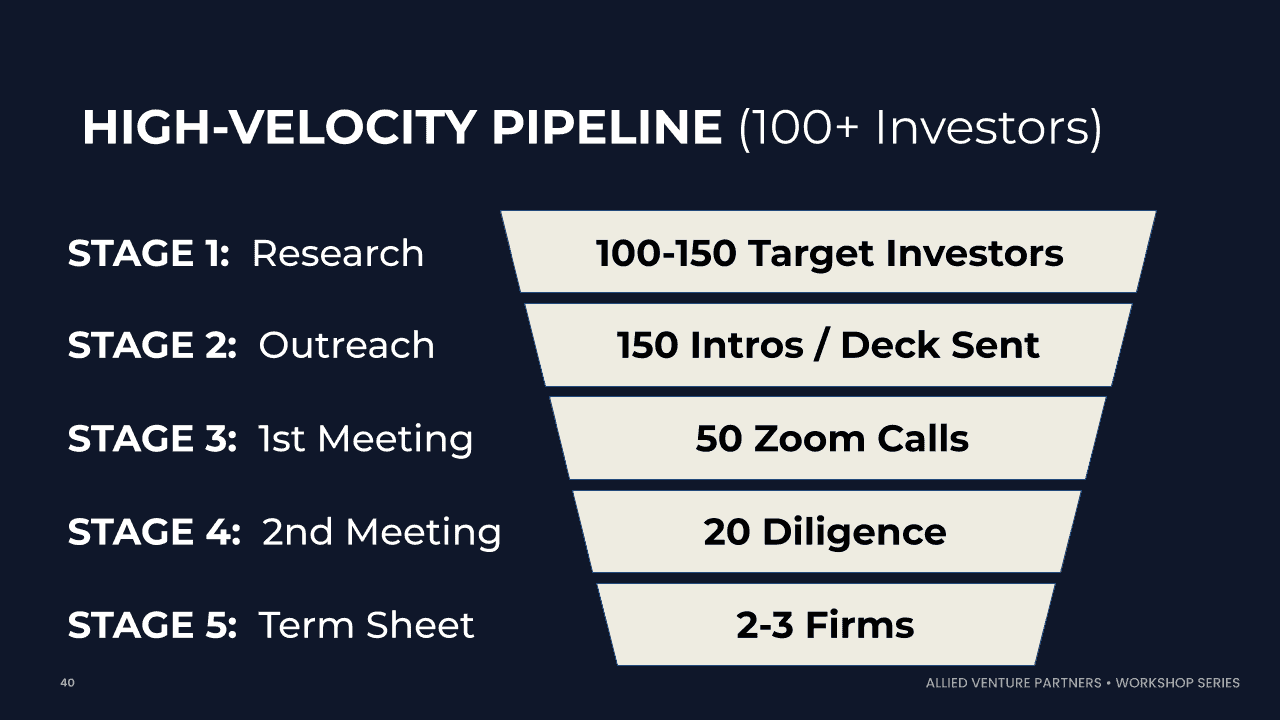
Mapping the traditional enterprise sales funnel directly to the startup fundraising process.
Top of Funnel: Building Your Ideal Investor Profile (IIP)
Your fundraising effort begins with a clean, high-intent list of targets. Just as in B2B sales, casting too wide a net wastes time. Define your IIP based on sector focus, stage, check size, and recent activity. Use data tools to confirm that the investor is actively deploying capital in your space. A well-segmented list ensures that your outreach is personalized, relevant, and statistically more likely to convert into an initial meeting.
Middle of Funnel: Qualified Leads, Initial Pitch, and Internal Champions
Once you make contact, you move into the qualification phase. During the first meeting, your goal isn't just to "sell"; it’s to qualify the lead. Are they a potential lead investor? Do they have the authority to make a decision? The "middle of the funnel" is where you identify your internal champion—the associate or partner who will carry the torch into the investment committee. Failing to build a champion at this stage is the leading cause of "ghosting" in the fundraising process.
Bottom of Funnel: Second Partner Meetings and the Investment Committee
When you reach the bottom of the funnel, the conversations should shift toward technical validation, competitive positioning, and deal structure. This is where you bring out your highest-conviction evidence (customer testimonials, revenue growth metrics, and a clear path to market leadership). You are no longer "pitching"; you are managing the final stages of the procurement cycle.
Post-Funnel: Term Sheet Negotiation and Closing the Round
Closing the round is the culmination of your sales pipeline. A term sheet is not the end of the journey; it is the "contracting" phase of a B2B deal. By managing the expectations early and building a syndicate of interested investors, you create the leverage necessary to finalize terms that are favorable to your founders and existing cap table.
Engineering Urgency: Creating a "Compression Event"
The Dangers of the Perpetual Fundraise: Avoiding Investor Purgatory
The worst mistake a founder can make is allowing a fundraise to drag on indefinitely. A "perpetual fundraise" signals to the market that your startup lacks traction. You must view the fundraise as a time-bound project. By giving yourself a hard deadline, you force the market to respond to your timeline rather than letting them dictate it.
Batching Your Outreach: Why Timing Your First Meetings is Critical
If you drip-feed meetings over three months, you lose the ability to create momentum. Instead, batch your first meetings into a two-week window. This ensures that a large number of investors are seeing your company simultaneously. When you tell a VC that you are "currently in the middle of your meeting cycle," it creates a tangible pressure that forces them to act quickly if they want a seat at the table.
Leveraging Scarcity and FOMO Through Strategic Sequencing
Fear of Missing Out (FOMO) is a real psychological driver in venture capital. By running a compressed process, you enable "competitive tension." If a Tier-1 firm knows that five other firms are looking at the deal and that the round is filling up, they are far more likely to issue a term sheet immediately. This is the definition of a "compression event."
Navigating the VC Firm: Managing the "Champion" vs. the "Decision Maker"
The Investment Associate: Your Internal Champion and Data Gatekeeper
Never underestimate the role of the investment associate. They are the gatekeepers who influence the investment memo. By providing them with high-quality, organized, and timely information, you make their job easier. If the associate views you as a partner, they will fight for you in the room when the GP asks tough questions.
Winning Over the General Partner (GP): Securing the Final Commitment
The GP is your final decision-maker. Your interactions with the GP should be focused on the "Big Picture" (market opportunity, long-term vision, and why your team is the one to build the winner). Use your champion to understand the GP’s specific concerns and tailor your final, high-level pitch to directly address those points.
Mapping the Internal Sales Process: How VCs Reach a "Yes"
Every VC firm has a slightly different internal process. Ask your champion: "What does the investment committee (IC) process look like? Who are the key influencers? What concerns do they usually raise?" Understanding their internal workflow allows you to prepare for objections before they are even voiced in the boardroom.
Operational Precision: Building a Pipeline System for Velocity
Choosing Your CRM: Using HubSpot, Visible, or Kanban for Investor Tracking
Spreadsheets are insufficient for a high-velocity fundraise. Use a CRM to track every interaction, follow-up, and sentiment score. Your pipeline should be visible and actionable, allowing you to see exactly where your deals are stuck. If a lead has been in the "Initial Pitch" stage for more than 14 days, you must re-engage or move them to "Closed-Lost."
Pipeline Velocity: Measuring the Time Between "First Look" and "Term Sheet"
Calculate your velocity metrics. How many meetings result in a second meeting? How many second meetings result in a term sheet? By measuring these conversion rates, you can diagnose leaks in your narrative. If you are getting many first meetings but no second meetings, your initial pitch is the problem. If you get to the IC stage but fail to close, your data or due diligence is likely the bottleneck.
Conversion Rates: Identifying Leaks in Your Fundraising Narrative
Treating your fundraising as a sales funnel allows for clinical analysis. If the funnel is tight at the top, adjust your sourcing. If it’s tight in the middle, refine your pitch deck. If it’s tight at the bottom, audit your data room and references. Data-driven adjustments will always outperform "gut-feel" pivots.
Free Tool: Investor Pipeline Calculator
Successful fundraising follows ‘The Law of the Pipeline.’ If you know your conversion rate, average check size, and how much you want to raise, you can quickly calculate how many investors you need at the top of your outreach funnel to successfully close your round.
Use our free Investor Pipeline Calculator.
The Art of the Nurture: Keeping Momentum Alive Between Meetings
The Investor Newsletter as a Sales Nurture Sequence
Many startups fail to maintain relationships with investors they spoke to six months ago. An investor newsletter acts as a drip campaign. Use it to share wins, traction, and milestones. When you eventually reach out for a formal fundraise, these investors are already "warm" and familiar with your consistent execution, which significantly shortens the sales cycle.
Sharing GTM Momentum: Using Traction to Re-Engage Stalled Leads
If a potential investor previously passed on you, use your growth metrics to change their mind. A quarterly update that highlights record revenue or a major new customer partnership is a powerful "re-engagement" hook. It demonstrates that your startup is moving faster than their original analysis anticipated.
Automated Follow-Up Reminders: Staying Top-of-Mind Without Being a Nuisance
In enterprise sales, the fortune is in the follow-up. Set automated reminders to reach out to investors every 4–6 weeks with a brief update. Keep these communications value-add—share a piece of industry news, an insight, or a milestone—rather than simply asking "do you have an update for me?"
Due Diligence as Procurement: Reducing Friction to Accelerate the Close
Preparing the Virtual Data Room (VDR) to Minimize Cycle Time
Your VDR should be organized, comprehensive, and ready to go before you take your first meeting. A clean structure (incorporating folders for legal, financial, HR, and technical assets) demonstrates professionalism. If an investor requests a document and you provide it within 30 minutes, you build trust. If you take three days, you leak momentum.
Proactive Transparency: Solving for Potential Red Flags Early
Every startup has skeletons in the closet—a pending legal issue, a departing co-founder, or a complex cap table. Do not wait for the investor to uncover these during due diligence. Proactively address these issues in the data room or during the pitch. Framing the narrative yourself is the ultimate mark of a confident, transparent, and trustworthy founder.
The Lead Investor Catalyst: Using One Commitment to Close the Rest of the Syndicate
Once you secure a lead investor, the dynamic of the fundraise changes instantly. The lead investor is the "anchor tenant" of your round. With their commitment in writing, your remaining outreach becomes about "filling the remaining allocation." Use your lead investor to provide social proof to smaller, follow-on investors, which allows you to close the round with efficiency and speed.
Summary: Build an Investor Funnel That Converts
Fundraising, when executed as an enterprise sales process, transitions from a chaotic, nerve-wracking ordeal into a manageable project with predictable outcomes. By viewing your investors as customers, your equity as a product, and your pipeline as a CRM-driven engine, you take control of your startup’s financial destiny.
The path to a successful fundraise is built on these foundational pillars:
Rigorous Qualification: Identify the right investors and focus only on those whose mandates match your stage and vision.
Compressive Timing: Batch your meetings to force competition, drive FOMO, and create a "compression event" that forces rapid decision-making.
Operational Discipline: Use a CRM to track metrics, diagnose conversion leaks, and maintain professional velocity.
Proactive Sales Enablement: Treat your due diligence as an enterprise procurement process, ensuring that your data room and legal documents are flawless and ready for inspection.
Nurture for the Long-Term: Never let a "no" stay a "no" forever. Use consistent updates to keep your startup top-of-mind, creating a pipeline that matures with every passing quarter.
As you step into your next fundraise, remember that you are not just asking for money. You are managing a high-stakes, professional interaction. When you align your internal operations with the methodology used by the world’s most successful sales organizations, you do more than just raise capital; you build the credibility, urgency, and systematic infrastructure required to scale your company to its full potential. Stop asking for permission, start building your pipeline, and close your round with the precision that defines a top-tier operator.
Frequently Asked Questions
Why should founders treat fundraising like an enterprise sale instead of a pitch?
Approaching a fundraise as an enterprise sales process shifts the power dynamic from supplicant to partner. Rather than asking for a favor, founders are offering a limited opportunity to own a piece of a high-growth asset, and can measure every interaction using the same conversion metrics and pipeline discipline a VP of Sales would use.
What is an Ideal Investor Profile (IIP), and why does it matter?
An IIP is a clean, high-intent target list defined by sector focus, stage, check size, and recent investment activity. Building this list before outreach begins ensures your pitches go to investors who are actively deploying capital in your space, making conversations more relevant and more likely to convert into meetings.
What is a "compression event," and how do founders create one?
A compression event is the momentum created by batching investor meetings into a tight window (typically two weeks) instead of spreading them out over months. Running a compressed process enables competitive tension: when investors know other firms are actively evaluating the deal, they're more likely to move quickly rather than let the round stall.
Why is the investment associate as important as the general partner?
The investment associate acts as an internal champion and gatekeeper who shapes the investment memo before it ever reaches the GP. Providing associates with organized, timely information makes them more likely to advocate for the deal internally, while the GP conversation should focus on big-picture vision and market opportunity.
What metrics should founders track during a fundraise?
Founders should measure pipeline velocity: the time between a first meeting and a term sheet, along with conversion rates at each funnel stage. Tracking these numbers with a CRM (rather than a spreadsheet) helps diagnose exactly where a fundraising narrative is leaking, whether that's at sourcing, pitch, or diligence.
How should founders handle due diligence to avoid slowing down a round?
Treat due diligence like a procurement process: prepare an organized virtual data room in advance, and proactively surface potential red flags, like a pending legal issue or a complex cap table, rather than waiting for investors to find them. Responding to document requests quickly (minutes, not days) builds trust and preserves momentum.
How does securing a lead investor help close the rest of the round?
A lead investor functions as an "anchor tenant." Once their commitment is in writing, remaining outreach shifts from convincing new investors to simply filling remaining allocation, since the lead's participation provides social proof that accelerates decisions from smaller, follow-on investors.
What should founders do with investors who previously passed?
A "no" doesn't have to be permanent. Regular updates, such as an investor newsletter or quarterly traction highlights, keep previously stalled leads warm. Sharing record revenue or a major new customer partnership can prompt a passed-on investor to revisit their original decision.