The Scaling Trap: Evolving Operating Principles for Startups
Key Takeaways
3 people: Everyone shares context instinctively. Decisions happen in real time, in the same room.
10 people: Informal alignment starts failing. Side conversations replace shared understanding, and the founder becomes the only connective tissue.
30 people: Departments begin forming. Communication siloes emerge, and cross-functional work requires deliberate coordination for the first time.
100 people: The organization needs documented processes, explicit ownership, and leadership layers (none of which existed before).
Audit generalist roles honestly. Ask whether each early hire's strengths still match what the role now requires, not what it required at founding.
The Brutal Reality of Premature Scaling
Most scaling startups don't fail because the product stopped working; they fail because the operating model never caught up.
There's a meaningful difference between growth and scaling that founders often conflate. Growth is linear: more customers, more revenue, more headcount added in proportion. Scaling is something else entirely: it's building a system where revenue can expand significantly faster than the costs required to generate it. Confusing the two is where the trap begins.
The Startup Genome Report found that 70% of startups that fail do so due to premature scaling. Specifically, hiring aggressively or spending on marketing before achieving genuine product-market fit. The same research shows that startups that scale too early spend 2–3x more than necessary and grow significantly slower than those that wait for the right structural signals. That's not a margin of error. That's the difference between a fundable Series A and a wind-down.
The Scaling Trap is the moment overhead outpaces revenue. And for most early-stage software companies, it arrives quietly, disguised as momentum.
At the Seed stage, speed and improvisation are genuine assets. Founders make fast calls, communication is informal, and the whole team holds context in their heads. Those same habits become liabilities the moment you're navigating a Series A raise or managing a team that no longer fits in one room. Understanding common venture capital terms like burn multiple and unit economics helps founders recognize when they're approaching that inflection point before it becomes a crisis.
What happens structurally at that inflection point (and why it forces founders to fundamentally reinvent how they operate) is where the real challenge begins.
The Rule of 3 and 10: Why Your Process Will Break
Understanding how to scale a startup means accepting an uncomfortable truth: every process you build will eventually break. Not because it was poorly designed, but because organizational physics guarantees it.
Rakuten CEO Hiroshi Mikitani, cited by Sequoia Capital, codified this as the Rule of 3 and 10: internal systems fracture every time a company triples in headcount. The milestones aren't arbitrary; they map to real communication thresholds where what worked before simply stops working.
Here's what typically breaks at each stage:
3 people: Everyone shares context instinctively. Decisions happen in real time, in the same room.
10 people: Informal alignment starts failing. Side conversations replace shared understanding, and the founder becomes the only connective tissue.
30 people: Departments begin forming. Communication siloes emerge, and cross-functional work requires deliberate coordination for the first time.
100 people: The organization needs documented processes, explicit ownership, and leadership layers — none of which existed before.
At each threshold, the founder's role must be reinvented. The hands-on executor who thrived with 10 people often becomes the bottleneck at 30. The trusted generalist who held everything together starts slowing down decisions at 100.
What's striking is how predictable this pattern is, yet how few early-stage teams build for it proactively. The SaaS health metrics investors track change materially at each inflection point, and so does the team structure required to sustain them.
That structural reinvention doesn't stop with process. It extends directly into who you're hiring, and whether those people can grow with the company or only fit where it is today.
Hiring for Slope: Building the 100-Person Team
The single most underrated startup scaling strategy is hiring for trajectory, not credentials. When a team is small, every hire is a generalist who ships fast and figures things out. But the person who thrived at 10 employees (i.e., wearing five hats and improvising constantly) may actively resist the specialization a 100-person organization demands.
Sam Altman captures this tension precisely:
"Hire for 'Slope,' not 'Y-intercept' to ensure the team can evolve as the company grows."
Slope is the learning rate (i.e., how quickly someone absorbs context, builds new skills, and raises the ceiling on what they can own). Y-intercept is their current skill level, the resume credential that feels safe but tells you nothing about adaptability. Early-stage hiring often optimizes for Y-intercept because speed feels urgent. That tradeoff compounds badly at scale.
According to CB Insights, 23% of startups that fail do so because they don't have the right team in place for the growth phase. That's not a product failure, it's a hiring philosophy failure.
Three practical shifts for Series A founders building toward 100 people:
Audit generalist roles honestly. Ask whether each early hire's strengths still match what the role now requires, not what it required at founding.
Hire ahead of the inflection point. Bringing in senior operators after chaos arrives is always more expensive than anticipating the need.
Treat B-player hires as compounding debt. One underperformer in a leadership seat shapes team culture, hiring decisions, and execution quality downstream. It's rarely a contained problem.
Assembling a high-slope team is necessary, but it's not sufficient. Even the right people become bottlenecks when decision-making authority hasn't scaled alongside headcount, which is exactly where the next challenge lives.
The Trust Battery: Scaling Decision-Making
Decentralized decision-making is one of the most critical and most overlooked operating principles for startups moving beyond 30 people. When every call still routes through the founder, velocity collapses under its own weight.
Shopify CEO Tobi Lütke introduced a practical mental model to solve exactly this problem. As he explained on The Knowledge Project, the Trust Battery framework quantifies the level of confidence among team members on a scale from 0% to 100%. A new hire starts around 50%, and every interaction (e.g., a delivered commitment, a missed deadline, a transparent mistake) either charges or drains that battery. When trust is high, teammates need less oversight. When it's low, every decision requires verification.
High trust is the only structural alternative to bureaucratic bottlenecks.
The practical shift this creates is moving from "command and control" to what Netflix and others have described as "context, not control." Instead of approving decisions, founders define the why behind the strategy (e.g., the constraints, priorities, and trade-offs) and then let high-trust team members act independently within that context. The result isn't chaos; it's speed with accountability baked in.
In practice, this means being deliberate about how trust gets built early. When evaluating a new hire or key operator, the questions you ask upfront shape the trust baseline you're starting from.
As your team's trust batteries charge collectively, something useful happens: the 20% of processes that actually drive your scaling efficiency become visible, and that's precisely where your attention should go next.
The 80/20 Rule for Scaling Operations
Most of the leverage in scaling from 0 to 100 employees comes from a small number of high-impact processes, and misidentifying them is one of the costliest mistakes an early-stage founder can make.
The practical reality is that roughly 20% of your operational decisions drive 80% of your scaling efficiency. For software companies at Seed and Series A, those decisions almost always cluster around unit economics, not top-line growth. Andreessen Horowitz notes that companies which develop a clear picture of their LTV/CAC ratio early are far better positioned to pivot during venture capital downturns, because they're optimizing for the right signal.
The danger isn't stagnation; it's over-optimizing the wrong metric at the wrong stage.
Consider the difference in focus between early and growth-stage priorities:
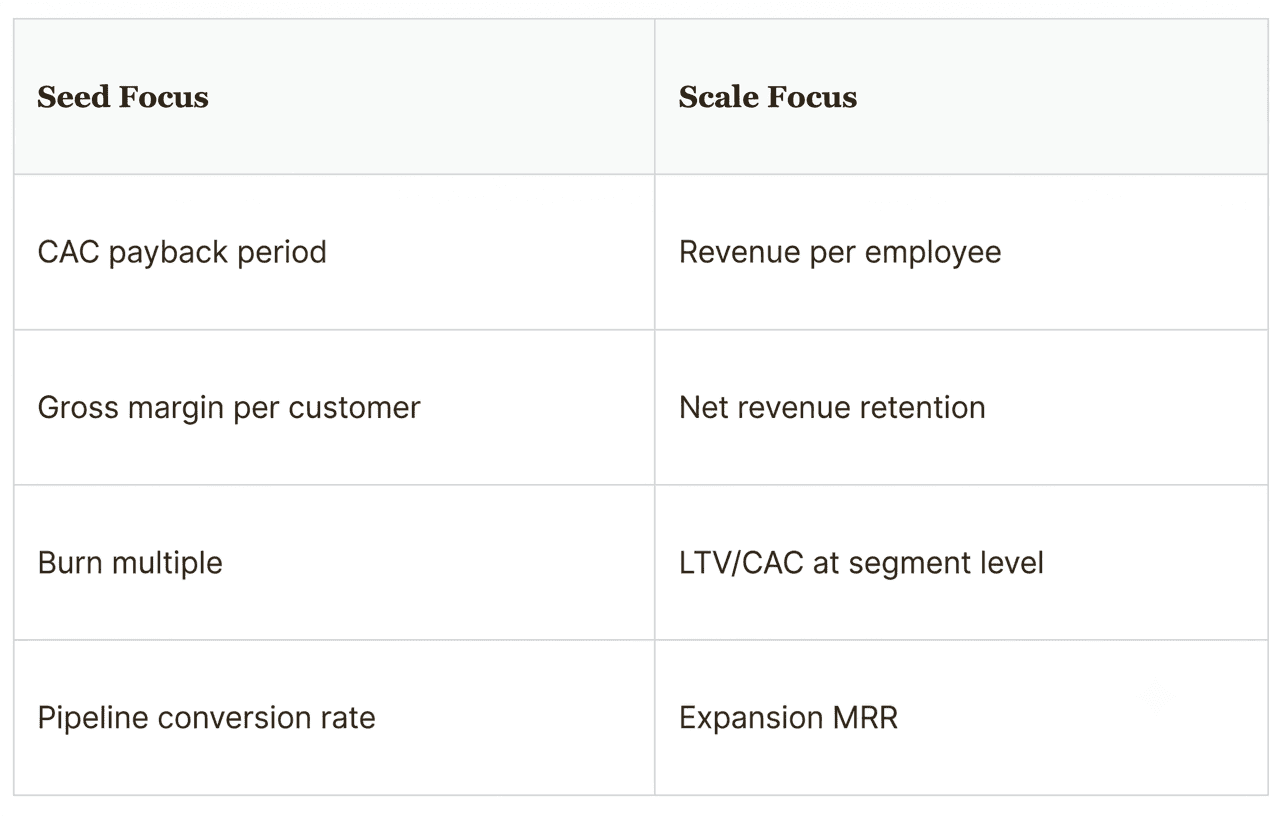
Founders who fixate on top-line ARR before nailing gross margin often build teams and infrastructure that are structurally unprofitable at scale. The process you optimize at 15 people will compound (positively or negatively) by the time you hit 80.
Prioritizing unit economics also disciplines hiring. When every new role must justify itself against margin contribution, you avoid the common trap of scaling headcount ahead of revenue capacity. This connects directly to the trust frameworks discussed earlier: distributed decision-making only works when the underlying financial model is understood across the team.
Getting the 80/20 right operationally sets the foundation for what holds an organization together as it grows, and that's where culture becomes the real operating system.
Culture as the Operating System
Culture isn't a values poster; it's the mechanism that determines how your team behaves when no one's watching. As Brian Chesky has said, "Culture is what people do when you're not in the room; it is the only way to scale decision-making." At 100 employees, that reality hits hard.
Culture is, effectively, your most scalable operating system. When unit economics for scaling favor speed and headcount growth, informal norms break down fast. What held together a 12-person team (such as shared context, proximity, founder instinct) becomes noise by employee 60.
The "Don't Fuck Up the Culture" philosophy, famously articulated during Airbnb's early growth, isn't sentimental. It's a practical warning that hiring velocity and cultural dilution tend to move together. Every new hire is either reinforcing your operating norms or quietly eroding them. Without codified values, the default is drift.
Codifying culture means translating implicit behavior into explicit, testable principles. According to LinkedIn's analysis of startup scaling strategies, founders who document decision-making frameworks early consistently outperform those who treat culture as an afterthought. Useful codification looks like:
Decision criteria: what trade-offs the company always makes (speed vs. polish, growth vs. margin)
Behavioral anchors: specific examples of values in action, not abstract nouns
Onboarding rituals: structured moments that transmit culture to every new hire
The goal isn't rigidity, it's repeatability. A culture that survives 100 employees is one that new team members can learn, practice, and eventually model for the people they hire next. That repeatability becomes the foundation for the structured scaling process covered in the next section.
Transitioning from 0 to 100
Shifting from founding a product to leading a company requires four distinct operating upgrades, and skipping any one of them is how promising startups stall. Harvard Business Review research shows founders who've scaled before succeed 30% of the time versus 18% for first-timers, which tells you something important: the pattern is learnable, but it has to be intentionally applied.
Repeatable Sales Motion. Before you scale headcount, you need a sales process that works without you in the room. A common pattern is documenting every step of the customer journey (from first touch to closed deal), then stress-testing whether a new hire can replicate it. If the answer is no, adding salespeople just multiplies inconsistency.
Management Layer Implementation. The jump from 10 to 30 people breaks every founder who tries to stay the primary decision-maker. In practice, this means hiring or promoting managers who own outcomes (not just tasks) and giving them the authority to match. This is also the stage where structuring investor communications becomes a dedicated function rather than a founder's side responsibility.
Data-Driven Operational Rigor. What gets measured gets managed. According to Andreessen Horowitz's startup metrics framework, tracking the right unit economics early prevents the costly habit of optimizing vanity metrics at scale.
Continuous Cultural Reinforcement. As the previous section covered, culture isn't set once; it degrades under growth pressure unless it's actively re-encoded. The founders who scale successfully treat culture maintenance as a recurring operational task, not a one-time offsite. How you sustain that intentionality across every growth milestone is exactly where scaling strategy becomes a long-term commitment.
The Bottom Line: Scaling with Intent
Scaling isn't something that happens to a company; it's a deliberate series of choices made at every stage of growth. The founders who avoid the scaling trap aren't the ones who grow fastest; they're the ones who stay most intentional.
Four principles cut across everything covered in this article:
Rebuild your processes at every 3x milestone. What worked at 10 people breaks at 30. What works at 30 breaks at 100. Treating process as permanent is one of the fastest ways to create organizational drag.
Hire for slope, not just credentials. A candidate's trajectory matters more than their résumé. The team you build between Seed and Series A defines your operational ceiling for years.
Protect your trust batteries. Relationships with your team, your investors, and your early customers are depleted by poor communication and rebuilt through consistent follow-through. Culture is the operating system; trust is the power source.
Make unit economics your true north. As Andreessen Horowitz notes, sustainable scaling requires shifting focus from top-line growth to contribution margin. Revenue without healthy unit economics is a growth illusion, not a growth story.
Scaling with intent means knowing which lever to pull (and which to leave alone) at each stage of the journey. For founders navigating ARR expansion, understanding how public-market valuations are shaped by the same fundamentals can sharpen your long-term perspective.
The principles don't change. The application of them does, and that distinction is everything.
Partnering for the Next Phase of Growth
No founder scales successfully in isolation. The most consistent differentiator between startups that stall and those that reach Series A is access to operators who have navigated the same terrain.
The transitions covered throughout this article (from founder-led selling to systematic revenue, from intuitive decisions to metric-driven operations, from a tight-knit team to a structured organization) each carry real execution risk. That risk compresses when you're connected to investors and operators who have made those same calls before, often under similar constraints.
Allied Venture Partners sits at the intersection of angel syndication and venture capital, specifically designed to support founders at Seed and Series A. The model is built around one practical reality: early-stage founders need more than a term sheet. They need a diverse operator network that can stress-test assumptions, open doors, and flag scaling pitfalls before they become expensive problems. That's what the Allied platform is designed to provide — and it starts with a process that's always free to pitch.
Our fee-free pitching process removes one of the most common barriers between a fundable idea and a funded company. Founders can submit through the 'Pitch Us' portal without the friction of membership fees or gatekeeping — just a direct path to curated operator feedback.
If you're building a software company and approaching your next funding milestone, submit your pitch to connect with a network built to help you scale with intent.
Frequently Asked Questions
What is the Scaling Trap, and why do most scaling startups struggle with efficient growth?
The Scaling Trap occurs when overhead grows faster than revenue because the company’s operating model fails to keep pace. Most scaling startups don’t fail because the product broke; they fail because they scaled headcount, spending, or complexity before achieving genuine product-market fit. Research shows these companies spend 2–3x more than necessary and grow far slower than peers that wait for the right structural signals.
Why must operating principles for startups evolve at each stage of growth according to the Rule of 3 and 10?
The Rule of 3 and 10 states that internal systems fracture every time headcount roughly triples. At ~3 people everyone shares context instinctively; at ~10 informal alignment collapses and the founder becomes the sole connective tissue; at ~30 departments and silos appear; at ~100 the organization needs documented processes, clear ownership, and leadership layers that never existed before. Founders who treat early habits as permanent create drag that compounds at every threshold.
What is the recommended approach for how to scale a startup’s team effectively?
Hire for “slope” (learning rate and future adaptability) rather than only “Y-intercept” (current credentials or resume). The generalist who thrived wearing five hats at 10 people may actively resist the specialization a 100-person company requires. Practical moves include auditing whether early hires still match the role’s current demands, hiring senior operators ahead of chaos, and treating B-player leadership hires as compounding cultural and execution debt.
How can the Trust Battery framework support better decision-making when scaling from 0 to 100?
The Trust Battery (popularized by Shopify’s Tobi Lutke) measures confidence in teammates on a 0–100% scale. Every delivered commitment charges it; every missed deadline or opaque decision drains it. When trust is high, teams need far less oversight. Founders shift from “command and control” to “context, not control”—defining the strategic why, constraints, and priorities so high-trust teammates can act independently. This is the only scalable alternative to founder bottlenecks as the company grows from 0 to 100.
Why prioritize unit economics for scaling over top-line revenue metrics?
Unit economics for scaling reveal whether growth is structurally healthy. Early focus areas (CAC payback, gross margin per customer, burn multiple) give way to later ones (revenue per employee, net revenue retention, segment-level LTV/CAC). Founders who chase ARR before nailing contribution margins often build teams and infrastructure that become unprofitable at scale. Roughly 20% of operational decisions centered on these metrics drive 80% of long-term scaling efficiency.
What are key startup scaling strategies for maintaining culture and operational rigor as teams grow?
Treat culture as the operating system: codify decision criteria, behavioral anchors, and onboarding rituals so new hires can learn and model the norms. Build repeatable sales motions that work without the founder in the room, install management layers with real outcome ownership, enforce data-driven operational rigor, and treat continuous cultural reinforcement as a recurring operational task rather than a one-time offsite. These startup scaling strategies prevent drift and keep the organization aligned through every growth milestone.