The PMF Fallacy: How to Find Product-Market Fit Before You Scale
Key Takeaways
Dominate a wedge before expanding: A narrow ICP lets you build defensible depth. Broad platform ambitions come after you've earned the right.
Apply the 40% disappointment benchmark: If fewer than 40% of your users say they'd be "very disappointed" without your product, you don't yet have the necessity signal investors fund.
Hypothesize: Define one specific assumption about your customer's underserved need and what would change if you solved it.
Test: Ship the smallest version that honestly tests that assumption, not the most polished one.
Pivot or Persevere: Make a deliberate, evidence-based call before the next cycle begins.
The 42% Failure Rate: Why PMF is the Only Metric That Matters
Startups don't fail because of poor engineering; they fail because nobody wanted the product in the first place.
CB Insights research consistently shows that 42% of startup failures trace back to a single cause: no market need. Not a bad hire, not a missed sprint deadline, not a pricing error. The market simply didn't want what was built.
As Marc Andreessen has put it, "You can always fix a sloppy operation, but you can't fix a lack of market." Operational excellence is a multiplier, but only when applied to something the market already pulls toward. Without that pull, scaling faster just burns capital on a product the world hasn't asked for.
What makes this pattern so persistent is that founders often can't tell the difference between genuine traction and early noise. A strong launch week, enthusiastic feedback from a few design partners, or a spike in sign-ups after a press mention can all feel like proof of fit. In practice, these signals tend to reflect novelty, not necessity. Understanding how to find product-market fit means learning to separate that initial hype from durable, repeatable demand.
At Allied Venture Partners, evaluating whether a founding team is truly market-first (not just product-proud) is central to how the firm assesses Seed and Series A opportunities. The firms that earn a place in a curated deal-flow portfolio aren't just building well; they're building for a specific, validated need.
PMF isn't a moment. It's a spectrum, and understanding exactly where your company sits on that spectrum is where the real analysis begins.
Defining the Spectrum: Why PMF is Not a Binary Switch
How to define product-market fit accurately means resisting the urge to treat it as a moment; it's a measurement.
Most early-stage founders operate with a mental model that goes something like: "We don't have PMF yet, but one day we will." That framing is dangerous. It implies a threshold you cross, after which scaling is safe. In practice, PMF behaves less like a light switch and more like a signal you track over time; one that can strengthen, weaken, or plateau depending on how well your product continues to serve a real need.
The 'Leaky Bucket' reality: If your product acquires users faster than it retains them, you don't have PMF — you have a growth illusion. As Brian Balfour (Reforge) frames it, PMF is best understood through long-term retention plateaus, not activation spikes.
Cohort retention curves are the most honest signal available to a Seed-stage founder. Plot retention by cohort (week over week or month over month) and watch what the curve does over time. A curve that drops to zero tells you users tried the product and left. A curve that keeps declining tells you the same thing, more slowly. The only shape that matters is a curve that flattens above zero, because that flatline represents users who found enough value to stay.
For Series A investors, that flattening curve isn't just a positive signal; it's often a prerequisite. It confirms that the core use case is durable, not just novel. Pair this with cohort-level revenue behavior, and you move from storytelling to evidence.
Understanding retention mechanics is foundational, but retention only tells you if people are staying. The harder question is who you're actually building for.
Identifying Underserved Needs: The 'Market' in Market Fit
Most Seed-stage founders build a solution first and hunt for a problem second. And that reversal is exactly where early traction dies.
Identifying underserved customer needs requires deliberately flipping that sequence. Before a single line of code is written, the real work is understanding which customer segment carries the most acute, poorly-served pain, and why existing alternatives fall short. A common pattern is that founders anchor to a technology or feature they find exciting, then retrofit a market around it. The result is a product with impressive specs and indifferent adoption.
The wedge beats the platform every time at the early stage. Bessemer Venture Partners is direct on this point: start with a tight, narrowly defined ICP rather than a broad platform vision. A wedge gives you one specific problem, one specific customer, and one specific context, which makes validation fast and the signal clear. Platforms come later, once you've earned the right through demonstrated retention and expansion within that wedge.
Narrowing your Ideal Customer Profile reduces market noise considerably. Instead of asking "who could use this?", the productive question is "who feels this problem so acutely that they'd use an imperfect solution today?" That framing surfaces the customers whose feedback actually calibrates your product. It's also the foundation for the early retention patterns that indicate real fit; something worth tracking closely from your first cohort onward.
Once you've identified that narrow customer segment and confirmed the gap is real and underserved, you're ready to move into the harder question: how do you build a repeatable loop that turns that insight into a validated product?
The Iteration Playbook: Building a Repeatable Validation Loop
A practical PMF playbook for founders isn't about moving fast for its own sake. It's about building a loop where every ship cycle teaches you something actionable.
The foundation of that loop is the Lean Product Process: start with a clearly defined value proposition, identify the minimum feature set that delivers on it, and ship an MVP that's narrow enough to generate a clean signal. Dan Olsen's playbook for achieving product-market fit frames this well — the MVP exists to test assumptions, not to impress. Once that framing clicks, the entire development rhythm changes.
The strongest validation loops run on four repeating steps:
Hypothesize: Define one specific assumption about your customer's underserved need and what would change if you solved it.
Test: Ship the smallest version that honestly tests that assumption, not the most polished one.
Measure: Track the signal that directly reflects behavior: retention, activation, referrals, not vanity metrics. Early traction metrics like cohort analyses and conversion rates are what actually tell you if something is working.
Pivot or Persevere: Make a deliberate, evidence-based call before the next cycle begins.
On pivoting: the data is instructive. According to the Startup Genome Report, startups that pivot one to two times raise 2.5x more money and see 3.6x better user growth. One or two pivots is a sweet spot, not a failure signal. However, constant pivoting destroys momentum and signals a hypothesis problem, not a product problem. If the direction changes every sprint, the issue is upstream: the target customer or the problem definition hasn't been locked down yet.
Shipping fast matters, but only if the purpose is integrating feedback rather than clearing a roadmap. Speed without a feedback mechanism is just expensive guessing, and that distinction is exactly what separates durable iteration from premature scaling.
Is PMF Overrated? Addressing the Modern Skepticism
PMF skepticism is rising, but dismissing the concept entirely is a mistake that conflates a flawed measurement with a flawed objective.
A growing thread in startup communities questions whether chasing PMF is actually a distraction from building a sustainable business model. The argument has some merit: too many founders treat PMF as a checkbox rather than a continuous discipline, using the label to sidestep hard questions about unit economics and long-term retention. In practice, this makes PMF sound overrated when the real problem is how it's being applied.
Distribution-Market Fit deserves equal attention. A product that resonates deeply with a narrow segment still fails if founders can't scale the channel that reached those early believers. Fit without a repeatable go-to-market motion is just a well-validated dead end. The new era of startup growth makes this increasingly clear: distribution constraints are killing otherwise solid products at Series A.
The more useful reframe is "Foundational Fit" — the idea that PMF isn't a destination but the structural layer that every other scaling decision sits on top of. A healthy product market fit iteration loop doesn't stop when early retention looks promising; it keeps stress-testing assumptions as the customer base broadens and the competitive landscape shifts.
The AI hype cycle makes this reframe urgent. Founders chasing LLM-adjacent positioning often skip Foundational Fit entirely, assuming that technical novelty substitutes for genuine demand. It rarely does, and that gap between a compelling demo and durable market pull is exactly where the next section picks up.
Mastering the AI Pivot: PMF in the Age of LLMs
'AI-powered' is a feature descriptor, not a market-fit signal, and conflating the two is one of the most common scaling mistakes founders make right now.
The 'Demo-to-Value' gap is where most AI startups stall. A compelling demo that showcases a model's capabilities can generate early buzz, but buzz doesn't translate into workflow adoption. In practice, users will engage with an impressive demo once and abandon the product if it doesn't solve a problem they encounter repeatedly. The model's performance becomes irrelevant if it doesn't embed into how teams actually work.
Workflow integration is the real PMF signal for AI-native products. Founders should ask whether their product changes what a user does on a Tuesday afternoon, not just what they could do in a controlled demo environment. This framing shifts evaluation from capability to dependency, which is exactly where durable fit lives.
As Bessemer Venture Partners notes, AI founders must be ruthless about proving ROI while also appealing to end users. That dual obligation (economic value for buyers, intuitive value for users) is what separates AI products with real traction from those accumulating vanity metrics vs durable fit.
When Allied Venture Partners evaluates AI-native startups, the focus falls on retention cohorts and workflow entrenchment rather than activation spikes. A useful starting point for founders preparing to demonstrate this is understanding what investors prioritize in early-stage pitches before entering any structured diligence process.
That distinction between metrics that look good and metrics that prove something is exactly what our next section unpacks.
Vanity Metrics vs. Durable Fit: What Investors Actually Look For
Sophisticated investors don't fund dashboards; they fund evidence that a product has earned a permanent place in a customer's workflow.
Total registered users is perhaps the most misleading metric a founder can lead with. Sign-up numbers tell investors nothing about whether users returned, derived value, or would notice the product's absence. A user who registers and never logs in again isn't a customer; they're a data point that flatters a pitch deck while concealing a retention problem.
The Sean Ellis Test offers a more honest signal: ask your active users how they'd feel if the product disappeared tomorrow. If fewer than 40% answer "very disappointed," you haven't found fit, you've found curiosity. That threshold isn't arbitrary; it's a qualitative benchmark for whether a product has become genuinely necessary rather than merely convenient.
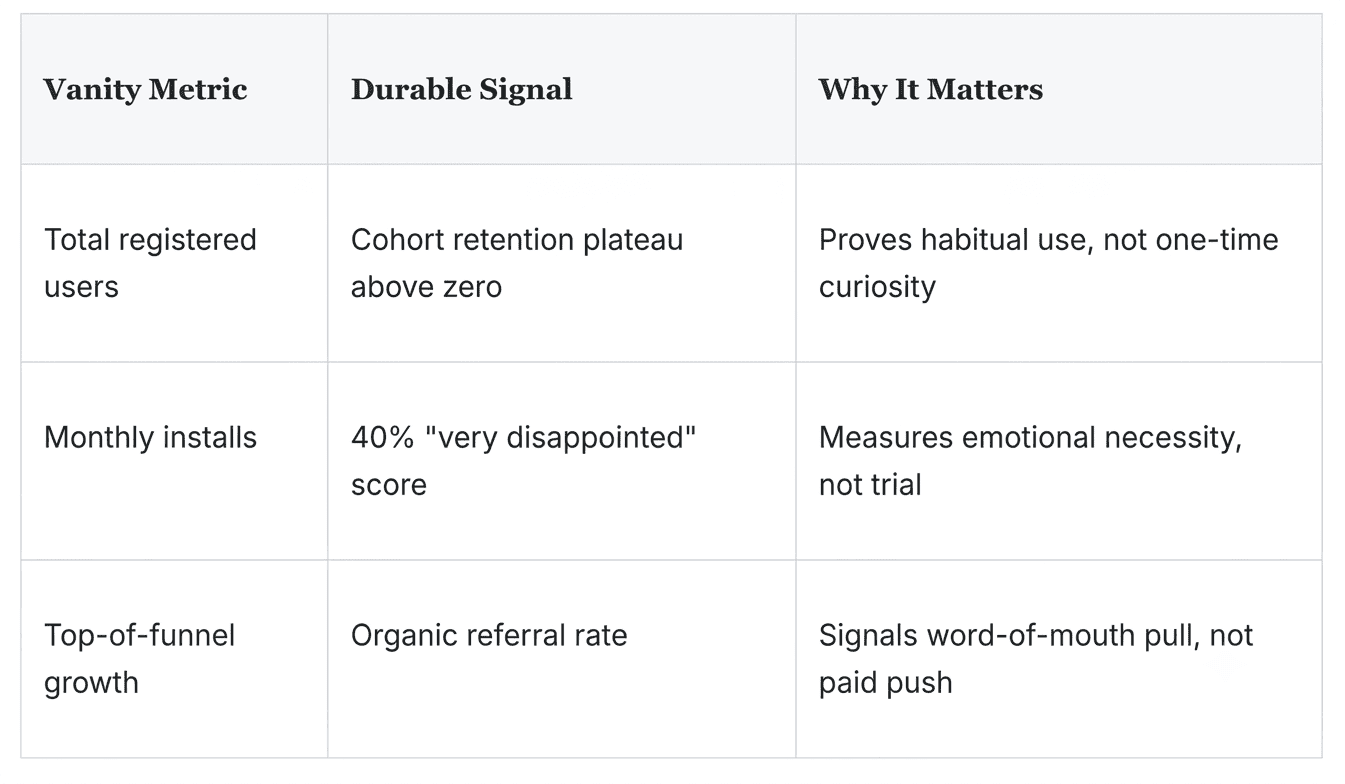
At Allied Venture Partners, PMF signals like these are central to how deal flow gets curated for the angel investor network. The fee-free pitching process rewards founders who arrive with durable evidence (retention curves, disappointment scores, and cohort data) rather than vanity metrics dressed up as traction. As Brian Balfour has noted, a product achieves PMF when the cohort retention curve flattens above zero, not when it spikes and collapses.
Understanding which signals matter (and which ones mislead) is exactly the kind of clarity that separates a fundable pitch from one that stalls in due diligence. The next step is turning that clarity into a practical, repeatable framework you can apply before you ever walk into a room with investors.
The Bottom Line: Your PMF Checklist
Scaling without verified product-market fit doesn't accelerate growth; it accelerates the path to failure. The evidence is consistent: premature scaling is the single most common reason early-stage startups stall, and avoiding it comes down to disciplined signal-reading over wishful thinking.
Genuine PMF is confirmed by behavior, not sentiment. Before you shift focus toward growth infrastructure, run through these five checkpoints:
Validate the market first. Scaling operations before your market has confirmed demand accounts for the 42% of startups that cite "no market need" as their cause of failure. Build evidence before building headcount.
Read retention, not acquisition. Long-term cohort retention plateaus (not top-of-funnel growth) are the most reliable PMF signal. Tracking early traction metrics helps distinguish sustainable engagement from noise.
Pivot with purpose. The Startup Genome Report confirms that a repeatable iteration loop outperforms both blind persistence and reactive pivoting. One to two strategic pivots anchored in underserved customer needs is the target range.
Dominate a wedge before expanding. A narrow ICP lets you build defensible depth. Broad platform ambitions come after you've earned the right.
Apply the 40% disappointment benchmark. If fewer than 40% of your users say they'd be "very disappointed" without your product, you don't yet have the necessity signal investors fund.
In practice, these checkpoints aren't a one-time audit; they're an ongoing calibration. Once each one clears, the conversation naturally shifts from fit to fuel: the capital, networks, and operator access that convert validated traction into scalable growth.
Scaling Beyond the Playbook: Next Steps for Founders
Verified product-market fit doesn't end the work; it reframes the challenge from finding fit to financing and executing on it.
Once your retention curves flatten at a healthy level, your NPS scores reflect genuine pull, and customers are renewing without prompting, the constraint shifts. You no longer need to validate whether the product deserves to exist; you need the capital and operator relationships to scale it responsibly. That transition from iteration to growth is where many otherwise strong founding teams stall, not because the product failed, but because the funding path wasn't in place.
For Seed and Series A founders, access to a structured, operator-connected investor network is what separates durable growth from another premature scale attempt. Allied Venture Partners works specifically in this window, connecting North American software founders with a diverse network of operators and investors who understand what early-stage traction actually looks like. If you're building in this stage, we want to hear from you.
Our free pitching process at Allied removes a friction point that often delays validated startups from accessing the right capital. There's no entry cost to submit your pitch, which means founders can focus their resources on the product and team rather than gatekeeping fees. For accredited angel investors, the platform offers curated deal flow without traditional membership fees, making it practical to build a diversified portfolio in high-growth software.
If you've done the hard work of building a durable iteration loop and the signals confirm your fit is real, the logical next step is matching that validated business with investors who can recognize it. Submit your pitch through Allied Venture Partners' Pitch Us portal to connect with one of North America’s largest angel networks, and bring your verified fit to the table.
Frequently Asked Questions
What is the most accurate way to define product-market fit?
The most important thing to understand when determining how to define product market fit is that it isn't a binary event — it's a spectrum. PMF is better understood as a continuous signal you track over time rather than a threshold you cross. The clearest behavioral evidence of fit is a cohort retention curve that flattens above zero, meaning a meaningful portion of users found enough value to stay. Pair that with a Sean Ellis score above 40% (where at least four in ten active users say they'd be "very disappointed" if the product disappeared), and you have a foundation that goes beyond storytelling into evidence.
How do you find product-market fit without mistaking early noise for real traction?
Learning how to find product-market fit starts with separating novelty from necessity. A strong launch week or a spike in sign-ups after press coverage can feel like validation, but these signals typically reflect curiosity rather than durable demand. The discipline is to track cohort-level retention over time, not top-of-funnel growth, and to pressure-test whether users are returning because the product is genuinely useful or simply because it's new.
How does identifying underserved customer needs change how you build?
Identifying underserved customer needs requires flipping the typical founding sequence. Rather than building a product and searching for a market afterward, the work begins with finding which customer segment carries the most acute, poorly-served pain, and understanding why existing alternatives fall short. This focus on a narrow Ideal Customer Profile (ICP) is what generates clean signal early: it surfaces the customers whose feedback actually calibrates the product, and it's the foundation for the retention patterns that confirm genuine fit.
What does a PMF playbook for founders actually look like in practice?
A practical PMF playbook for founders is built around a four-step repeating loop: hypothesize one specific assumption about your customer's underserved need, ship the smallest version that honestly tests it, measure behavioral signals like retention and activation rather than vanity metrics, and make a deliberate pivot-or-persevere call before beginning the next cycle. The Startup Genome Report supports one to two strategic pivots as a healthy signal (e.g., startups in that range raise 2.5x more capital and see 3.6x better user growth). Constant pivoting, however, usually indicates the target customer or problem definition hasn't been adequately defined upstream.
What is a product-market fit iteration loop and why does it matter?
A product market fit iteration loop is the repeatable cycle a founding team uses to turn assumptions into evidence and evidence into product decisions. Its purpose isn't speed for its own sake; it's ensuring that every development cycle generates an actionable signal. Without a structured loop, shipping fast is just expensive guessing. The loop matters because PMF isn't validated once and then fixed; it requires ongoing calibration as the customer base broadens, the competitive landscape shifts, and the product evolves.
What's the difference between vanity metrics and durable fit — and why does it matter for fundraising?
The distinction between vanity metrics vs durable fit is central to how sophisticated investors evaluate early-stage companies. Total registered users, monthly installs, and top-of-funnel growth numbers tell an investor nothing about whether a product has earned a place in a customer's workflow. Durable signals (i.e., cohort retention plateaus, organic referral rates, and a 40% disappointment score) demonstrate that users depend on the product, not just that they tried it once. Founders who arrive at a pitch with behavioral evidence rather than impressive-looking dashboards are far better positioned to move through diligence without stalling.
Why do so many AI startups struggle to demonstrate genuine PMF?
The core problem is conflating a compelling demo with real demand. "AI-powered" describes a technical capability, not a market need, and impressive demos often generate a one-time engagement without translating into workflow adoption. The meaningful question for AI-native products is whether the product changes what a user actually does on a regular workday, not what they could do in a controlled environment. Retention cohorts and evidence of workflow entrenchment are the signals that separate durable fit from accumulated hype.