Startup Governance: How Board Seat Allocation Shapes Your Company's Future
Key Takeaways
Board seat allocation is a foundational governance decision that determines the balance of power, influences strategic direction, and shapes a startup's ability to execute its vision while maintaining investor confidence.
Board composition evolves with funding stages: Founders typically control early boards, but by the fourth financing round, venture capitalists hold most seats. Strategic planning for this transition is essential from the outset.
The ideal board size maintains an odd number of members to avoid voting deadlocks—typically three members after Series A (two founders, one investor), expanding to five or seven as the company scales and adds independent directors.
Independent directors provide critical value beyond objectivity, bringing specialized expertise in areas like regulatory compliance, financial oversight, risk management, and emerging market trends that founders and investors may lack.
Diversity in board composition drives better decisions: Effective boards prioritize diversity of thought, experience, background, and perspective—not just demographic diversity—to challenge assumptions and identify blind spots.
Board seat allocation directly impacts fundraising success: A well-structured board demonstrating strong governance and balanced stakeholder representation attracts future investors, while imbalanced boards can deter capital.
Founders must balance control with strategic value: While retaining board influence is important for preserving vision, over-prioritizing control can limit access to essential capital, expertise, and networks needed for growth.
The true cost of capital extends beyond equity dilution to include board representation and strategic influence—founders should ensure any loss of board control is proportionate to the value investors provide.
Proper board onboarding and clear governance structures prevent dysfunction: Board charters, defined roles, communication protocols, and conflict resolution mechanisms are essential for board effectiveness and collaborative decision-making.
Board decisions create long-term cultural impact: The principles of governance, ethics, and accountability championed at the board level permeate throughout the organization, influencing company culture and operational practices.
Strategic board planning prepares companies for exit: As startups approach IPO or acquisition, boards must transition toward structures that meet public company standards, including majority independent directors and formal committee structures.
With US venture capital investment reaching $274 billion in 2025, robust governance and well-structured boards are paramount for attracting capital, managing investor relationships, and achieving sustainable long-term success.
Startup Governance: How Board Seat Allocation Shapes Your Company's Future
The journey of a startup is a high-stakes odyssey, fraught with ambition, innovation, and the constant pursuit of capital. Amidst the relentless drive for growth, a critical, often underestimated element dictates the company's trajectory: governance. Specifically, the strategic allocation of board seats is not merely an administrative detail but a foundational decision that profoundly shapes a startup's future.
These seats are the power centers of oversight, strategy, and accountability. How they are distributed among founders, investors, and other stakeholders determines the balance of control, the speed of decision-making, and ultimately, the capacity of the board of directors to guide the company towards its objectives. Understanding this intricate dance of representation is paramount for any founder seeking to build a resilient, successful enterprise.
The Board of Directors: More Than Just Oversight
The board of directors in a startup context often evolves from an informal advisory group into a formal governing body. Its primary function extends far beyond mere oversight; it is the strategic compass of the organization. A well-composed board brings diverse perspectives, crucial expertise, and an objective lens to the often turbulent early stages of a company. They are tasked with setting high-level strategy, approving major financial decisions, ensuring compliance, and crucially, holding the management team accountable.
In essence, the board acts as the custodian of shareholder value, balancing the short-term needs of operations with the long-term vision of sustainable growth. The composition of this board, therefore, is not a secondary concern but a direct determinant of its effectiveness in fulfilling these vital roles.
Why Board Seat Allocation is Your First Strategic Governance Move
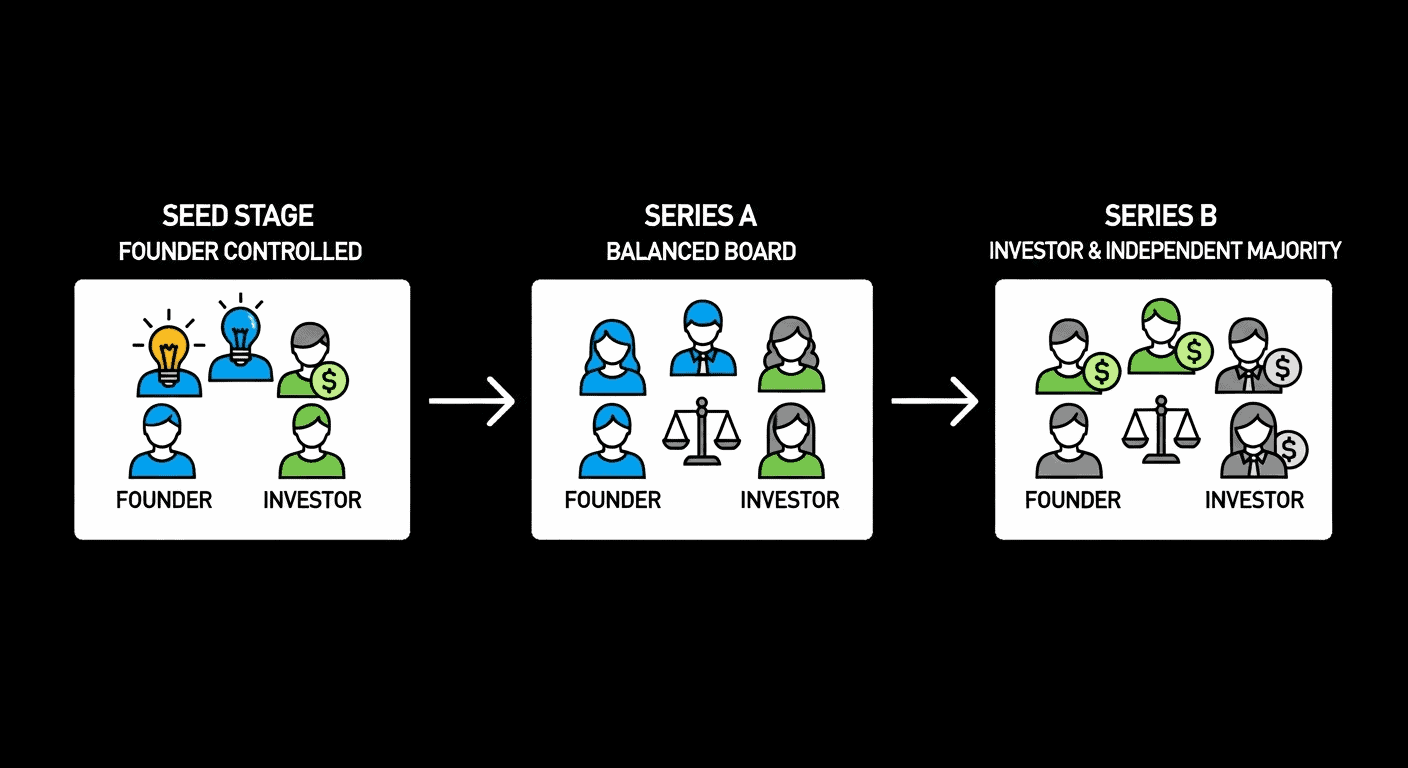
A typical startup board's composition shifts with each funding round, often moving from founder-controlled to a more balanced structure with investor and independent representation.
The initial allocation of board seats is arguably the most significant governance decision a startup will make. It sets the precedent for how power and influence will be distributed as the company matures and attracts external capital. This isn't simply about who gets a seat at the table; it's about who influences the direction of the company, how quickly decisions are made, and what risks the company is willing to take.
For founders, retaining sufficient representation is vital for preserving their vision and operational agility. For investors, securing representation is crucial for safeguarding their capital and ensuring a return on investment. Getting this allocation right from the outset lays a robust foundation for future funding rounds and strategic partnerships, while an imbalanced allocation can sow the seeds of conflict and stagnation.
Understanding the Core Players and Their Board Seat Stakes
The landscape of startup board seats is typically populated by several key stakeholders, each with distinct interests and contributions. Understanding these roles is fundamental to negotiating an effective board composition.
Startup Founders: Retaining Vision and Control
Founders are the architects of the startup, driven by an original vision and a deep commitment to its success. They typically hold the initial majority of board seats, reflecting their ownership stake and operational leadership. Their primary interest lies in steering the company according to their original mission, driving innovation, and maintaining the agility required in the fast-paced startup environment.
While founders are responsible for execution, their continued presence on the board is essential for translating vision into reality. However, as the company grows and seeks external capital, founders must navigate the delicate balance between retaining influence and accommodating the governance requirements of new investors. Their role on the board of directors is to champion the long-term vision while ensuring operational excellence and effective management team execution.
Investors: Capital, Expertise, and Influence
Investors, particularly venture capital firms and angel investors, provide essential capital that fuels a startup's growth. In return for their investment, they typically seek representation on the board of directors through designated board seats. Their stake goes beyond financial returns; they bring invaluable industry expertise, strategic guidance, extensive networks, and a critical oversight function.
Investors are motivated by maximizing the value of their investment and ensuring a profitable exit. Their presence on the board helps ensure sound financial management, strategic alignment, and adherence to compliance standards. For instance, US venture capital investment reached about $209 billion in 2024, up from about $162.2 billion in 2023, a testament to the significant capital influx startups seek. This capital infusion inherently brings with it a demand for governance structures that protect their interests.
Independent Directors: The Strategic Catalysts
Independent directors are individuals who have no significant financial or personal ties to the company, its founders, or its major shareholders. Their value lies in their objectivity, impartiality, and diverse range of skills and experiences that may not be present within the core management team or investor group.
These board members bring a fresh perspective, challenge assumptions, and provide unbiased counsel, which is particularly crucial for robust governance. They can offer expertise in areas like finance, marketing, technology, or regulatory affairs, and play a vital role in risk oversight and strategic planning. As companies mature, the inclusion of independent directors becomes increasingly important for ensuring accountability and sophisticated decision-making.
The Management Team and Key Executives: Operational Alignment
While not always holding formal board seats themselves, the management team and its key executives are central to the functioning of any startup. The board of directors is responsible for appointing, evaluating, and, if necessary, replacing the CEO and other senior executives.
The composition of the board directly influences the management team's mandate, accountability, and strategic direction. A board with a strong understanding of the operational realities can provide more effective guidance and support to the executive team, fostering alignment between strategy and execution. Conversely, a disconnect between the board and management can lead to strategic missteps and operational inefficiencies.
The Power Dynamics of Seat Allocation: Impact on Control and Strategy
The allocation of board seats is a continuous negotiation, especially as a startup navigates different funding rounds. This distribution of power profoundly impacts the company's direction and its ability to adapt.
Balancing Founder Vision with Investor Imperatives
A core tension in startup governance arises from balancing the founders' entrepreneurial vision with the investors' imperative to maximize returns. Founders typically aim to retain majority control to ensure their vision is executed without undue compromise. Investors, however, require sufficient representation to protect their capital and ensure strategic oversight.
This balance is often achieved through negotiation. During the early stages, before the second VC financing round, entrepreneurs typically control startup boards, but over the life cycle, control shifts to VCs, with most board seats held by investors by the fourth round of financing. Early-stage capital might grant investors one seat, while later rounds, like Series A or Series B, might demand more, influencing the overall Board Composition.
Pro tip: To learn more about how investors think about board control, see our complete guide on Negotiating Board Control in Term Sheets.
The Tie-Breaking Vote: A Critical Consideration
The size of the board of directors and the number of seats allocated to each group are critical. A common practice is to ensure an odd number of board members to avoid deadlocks. If a board has an even number of seats and a decision results in a split vote, it can paralyze progress. For instance, in a three-person board (two founders, one investor), the investor might find themselves in a pivotal position.
However, as more capital is injected, boards often grow. As more rounds are raised, boards often grow to 5 members (founders, investors, plus an independent seat) to maintain an odd number for voting. The distribution of these seats, especially around the tie-breaking vote, significantly influences who ultimately drives key decisions.
Influence on Strategic Decision-Making and Risk Appetite
The composition of the board of directors directly shapes the startup's strategy and its appetite for risk. A board dominated by founders might be more inclined to take bold, innovative risks, aligning with an entrepreneurial spirit. Conversely, a board with significant investor representation, especially from more risk-averse venture capital firms or institutional investors, might favor a more conservative approach, prioritizing stability and predictable growth.
This dynamic is crucial for navigating challenging market conditions and for long-term success. The skills and experiences of board members also play a significant role; for example, only 32% of executives say their boards are equipped with the right mix of skills and expertise. This highlights the need for careful selection beyond just stakeholder representation.
Implications for Fundraising and Future Capital Rounds
The way board seats are allocated has a direct impact on a startup's ability to secure future funding. A well-structured board, demonstrating good governance and a balanced representation of founder vision and investor oversight, can be a strong selling point to potential investors. If early funding rounds resulted in an imbalanced board that stifled growth or created conflict, it can deter subsequent investors. Conversely, a board that has proven its ability to guide the company strategically and deliver returns can attract significant interest. Venture capital firms look for evidence of strong governance, and a thoughtfully composed board signals maturity and a commitment to best practices, making the company a more attractive prospect for further capital infusion.
Board Seat Allocation Across the Startup Lifecycle: From Seed to Exit
The ideal Board Composition for a startup is not static; it evolves significantly as the company progresses through its lifecycle and secures different rounds of funding. Each stage presents unique governance challenges and opportunities.
Seed Stage: Setting the Initial Foundation
In the seed stage, startups are typically lean, often comprising a small group of founders. If the team elects to establish a formal board of directors at this stage, it usually consists solely of the founders, possibly with an advisor or two. The focus is on validating the business idea, building a minimal viable product, and securing initial seed funding. The primary objective of board representation here is to ensure that the founders can operate with maximum agility and retain full control over their vision. Governance is informal, with decisions made rapidly, often in board meetings attended only by the founding team. The core concern is execution and survival.
Pro tip: Most startups do not establish a formal board of directors until their first priced equity financing round (often a Series A). Some Seed investors may request that the startup form a formal board of directors as part of the Seed financing, particularly when the VC is investing a significant amount of capital (typically $1 million or more).
Series A & B: Scaling the Board with Capital Influx
Upon raising Series A or subsequent rounds like Series B, the startup's growth trajectory accelerates, and the need for formal governance becomes more pronounced. Investors, particularly venture capital firms, will require board seats as a condition of their investment.
A typical Series A round might result in a board of three: two seats for founders and one for the lead investor. As the company grows and secures more capital, the board expands. For example, a Series B round might see the board grow to five members, often including founders, investor representatives, and potentially the first independent director. This stage is critical for establishing more structured processes and aligning the management team with the strategic objectives driven by the expanded investor base.
Growth Stage: Integrating Independent Expertise for Maturity
As a startup enters its growth stage, transitioning towards maturity, the importance of independent directors escalates. The board composition typically expands further, often to seven or more members. This is when seasoned professionals with diverse expertise, who are not directly tied to the company's founders or current investors, are brought on board. Their role is to provide objective oversight, guide the company through complex challenges, and prepare it for future milestones, such as an eventual exit or IPO.
Only 32% of executives say their boards are equipped with the right mix of skills and expertise, underscoring the strategic imperative to recruit independent directors who bring specific, needed competencies. This stage also sees a greater emphasis on compliance and formalized board meetings with detailed agendas and minutes.
Anticipating Future Stages and Exit Strategy
Thoughtful board seat allocation is also about future-proofing the company and planning for an eventual exit, whether through an acquisition or an Initial Public Offering (IPO). As a startup approaches these critical junctures, the board composition may need to shift again.
For an IPO, a public company's board is typically expected to have a majority of independent directors, adhere to strict regulatory requirements, and possess expertise in areas like audit committees and executive compensation. Therefore, building a board with a strategic long-term view, including seats that can accommodate future independent expertise, is essential. This proactive approach ensures that the company is well-governed and attractive to public markets or potential acquirers, maximizing shareholder value.
Crafting a Strategic Board: Beyond Just Filling Seats
Building an effective board of directors involves more than simply assigning board seats based on ownership or investment size. It requires a deliberate and strategic approach to Board Composition aimed at achieving specific organizational goals.
Proactive Allocation for Specific Strategic Goals
Instead of reacting to funding rounds, founders and early investors should proactively consider what strategic objectives the company needs to achieve and design the board accordingly. If the startup aims to disrupt a highly regulated industry, seats might be allocated to individuals with deep regulatory or compliance expertise. If the goal is rapid international expansion, board members with global market experience are invaluable. This proactive allocation ensures that the board possesses the right blend of skills and perspectives to support the company's ambitious strategy from the outset.
Leveraging Independent Directors for Innovation and Unbiased Oversight
Independent directors are not just placeholders for objectivity; they can be powerful drivers of innovation and strategic growth. Their external perspective can challenge conventional thinking, spark new ideas, and identify blind spots within the management team or investor group. They can act as neutral arbiters in potential conflicts and provide valuable guidance on emerging trends, technological advancements, and competitive landscapes. By deliberately recruiting individuals with a proven track record in areas like R&D, marketing innovation, or digital transformation, a startup can harness their expertise to foster a culture of continuous improvement and competitive advantage.
The Importance of Diversity in Board Composition
Diversity, in its broadest sense, is a critical component of an effective board of directors. This extends beyond gender and ethnicity to include diversity of thought, experience, background, and perspective. The most effective boards today also prioritise diversity of thought, neurodiversity, disability inclusion, and socioeconomic diversity. Diverse boards are more likely to challenge assumptions, consider a wider range of options, and make more robust decisions.
Although the overall number of women on Russell 3000 boards increased slightly in 2025 to 30.6%, the number of gender diverse, first-year appointments at Russell 3000 companies decreased from 35% in 2024 to 28.4%. This underscores the ongoing need for intentional efforts to build truly diverse boards.
Defining Roles and Responsibilities with a Board Charter
A well-defined Board Charter is an essential tool for ensuring clarity and accountability within the board of directors. This document outlines the board's mandate, its responsibilities, committees (if any), and the expected conduct of board members. It serves as a foundational agreement, establishing how the board will operate, how decisions will be made, and how conflicts will be resolved.
A clear charter helps to manage expectations, prevent misunderstandings, and ensure that all members, whether founders, investors, or independent directors, understand their roles and how they contribute to the overall strategy and governance of the startup.
Navigating the Trade-Offs and Avoiding Common Pitfalls
The process of allocating board seats is rarely without challenges. Founders and investors must navigate complex trade-offs and be aware of common pitfalls that can undermine effective governance.
The Cost of "Free" Capital: Giving Up Too Much Control
While external capital is essential for growth, founders must be acutely aware of the price of that funding, which often includes a dilution of control through the allocation of board seats. The allure of significant venture capital can sometimes lead founders to cede more board representation than is strategically wise, potentially compromising their long-term vision or agility. It's a delicate balance; too much control can hinder growth by limiting access to capital, while too little can lead to a loss of strategic direction and founder burnout.
Founder Dilution vs. Strategic Value Creation
The concept of founder dilution is often discussed purely in terms of equity percentage. However, dilution of board seats represents a more immediate and potent loss of strategic influence. While investors bring valuable capital and expertise, an over-allocation of seats to investors can lead to a situation where the founders' original vision is no longer the primary driver of decisions. The key is to ensure that any dilution of founder control on the board is directly commensurate with the strategic value and capital provided, and that the new board composition actively contributes to value creation rather than solely serving investor interests.
The Challenge of Board Onboarding and Effectiveness
A common pitfall is assuming that once board seats are allocated, the work is done. The effectiveness of a board of directors hinges on the ability of its members to collaborate, contribute meaningfully, and understand the company's business. New board members, particularly independent directors, require a robust onboarding process to familiarize themselves with the startup's operations, strategy, and culture. Without proper onboarding, their contributions may be superficial, or worse, misinformed, diminishing the board's overall effectiveness. Efficient board meetings, clear communication, and regular performance reviews are essential for sustained effectiveness.
Avoiding Board Dysfunction: Clear Expectations and Communication
Board dysfunction can arise from a lack of clear expectations, poor communication, or unresolved conflicts between founders and investors. When board members do not understand their roles, or when disagreements are not addressed constructively, it can lead to paralysis, mistrust, and detrimental decisions.
Establishing clear communication protocols, fostering an environment of open dialogue, and having mechanisms for conflict resolution are vital. A well-drafted Board Charter and regular, productive board meetings where all members feel heard and respected are crucial for preventing dysfunction and ensuring the board functions as a cohesive unit driving strategy.
The Long-Term Impact: How Board Seat Choices Shape Company Culture and Success
The decisions made regarding board seat allocation extend far beyond the boardroom, significantly influencing the startup's culture, operational ethos, and ultimate success. A thoughtfully constructed board of directors can foster a culture of transparency, accountability, and innovation, which permeates throughout the entire organization.
The principles of good governance championed at the board level often translate into how the management team leads and how employees are treated. A board that prioritizes ethical conduct and compliance sets a strong precedent. Conversely, a board marked by internal conflict or a lack of strategic direction can create an environment of uncertainty and instability.
The selection of board members who embody the desired company values also reinforces the cultural DNA of the startup. For example, a board that champions diversity and inclusion will naturally encourage these practices throughout the company. Ultimately, the long-term impact of strategic board seat allocation is the creation of a resilient, adaptable, and ethically grounded organization poised for sustained growth and the creation of enduring shareholder value.
Summary: How Board Seat Allocation Shapes Your Company's Future
The allocation of board seats is a foundational act of governance that profoundly shapes a startup's destiny. It is far more than a negotiation over representation; it is a strategic decision that dictates the balance of power, influences strategy, and determines the effectiveness of oversight. From the initial dominance of founders in the seed stage to the integration of investors and independent directors as the company scales, each shift in board composition carries significant implications.
Founders must approach this process with foresight, understanding the unique contributions and motivations of each stakeholder. The goal should not be to maximize personal control at all costs, but to assemble a board of directors that provides the optimal blend of vision, expertise, and accountability. This means being deliberate about the skills brought by independent directors, understanding the true cost of external capital beyond equity dilution, and proactively designing the board to support specific strategic objectives.
As startups continue to attract significant capital – US venture capital investment reached about $209 billion in 2024, up from about $162.2 billion in 2023 – the need for robust governance and well-structured boards becomes paramount. A strong board not only safeguards investor interests but also empowers the management team to execute its vision effectively, fosters innovation, and ensures the company is prepared for future challenges and opportunities, including successful fundraising and eventual exit strategies.
Ultimately, by strategically crafting their board seats, founders can build a more resilient company, one that is better equipped to navigate the complexities of the market, attract further funding, and achieve sustainable long-term success. The future of your startup is, in no small part, determined by the composition of its board.
Frequently Asked Questions
General Board Governance Questions
What is the ideal board size for startups at different stages?
Board size typically evolves with your startup's lifecycle. In the friends and family stage, you may not have a formal board at all. After your first institutional round, a three-person board is common (two founders, one investor). As you progress through Series A, B, and Series C funding, boards often expand to five or seven members to maintain an odd number for voting purposes. The optimal board structure balances diverse expertise with efficient decision-making—larger boards provide more perspectives but can slow down execution, which is critical during the product development phase.
How do startup boards differ from public firms in terms of governance?
Startup boards operate with significantly more flexibility than public firms. While public companies must adhere to strict regulatory frameworks and compliance requirements including mandatory independent directors, audit committees, and detailed financial reporting standards, startups can tailor their board structures to their specific needs. Public firms face extensive financial regulations and regulatory compliance obligations that don't typically apply to early-stage companies. However, as startups approach IPO, they must transition toward these more formal governance policies and corporate governance standards that characterize the corporate environment of public markets.
What role does a company secretary or virtual company secretaries play in startup governance?
A company secretary ensures proper governance policies are followed, manages meeting preparation, maintains corporate records, handles action item tracking, and ensures regulatory compliance. Many startups now use virtual company secretaries or board management software to handle these administrative functions cost-effectively. They're essential for security and confidentiality of board materials, coordinating board meetings, and ensuring legal and compliance issues are properly documented—particularly important as compliance requirements increase with company growth.
Board Composition and Structure
When should startups add independent board members, and what value do they bring?
Independent corporate directors should typically be added around Series A or B, once you've achieved some product-market fit and are scaling. These board members bring unbiased oversight, specialized expertise in areas like financial oversight, risk management, or market expansion, and can serve as neutral arbiters between founders and venture capitalists. They're particularly valuable for director recruitment, evaluating executive compensation proposals, and providing guidance on industry trends and emerging technologies. Companies backed by Y Combinator and similar accelerators often add independent directors earlier to strengthen their corporate governance and attract subsequent investors' expertise.
How should founders think about board control versus bringing in investors?
Board control is a delicate balance between maintaining your vision and accessing capital and expertise that drives startup growth. During investment negotiations, founders should focus on board effectiveness rather than absolute control. Early-stage investors typically receive one seat initially, but board control often shifts to venture capitalists by the fourth funding round. The key is ensuring any loss of control is proportional to the strategic value provided. Consider whether the investment relationship and investors' expertise in areas like go to market strategy, financial performance, and business relationships justify the board representation requested.
Should boards have independent Chairs, and when?
Independent Chairs are more common in public firms and later-stage companies. Most startups have the founder-CEO serve as board chair initially to maintain decision-making speed. However, as you approach IPO or if there are conflicts between management and investors requiring neutral mediation, appointing an independent Chair can improve board effectiveness. This governance structure helps separate oversight from execution and can strengthen corporate governance, particularly when managing complex issues around executive compensation, performance evaluations, or strategic direction.
Financial and Operational Oversight
What financial oversight responsibilities do board members have?
Board members are responsible for:
Overseeing financial performance
Reviewing financial reporting
Approving budgets and major expenditures
Monitoring cash flow and cash flow management
Ensuring sound financial habits.
They must understand key metrics like revenue/ARR, valuation trends, and market capitalization (for later-stage companies). The board also oversees risk management related to finances, approves investment decision-making, and ensures proper controls are in place. This financial oversight extends to monitoring the interests of all stakeholders including shareholders and debtholders.
How involved should startup boards be in business strategy and go to market strategy?
Boards should set high-level business strategy while allowing the management team to execute tactics. Their role includes challenging assumptions, approving major strategic pivots, evaluating product-market fit, and providing guidance on market expansion based on industry trends and market forces. Board members—especially those with startup investment experience or who are market practitioners—can offer valuable perspectives on go to market strategy, branding, and adapting to emerging technologies. However, micromanaging operational details undermines the management team and slows execution.
What role does the board play in risk management and compliance?
The board is ultimately responsible for risk management across the organization, including legal and compliance issues, regulatory compliance, and adherence to relevant regulatory frameworks. This includes overseeing security and confidentiality measures, ensuring ethical practices, monitoring compliance requirements in your industry, and reviewing financial regulations that apply to your business. As companies scale, boards often establish committees focused specifically on audit and compliance, particularly important for maintaining financial reporting standards and preparing for eventual transition to public company status.
Investor Relations and Fundraising
How does board structure impact fundraising timelines and future investment rounds?
A well-structured board with strong corporate governance signals maturity to potential investors, which can accelerate fundraising timelines. Investors evaluate board composition as evidence of sound investment management and oversight. A dysfunctional board or one that lacks relevant expertise can deter investment. Conversely, a board with respected investors' expertise, diverse skills, and proven ability to guide company performance attracts early-stage investors and later-stage venture capitalists. Your board structures should demonstrate you've built governance that can scale from current stage through Series C and beyond.
What should founders negotiate regarding board seats during investment negotiations?
Beyond the number of seats, negotiate observer rights, voting provisions, board size constraints for future rounds, and protective provisions that require board approval. Clarify the investment relationship expectations: Will the investor actively contribute to business strategy, provide access to business relationships, or mainly provide financial oversight? Discuss how the board structure will evolve in future rounds and whether there's alignment on adding independent directors. Understanding the long-term orientation and long-term time horizon of your investors helps ensure board composition supports sustainable startup growth rather than short-term exits.
How do venture capitalists typically approach board participation?
Venture capitalists view board participation as essential to investment management and protecting their startup investment. They typically designate specific partners to serve as board representatives who bring domain expertise, pattern recognition from portfolio companies, and strategic networks. VCs often push for governance policies that enable proper financial oversight and risk management. Successful VC board members balance oversight with support—they challenge management constructively, assist with director recruitment, facilitate introductions, and help navigate market forces while respecting the founder-CEO's operational authority.
Board Operations and Effectiveness
What tools and processes improve board effectiveness?
Board management software centralizes documents, streamlines meeting preparation, tracks action item tracking, and ensures security and confidentiality of sensitive information. Establish clear governance policies including meeting cadences (typically monthly or quarterly), standardized financial reporting formats, and defined approval thresholds. Create board committees (audit, compensation) as you scale. Regular performance evaluations of both the board collectively and individual board members help maintain effectiveness. External counsel can provide guidance on best practices for board structures and compliance requirements.
How should boards approach executive compensation and equity-based compensation?
Executive compensation should be structured to align management incentives with long-term company performance and shareholder value creation. Boards must balance competitive compensation that attracts talent against dilution concerns. Equity-based compensation is standard for startups, with grants typically tied to performance milestones, revenue/ARR targets, or valuation achievements. Independent board members should lead compensation discussions to avoid conflicts of interest. Consider the long-term time horizon—vesting schedules should encourage retention through key milestones while providing flexibility for company growth stages.
What's the role of shareholder representation beyond board seats?
While board seats provide direct governance participation, shareholder representation extends through voting rights, protective provisions, information rights, and observer seats. Major shareholders may negotiate rights to approve certain decisions even without board representation: acquisitions, additional financings, or changes to governance policies. Regular shareholder communication beyond formal board meetings—through investor updates on financial performance, company performance, and strategic initiatives—builds trust and ensures alignment even for those without direct board control.
Strategic and Cultural Impact
How does board composition influence company culture and long-term orientation?
Board members set the tone for the entire corporate environment through their emphasis on ethical practices, diversity, transparency, and accountability. A board that prioritizes long-term value creation over short-term exits encourages patient capital approaches and sustainable company growth. The expertise brought by board members—whether in emerging technologies, industry trends, or specific functional areas—shapes what the organization values and pursues. Diverse board structures that include varied perspectives foster more innovative cultures and better investment decision-making.
Can you provide examples of well-governed startups?
While specific board structures vary, companies like OpenAI and Dropbox have navigated complex governance challenges. OpenAI's board structure has evolved significantly to balance its mission-driven orientation with commercial realities and investor interests. Dropbox successfully transitioned from startup boards to public company governance, maintaining founder influence while adding independent expertise. Y Combinator companies often demonstrate best practices by adding experienced independent directors early and maintaining balanced board structures that support both founder vision and investor oversight—critical factors in their strong financial performance and successful exits.
Disclaimer: This article is provided by Allied Venture Partners LLC for informational purposes only and does not constitute legal, financial, investment, or professional advice. Governance decisions should be made in consultation with qualified legal and financial advisors. Allied Venture Partners LLC makes no warranties regarding the accuracy or completeness of this information and disclaims all liability for any damages or losses arising from reliance on this content. Individual circumstances vary, and readers should seek professional guidance specific to their situation.