Rollup Vehicles Explained: Streamlining Startup Fundraising & Cap Table Management
Key Takeaways
Rollup Vehicles (RUVs) consolidate multiple small investments into a single entity, appearing as just one line on your startup's cap table instead of dozens or hundreds of individual investor entries, dramatically simplifying equity management and reducing administrative complexity.
Startups can save tens of thousands of dollars in legal fees, cap table management costs, and ongoing administration by using RUVs instead of managing multiple direct investments—with some companies saving an average of $18,800 in setup and administrative fees.
RUVs accelerate the fundraising process by streamlining negotiations and closing procedures, allowing founders to engage primarily with the RUV's lead investor rather than managing dozens of individual conversations, freeing up valuable time for product development and growth.
Angel investors gain access to promising startups with lower minimum investments, with some platforms allowing participation for as little as $1,000 USD, while also enabling better portfolio diversification across multiple companies to mitigate risk.
A clean cap table achieved through RUVs makes your startup significantly more attractive to venture capital firms during Series A, Series B, and later funding rounds, as it reduces due diligence complexity and signals professional equity management.
RUVs simplify exit events and acquisitions by presenting a consolidated shareholder structure that accelerates deal negotiations, reduces legal costs, and eliminates the need to negotiate with dozens of individual shareholders during M&A transactions.
The RUV structure ensures regulatory compliance by centralizing KYC/AML verification and investor accreditation checks through the RUV manager, protecting both startups and investors while meeting legal requirements.
RUVs work seamlessly with flexible investment instruments like SAFEs and convertible notes, allowing startups to maintain their preferred early-stage funding structures while still benefiting from cap table consolidation.
Cross-border fundraising becomes more manageable as RUVs can navigate complex international legal, regulatory, and tax considerations, making it easier for startups to accept capital from investors in multiple countries.
RUVs are particularly valuable for seed-stage companies raising capital from friends, family, and angel investors, though they remain effective through Series A, Series B, and beyond for companies seeking to maintain equity structure clarity throughout their growth journey.
Allied Venture Partners offers a unique hybrid syndicate/RUV structure that combines traditional rollup vehicle benefits with access to a global network of over 2,000 angel investors, venture capitalists, family offices, and institutional LPs—potentially doubling or tripling the amount of capital raised beyond what founders could secure independently (while also covering the setup costs).
Introduction: Navigating the Complexities of Startup Fundraising
Navigating the intricate world of startup fundraising presents a perpetual challenge for founders. The journey from a nascent idea to a flourishing company is often paved with complex financial maneuvers, and securing the necessary capital is paramount.
However, the process can be fraught with administrative burdens, intricate legalities, and the ever-present concern of managing a clean cap table. In today's dynamic market, where venture capital investment can be volatile – with fundraising falling to a six-year low in 2024, raising $104.7 billion globally [Venture Capital Journal, 2025] – startups need innovative solutions to stand out and attract investments.
This is where Rollup Vehicles (RUVs) emerge as a transformative financial instrument, offering a streamlined approach to capital infusion and a simplified path to managing shareholder equity.
The Founder's Dilemma: Balancing Capital Needs with Administrative Burden
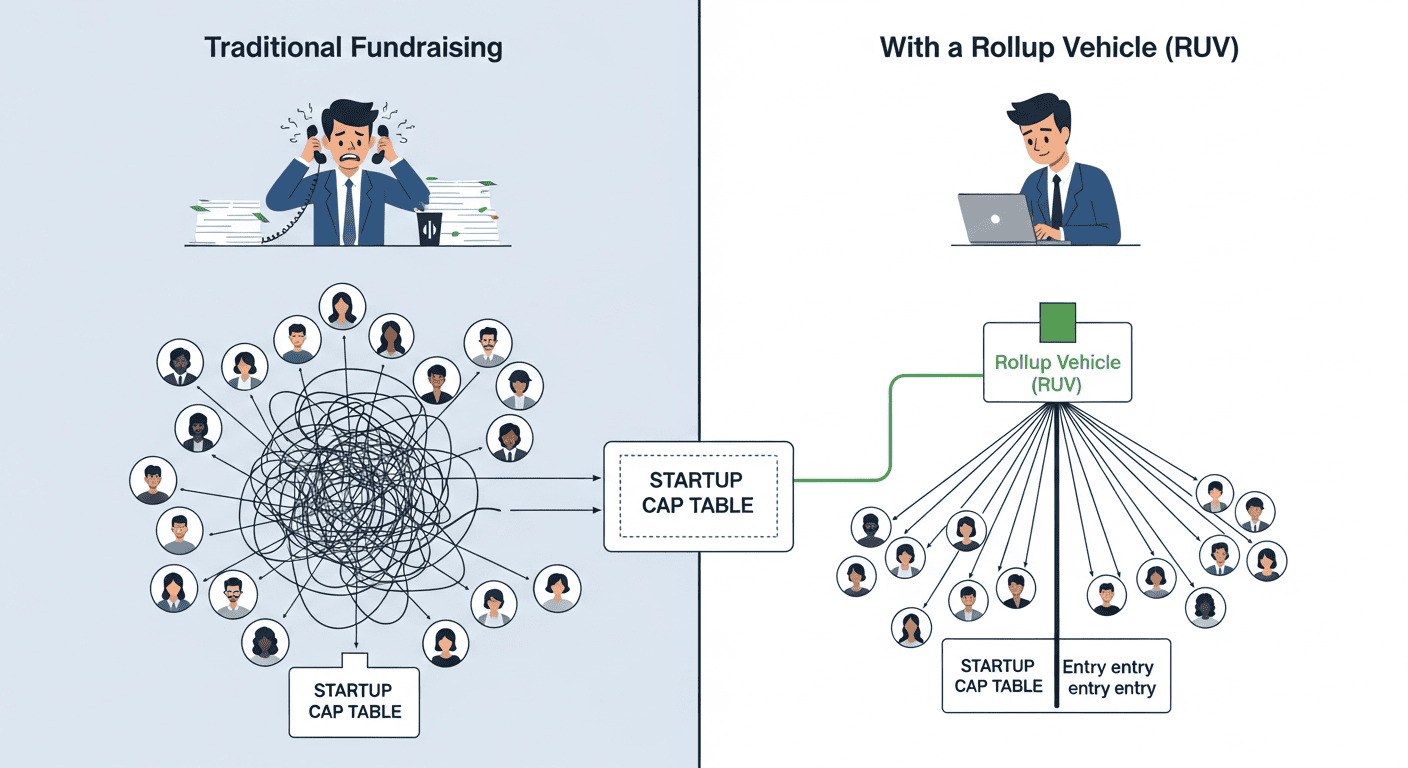
A Rollup Vehicle (RUV) consolidates numerous small investments into a single entity, dramatically simplifying a startup's cap table and reducing administrative overhead for the founder.
The entrepreneurial spirit is often defined by vision, innovation, and a relentless drive to build. Yet, the operational reality for founders frequently involves wrestling with the less glamorous, yet critically important, aspects of business management.
Securing funding is a perpetual cycle, from initial seed rounds to Series A, B, and beyond. Each funding round, while a testament to growth and potential, introduces new complexities. The administrative overhead associated with managing numerous investments can become overwhelming. This includes tracking various investor agreements, managing communications, and ensuring compliance for each individual investor. The sheer volume of paperwork and the constant need for updates can divert valuable time and resources away from core business operations, hindering product development, market expansion, and strategic planning.
Furthermore, the integrity of a startup's cap table is a crucial determinant of its future success. A cluttered, fragmented cap table with many small investments can deter larger institutional investors and complicate future fundraising rounds. It signals a lack of organizational polish and can introduce perceived risks. As many as 82% of companies that failed in 2023 did so due to ineffective financial management [Founders Forum Group, 2025], underscoring the direct link between financial health and survival. For founders, the challenge lies in balancing the immediate need for capital with the long-term imperative of maintaining a clean, manageable equity structure that positions the company favorably for sustained growth and potential exit opportunities.
What are Rollup Vehicles (RUVs)? A Snapshot of the Solution
Rollup Vehicles (RUVs), also known as Roll-Up Vehicles or Roll-up vehicles, represent an elegant solution to these multifaceted challenges. At their core, RUVs are specialized investment entities designed to consolidate multiple smaller investments into a single, larger investment from the perspective of the startup receiving the capital. Instead of a company accepting dozens or even hundreds of individual checks from angel investors and other early backers, an RUV acts as an intermediary.
This RUV pools the capital from these numerous investors and then makes a single, consolidated investment into the target startup. This mechanism fundamentally simplifies the fundraising process for founders and dramatically streamlines cap table management, creating a win-win scenario for both the company and its backers. They serve as a crucial tool in modern venture capital and startup finance, facilitating more efficient capital allocation in a competitive market.
Deconstructing the Rollup Vehicle (RUV): What It Is and How It Works
Defining the RUV: A Consolidated Investment Entity
A Rollup Vehicle (RUV) is best understood as a type of Special Purpose Vehicle (SPV). An SPV is a legal entity created for a specific, limited purpose. In the context of an RUV, that purpose is to aggregate capital from multiple investors – typically angel investors, friends and family, or other accredited individuals – for the sole objective of investing in a particular startup or a select portfolio of companies.
The RUV itself becomes an entity that holds equity or other investment instruments in the startup, thereby acting as a single investor on the startup's cap table. This consolidated entity represents the collective interests of all the underlying individuals who contributed capital to the RUV.
The Mechanics of Consolidation: One Line on the Cap Table
The most significant operational benefit of an RUV for a startup is the simplification of its cap table. Traditionally, if a company raises money from 50 different angel investors, each of those individuals would appear as a separate entry on the cap table, each with their own share class, agreement, and potential for individual communication and rights. This can quickly lead to a highly complex and unwieldy shareholder registry.
With an RUV, all 50 individual investments are bundled together. The RUV, as a single legal entity, is the only entry that appears on the startup's cap table. This means that instead of 50 separate lines, there is just one. This dramatically reduces administrative complexity, makes future fundraising easier by presenting a cleaner equity structure, and simplifies matters during liquidity events like acquisitions or IPOs. The concept of having "one line on the cap table for many investors" is the cornerstone of the RUV's appeal to founders.
Key Components: SPVs, Lead Investors, and Administrative Oversight
Several key components work in tandem to establish and operate an RUV. The Special Purpose Vehicle (SPV) is the legal wrapper that holds the investments. This entity is often structured as a limited partnership or limited liability company, depending on the jurisdiction and specific needs.
A crucial role is played by the "Lead Investor" or "Manager" of the RUV. This individual or entity typically takes responsibility for sourcing the investments, conducting due diligence on the target startup, negotiating the terms of the investment, and managing the RUV's operations. They act as the primary point of contact between the startup and the collective group of investors within the RUV. In some cases, platforms like AngelList facilitate the creation and management of these Rollup Vehicles, providing the necessary infrastructure and support.
Administrative oversight is also vital. This involves handling legal documentation, ensuring compliance with Know Your Customer (KYC) and Anti-Money Laundering (AML) regulations, managing distributions, and reporting to the underlying investors. This comprehensive structure ensures that the RUV functions efficiently and transparently, serving its purpose of consolidating investments effectively.
The Founder's Advantage: Revolutionizing Startup Fundraising
The adoption of Rollup Vehicles (RUVs) fundamentally transforms the fundraising landscape for founders, offering tangible benefits that accelerate growth and reduce operational friction.
Accelerating the Fundraising Process and Closing Rounds Faster
One of the most significant advantages of using an RUV is the dramatic acceleration of the fundraising process. Instead of managing dozens of individual conversations, negotiations, and closing processes with separate investors, founders engage primarily with the RUV's lead. This streamlined approach means fewer dotted i's and crossed t's across multiple agreements. The administrative burden is significantly reduced, allowing the startup to close rounds faster.
This speed is critical in the fast-paced startup industry, where market opportunities can be fleeting. While the overall market saw an increase in average round sizes in 2024 to $15.5 million [Carta, 2025], securing that capital efficiently remains paramount.
Expanding Your Investor Pool: Engaging More Angel and Accredited Investors
RUVs democratize access to startup investments. Many angel investors and accredited individuals may not have the capital to participate in large institutional rounds, but are keen to invest in promising companies. However, the traditional process of taking on numerous small checks can be prohibitively time-consuming for founders.
An RUV allows startups to tap into this broader pool of capital by aggregating these smaller investments into meaningful checks that the RUV’s manager then deploys. This allows companies to engage with a wider range of supporters, from friends and family to sophisticated angel investors, without bogging down their administrative resources. This is particularly relevant as platforms like AngelList continue to facilitate such structures.
Navigating Different Investment Instruments: SAFEs and Convertibles
Startups often utilize flexible investment instruments like Simple Agreements for Future Equity (SAFEs) and convertible notes during early-stage fundraising. These instruments convert into equity at a later funding round or liquidity event. An RUV can seamlessly incorporate these different investment types.
The RUV manager negotiates the terms of the SAFEs or convertibles with the startup, and the RUV itself holds these instruments. When the conversion event occurs, the RUV's holding converts into equity, and the underlying investors within the RUV then hold indirect equity interests through their stake in the RUV. This allows founders to continue using these flexible instruments while still benefiting from the single-entry simplicity of an RUV.
Significant Cost and Time Savings
The financial and temporal efficiencies offered by RUVs are substantial. By reducing the number of individual legal agreements, the associated legal fees are significantly curtailed. Instead of drafting and managing dozens of subscription agreements and shareholder documents, founders only need to handle the RUV agreement.
Furthermore, the ongoing cap table management costs, which can include specialized software and administrative personnel, are drastically reduced when there is only one entity to track. Companies can save tens of thousands of dollars on cap table costs and administration compared to accepting direct checks [AngelList]. This translates directly into more capital available for product development, marketing, and team expansion, vital for any early-stage company.
Pro tip: Startups that work with Allied Venture Partners on their rollup vehicle save an average of $18,800 in setup, legal, and administrative fees. Learn more at https://www.allied.vc/rollup.
Mastering Cap Table Management: Precision and Control with RUVs
Beyond immediate fundraising benefits, Rollup Vehicles (RUVs) empower founders with enhanced control and precision over their cap table, a critical asset for long-term success.
The Clean Cap Table: A Single Line for Many Investors
As previously highlighted, the most profound impact of an RUV on a startup's cap table is its simplification. A company that might have otherwise accumulated 50 or more individual entries for early investments can present a single, consolidated line item representing the RUV.
This "clean cap table" is highly attractive to subsequent investors, including venture capital firms. It signifies a well-organized company that has effectively managed its equity structure. This clarity reduces perceived complexity and potential friction during future fundraising rounds or merger and acquisition (M&A) discussions, making the company a more appealing prospect for larger investments.
Strategic Equity Management: Maintaining Founder Control
A common concern for founders is the potential dilution of their ownership and control. While taking investments is necessary for growth, founders aim to retain significant equity stakes. RUVs can be structured to maintain founder control. The RUV's manager typically acts on behalf of the investors, but voting rights and strategic decisions often remain with the startup's management or board. By consolidating multiple small stakes into one RUV, founders can avoid having a large number of individual shareholders who might demand disproportionate attention or exert influence in fragmented ways. The RUV's manager can act as a single point of proxy for voting, preserving the founder's ability to steer the company strategically.
Leveraging Cap Table Software for Enhanced Efficiency
Modern cap table management software plays a crucial role in maximizing the benefits of RUVs. While RUVs themselves simplify the number of entries, integrated software solutions can further enhance efficiency. These platforms can track the RUV's ownership stake, the underlying investors within the RUV, and their respective interests. This dual-layer approach ensures transparency and accuracy. For companies utilizing RUVs, leveraging sophisticated cap table software ensures that the simplified structure remains robust and easily auditable, preparing the company for future audits, fundraising rounds, and liquidity events.
Preparing for Future Rounds and Liquidity Events
A clean cap table is not just an aesthetic achievement; it's a strategic imperative for future fundraising and exit opportunities. When a company approaches its Series A or Series B fundraising rounds, institutional venture capital firms will conduct thorough due diligence, including a deep dive into the cap table. A simplified cap table achieved through RUVs reduces the time and resources required for this due diligence, making the company a more attractive candidate.
Furthermore, during M&A transactions, a consolidated shareholder structure significantly simplifies the negotiation and execution of the deal, as there are fewer parties to satisfy and fewer individual agreements to reconcile. This proactive approach to cap table management with RUVs lays a strong foundation for long-term growth and successful exits.
The Investor Perspective: Access, Diversification, and Simplified Investing
While founders are the primary beneficiaries of RUVs through simplified fundraising, investors also gain significant advantages, making these vehicles increasingly attractive in the startup investment ecosystem.
Lowering Barriers to Entry for Angel Investors and Beyond
The traditional threshold for participating in startup investments can be quite high, often requiring significant capital to make a meaningful impact and justify the due diligence effort. RUVs effectively lower these barriers. By pooling capital, RUVs can accommodate smaller check sizes from angel investors and other accredited individuals who might otherwise be priced out of direct investments. This democratization of access allows a broader range of individuals to participate in the growth of promising companies and the broader startup market. Platforms like AngelList have been instrumental in facilitating these types of investments for a wider audience.
Pro tip: At Allied Venture Partners, angel investors can participate in funding rounds with investment minimums as low as $1,000 USD. Learn more at https://www.allied.vc/investors.
Portfolio Diversification and Risk Management
For investors, RUVs offer an excellent avenue for portfolio diversification. Instead of allocating a substantial amount of capital to a single startup, an investor can contribute a smaller sum to a variety of RUVs, thereby diversifying that capital across multiple companies. This diversification helps to mitigate risk. If one startup within the RUV portfolio does not perform as expected, the impact on the individual investor's overall portfolio is cushioned by the performance of other investments. This is particularly valuable in the high-risk, high-reward environment of startup investments.
"After investing in more than 100 startup since 2012, my best piece of advice for angel investors is to take a portfolio approach. Aim for broad diversification across 30-50 companies. Angel investing is a power law game, so you need enough swings at a bat to maximize your chances of hitting a grand slam home run." – Matt Wilson, Founder and Managing Director, Allied Venture Partners
Streamlined Communication and Governance
Managing communications and understanding governance rights can be complex for individual investors in early-stage companies. An RUV simplifies this by designating a lead investor or manager who acts as the central point of contact. This lead is responsible for liaising with the startup, disseminating information, and managing any voting or governance-related matters on behalf of all the RUV's participants. This streamlined communication channel reduces the administrative burden on both the investor and the startup, ensuring a more efficient and less confusing investment experience for everyone involved.
Ensuring Compliance: KYC/AML and Investor Accreditation
RUVs also provide a structured framework for ensuring compliance with regulatory requirements. The RUV manager is responsible for verifying that all participating investors meet the necessary accreditation standards and for complying with KYC/AML regulations. This diligent screening process protects both the startup and the investors by ensuring that all participants are legally qualified to invest and that the investment process adheres to legal frameworks. This adds a layer of security and legitimacy to the investment, making it more palatable for all parties involved in the fundraising process.
Operational and Legal Mechanics: A Deeper Dive into RUV Setup and Governance
Establishing and operating a Rollup Vehicle (RUV) involves several critical operational and legal considerations that ensure its effectiveness and compliance.
Structuring the RUV: Choice of Legal Entity and Jurisdiction
The first step in setting up an RUV is determining the appropriate legal entity and jurisdiction. Common structures include Limited Partnerships (LPs) or Limited Liability Companies (LLCs). The choice often depends on the specific regulatory environment, tax implications, and the preference of the lead investor and the target startup.
For instance, an LP structure may be favored for its pass-through taxation. The jurisdiction selected for the RUV's incorporation can also influence its legal framework, reporting requirements, and tax liabilities. Many RUVs are established in jurisdictions known for their established legal precedents in investment vehicles, such as Delaware in the US or specific offshore financial centers if international investors are involved.
Governance and Management: The Role of the Lead Investor/Manager
The governance of an RUV is typically centralized around the Lead Investor or Manager. This role is pivotal. The Lead Investor is responsible for sourcing deals, conducting due diligence on companies, negotiating the terms of investments, appointing board observers or directors if applicable, and managing communications with the underlying investors. They act as fiduciaries, owing a duty of care to the RUV's participants. Clear delineation of responsibilities, decision-making processes, and fee structures for the Lead Investor is an essential component of the RUV's governing documents to ensure transparency and accountability.
Legal Documentation and Agreements
The formation and operation of an RUV require comprehensive legal documentation. Key documents include:
Operating Agreement (for LLCs) or Partnership Agreement (for LPs): This foundational document outlines the RUV's purpose, governance structure, management responsibilities, profit/loss allocation, and dissolution procedures.
Subscription Agreements: These agreements are executed by each individual investor contributing capital to the RUV, detailing their commitment, the terms of their participation, and their acknowledgement of the risks involved.
Investment Management Agreement: This agreement, often between the RUV and its manager, details the manager's fees, performance incentives, and fiduciary duties.
Term Sheets and Share Purchase Agreements: These documents outline the terms of the RUV's investment in the target startup and the legal framework for acquiring equity or other securities.
Regulatory Frameworks and Compliance Considerations
Operating an RUV necessitates adherence to various regulatory frameworks. This includes securities laws governing the offering and sale of investments to the public and private markets. Depending on the jurisdiction and the nature of the RUV's investors, compliance with regulations like the Securities Act of 1933 in the US, or similar legislation elsewhere, is crucial. Ensuring that all investors are properly accredited or qualified is a non-negotiable aspect. Furthermore, robust KYC/AML procedures must be implemented to prevent illicit activities and meet financial crime prevention standards. Failure to comply can result in significant legal penalties and reputational damage.
Potential Risks and Mitigation Strategies: The "Why Not" Perspective
While RUVs offer substantial advantages, they are not without potential risks and challenges. One significant consideration is the cost and complexity of setting up the RUV itself. Legal fees for establishing the entity and drafting agreements can be substantial, particularly for smaller fundraising rounds where the cost-to-capital ratio might be unfavorable. For example, at Allied Venture Partners, our average RUV setup cost is $11,200. However, depending on your RUV provider, setup costs can reach $30,000.
Another risk lies in potential governance disputes. Disagreements can arise between the RUV manager and the startup, or among the RUV's underlying investors regarding investment decisions or strategy. Clear governance structures and robust communication protocols are vital to mitigate this.
Investor lock-in is another factor. Investors within an RUV are typically locked into their investment for the duration of the RUV's life or until a specific liquidity event. Unlike direct equity holders who might have more immediate options, RUV participants' liquidity is tied to the RUV's structure and the exit of the underlying companies.
Finally, there's the perception of opacity. While RUVs simplify cap tables, some investors might feel a sense of distance from the actual company they are backing. To counteract this, RUV managers must prioritize transparency, providing regular, detailed updates and fostering clear communication channels with all participants. For companies considering RUVs, it's essential to weigh these potential drawbacks against the benefits and ensure the chosen RUV structure aligns with their long-term strategic goals.
Strategic Considerations: When and How to Utilize RUVs Effectively
The decision to employ a Rollup Vehicle (RUV) should be a strategic one, based on the startup's stage, funding goals, and overall business objectives. RUVs are not a one-size-fits-all solution but rather a powerful tool within a broader fundraising strategy.
RUVs in Your Fundraising Roadmap: Seed, Series A, and Beyond
RUVs are particularly well-suited for early-stage fundraising, such as seed rounds. At this stage, companies are often seeking to consolidate capital from a broad base of angel investors, friends, and family. The efficiency gained from using an RUV can be a game-changer, allowing founders to focus on product-market fit and initial growth.
They can also be highly effective for Series A rounds, especially when a company has a strong initial traction but needs to secure a larger pool of capital to scale operations. An RUV can help maintain a clean cap table as the company seeks to attract institutional venture capital.
While less common, RUVs can even be used for specific follow-on funding rounds or to facilitate employee stock option programs, though these applications require careful structuring and legal counsel. Nearly a third of seed deals on AngelList in 2024 were identified as AI companies [AngelList], highlighting a sector where rapid capital infusion is often needed, making RUVs a relevant tool.
RUVs vs. Syndicates vs. Direct Investments: A Comparative Analysis
Understanding the distinctions between RUVs, syndicates, and direct investments is crucial for strategic decision-making.
Direct Investments: The traditional method where investors commit capital directly to a company. This offers maximum control and transparency for the investor but creates significant administrative burden for the startup with many individual shareholders.
Syndicates: Often facilitated by platforms like AngelList, syndicates allow a lead investor to pool money from other investors to invest in a specific deal. While similar to RUVs in pooling capital, syndicates are often deal-specific and may not always create a permanent consolidated entity on the cap table in the same way an RUV does.
Rollup Vehicles (RUVs): As discussed, RUVs create a distinct legal entity that holds the investment. This entity persists, offering a more permanent consolidation on the cap table and potentially more structured governance than a typical deal-specific syndicate. RUVs aim to consolidate investments into a single line item for long-term management, whereas some syndicates might be structured more for a single funding round.
The choice depends on the company's immediate needs, long-term cap table strategy, and the desired level of investor engagement.
Choosing the Right RUV Solution or Platform
Selecting the right partner or platform to establish and manage an RUV is paramount. Several platforms, including AngelList, offer services that facilitate the creation and administration of RUVs and SPVs. These platforms provide the necessary legal infrastructure, compliance tools, and often, a network of potential lead investors. When evaluating options, founders should consider:
Track Record and Reputation: The platform's history in managing RUVs and its standing within the venture capital industry.
Cost Structure: Understanding fees for setup, ongoing management, and potential performance fees.
Technology and Tools: The sophistication of their cap table management, reporting, and communication tools.
Investor Network: The quality and reach of their network of accredited investors and fund managers.
Legal and Compliance Support: The robustness of their compliance framework and legal expertise.
By carefully evaluating these factors, founders can select a partner that aligns with their company's growth trajectory and fundraising objectives.
Pro tip: Rollup vehicles from Allied Venture Partners are a hybrid syndicate/RUV structure. We offer a traditional rollup vehicle to consolidate all investors into a single entity and combine it with our global network of over 2,000 angel investors, venture capitalists, family offices, and institutional LPs. As a result, we can potentially double or triple the amount of capital raised by the RUV – far beyond what founders could raise on their own.
Going Global: RUVs for International Fundraising and Expansion
The principles of Rollup Vehicles (RUVs) extend beyond domestic fundraising, offering solutions for companies looking to tap into the global market and for international investors seeking access to promising startups.
Cross-Border Fundraising Challenges and RUV Solutions
Cross-border fundraising introduces a complex layer of legal, regulatory, and tax considerations. Different countries have varying rules regarding securities offerings, investor accreditation, and capital repatriation. An RUV can act as a crucial intermediary to navigate these complexities. By establishing an RUV in a jurisdiction familiar with international investments and with a robust legal framework, a startup can simplify the process of accepting capital from investors located in multiple countries. The RUV manager can ensure that the investment process adheres to the regulations of both the startup's home country and the jurisdictions where the investors are based.
International Legal and Tax Implications
The tax implications of RUVs can vary significantly by jurisdiction. For instance, the tax treatment of profits, capital gains, and distributions will differ depending on the RUV's legal structure and the tax residency of both the startup and its investors. Founders and RUV managers must engage with international tax advisors to structure the RUV in a way that is tax-efficient for all parties involved.
Similarly, understanding the legal requirements for foreign investments in the target startup's country is essential. An RUV can help to standardize compliance across different national requirements, making the overall process more manageable. The UK venture capital market, for example, saw significant growth with funds raising £4bn in 2024 [BVCA, 2025], indicating a global interest in investment opportunities that RUVs can help facilitate.
Localized RUVs and Market-Specific Platforms
The effectiveness of an RUV can sometimes be enhanced by localizing its structure or leveraging market-specific platforms. In regions with developing venture capital ecosystems, specialized RUVs or syndicates may emerge to cater to local investor preferences and regulatory landscapes. Platforms that have a strong presence and understanding of particular regional markets can be invaluable in setting up and managing RUVs for companies targeting those regions or for investors within them. Understanding these nuances is key to successfully deploying RUVs in a global context.
Long-Term Impact and Exit Strategies: The Enduring Value of RUVs
The benefits of Rollup Vehicles (RUVs) extend far beyond the initial fundraising event, offering enduring value throughout a startup's lifecycle, particularly as it approaches critical milestones like future funding rounds and liquidity events.
Simplifying Future Funding Rounds and Investor Relations
As a company matures and seeks larger investments from institutional venture capital firms or private equity funds, a clean cap table becomes indispensable. RUVs provide this clarity by consolidating numerous early-stage investments into a manageable number of entities. This significantly streamlines the due diligence process for potential new investors.
Furthermore, managing communications with a single RUV entity, rather than a multitude of individual investors, simplifies ongoing investor relations. The RUV manager can serve as the primary point of contact, relaying important updates and facilitating necessary approvals, thereby freeing up the startup's management team to focus on strategic growth initiatives.
Enhancing Liquidity Events and Acquisitions
When a startup prepares for an exit through an Initial Public Offering (IPO) or acquisition, a simplified cap table dramatically accelerates and simplifies the process. In an acquisition scenario, the acquirer needs to understand the exact equity structure and negotiate with shareholders. A cap table dominated by a few RUVs is far easier and quicker to navigate than one with dozens or hundreds of individual shareholders, each potentially requiring separate legal representation and negotiation. This efficiency can lead to a smoother transaction, potentially reducing legal costs and accelerating deal closure. The market for buyouts continues to be a significant driver in private equity, accounting for 58% of capital raised in 2024 [Private Equity International, 2025], underscoring the importance of a clear equity structure for such events.
The Role of RUVs in Synergistic Growth and Strategic Partnerships
Beyond direct investment and exit scenarios, RUVs can play a role in fostering synergistic growth and strategic partnerships. By consolidating early investors, RUVs can create a more cohesive group of stakeholders who are aligned with the company's long-term vision. The RUV manager can act as a conduit for leveraging the collective expertise and network of these investors, potentially leading to valuable introductions, strategic advice, or even future investment opportunities. This creates a more engaged and supportive stakeholder base, contributing to the company's overall success and resilience in the competitive industry.
Summary: RUVs as a Pillar of Modern Startup Finance
The landscape of startup fundraising is in constant evolution, driven by the need for greater efficiency, accessibility, and streamlined management. Rollup Vehicles (RUVs) have emerged as a powerful and sophisticated solution, fundamentally reshaping how companies raise capital and manage their equity. For founders, RUVs offer a compelling pathway to accelerate fundraising, broaden their investor base, significantly reduce administrative burdens, and maintain greater control over their cap table. By consolidating multiple individual investments into a single entity, RUVs present a clean, manageable shareholder structure that is highly attractive to future investors, including venture capital firms.
From the investor's perspective, RUVs democratize access to startup investments, lowering the entry barriers for angel investors and allowing for greater portfolio diversification. They simplify the investment process through streamlined communication and governance, while also ensuring essential regulatory compliance. As the startup industry continues to grow and mature, the operational and legal mechanics of RUVs, from their structure and governance to their global applicability, offer a robust framework for managing complex capital structures.
While challenges and risks exist, a strategic approach to RUV implementation, coupled with careful selection of partners and platforms, ensures that these vehicles can be leveraged effectively across various stages of a company's lifecycle. As venture capital fundraising navigates dynamic market conditions, RUVs stand out not just as a tool for immediate capital infusion, but as a foundational element for sustainable growth, simplified future fundraising, and successful liquidity events. They represent a significant step forward in modern startup finance, benefiting both the innovative companies driving economic progress and the investors fueling their ascent.
Frequently Asked Questions (FAQ)
General Questions About RUVs
What exactly is a roll up vehicle (RUV)?
A roll up vehicle, also known as a Rollup Vehicle or RUV, is a specialized investment entity that consolidates multiple smaller investments into a single, larger investment from the perspective of the startup receiving capital. Instead of accepting dozens or hundreds of individual investor cheques, an RUV acts as an intermediary, pooling capital from numerous investors and then making one consolidated investment into the target startup. This approach is particularly valuable in today's startup economy, where maintaining a clean cap table is essential for future fundraising success.
How do roll-up vehicles differ from traditional direct investments?
Roll-up vehicles create a distinct legal entity that appears as a single line on a startup's cap table, whereas traditional direct investments result in each investor appearing as a separate shareholder entry. This consolidation vehicle structure dramatically reduces legal complexity and administrative burden for founders. While direct investments offer maximum control and transparency for individual investors, they create significant administrative overhead for startups managing numerous shareholders, making roll-up vehicles a more efficient alternative for early-stage fundraising.
What are consolidation vehicles and how do they work in practice?
Consolidation vehicles, including RUVs, are Special Purpose Vehicles (SPVs) designed specifically to aggregate capital from multiple investors for investment in startups. In practice, a lead investor or manager sources the investment opportunity, conducts due diligence, and negotiates investment terms with the target company. Individual investors then contribute capital to the consolidation vehicle, which makes a single investment on behalf of all participants. This structure is particularly effective for seed capital rounds where numerous angel investors want to participate without cluttering the startup's cap table.
Benefits and Cost Considerations
How do RUVs reduce administrative costs for startups?
RUVs significantly reduce administrative costs by consolidating multiple investor relationships into one. Instead of managing dozens of individual legal agreements, shareholder communications, and compliance requirements, founders only handle the RUV agreement. Companies can save tens of thousands of dollars on cap table costs, legal fees, and ongoing administration. This operational efficiency translates into more capital available for product development and growth initiatives, which is critical for seed stage businesses competing in today's investment landscape.
What are the typical setup costs for establishing an RUV?
RUV setup costs can vary significantly depending on the provider and complexity. At Allied Venture Partners, the average setup cost is $11,200, though depending on your provider and the involvement of law firms, costs can reach $30,000 or more. However, startups that work with experienced partners can save an average of $18,800 in setup, legal, and administrative fees compared to managing multiple direct investments. While there are upfront costs, the long-term savings in administrative costs, tax reporting, and investor communications typically far outweigh the initial investment.
Investor Considerations
What role does accreditation status play in RUV participation?
Accreditation status is critical for RUV participation, as these investment vehicles typically involve accredited investors who meet specific income or net worth thresholds. The RUV manager is responsible for verifying that all participating investors meet the necessary accreditation standards and for ensuring compliance with KYC/AML regulations. This verification process protects both the startup and investors by ensuring all participants are legally qualified to invest, which is particularly important in angel investing where regulatory compliance is paramount.
How do RUVs benefit angel investors specifically?
RUVs democratize angel investing by lowering barriers to entry. Through these structures, angel investors can participate in promising startups with smaller check sizes that might otherwise be too administratively burdensome for founders to accept directly. At Allied Venture Partners, for example, angel investors can participate with investment minimums as low as $1,000 USD. RUVs also enable better portfolio diversification, as investors can spread seed capital across multiple companies through different RUVs, mitigating risk in the high-risk, high-reward environment of early-stage investing.
Do RUV investors maintain pro rata rights in future funding rounds?
Pro rata rights for RUV investors depend on the specific investment terms negotiated between the RUV manager and the startup. In many cases, the RUV as a consolidated entity may receive pro rata rights to participate in future funding rounds, which the RUV manager can then exercise on behalf of underlying investors. However, individual investors within the RUV typically don't have direct pro rata rights themselves. This structure simplifies investor communications and decision-making for the startup while still allowing the consolidated investor group to maintain their proportional ownership through subsequent funding rounds.
Strategic and Operational Questions
How do RUVs help founders control the cap table?
RUVs enable founders to control the cap table by consolidating numerous small investments into a single shareholder entry. Instead of having 50 or more individual angel investors on the cap table, each potentially demanding attention or exerting influence, the RUV appears as one entity with a designated manager as the primary contact. This structure preserves founder control by avoiding fragmented shareholder influence while still allowing access to seed capital from a broad base of supporters. This streamlined structure is particularly attractive to venture capitalists and VC firms during due diligence for Series A and Series B rounds.
At what stage should startups consider using a consolidation vehicle?
RUVs are particularly valuable for seed stage businesses seeking to raise seed capital from multiple angel investors. They're also effective for Series A rounds when maintaining a clean cap table becomes crucial for attracting institutional investors. Some growth-stage companies use RUVs for follow-on rounds or when bringing in strategic investors from a specific market segment. The decision should align with your fundraising strategy—if you're accepting numerous small checks or want to tap into a broad investor network without cap table complexity, an RUV is an excellent solution from seed through Series B and beyond.
How do private RUVs differ from public syndicates?
Private RUVs are typically established for a specific group of investors, often through direct relationships with a lead investor or venture capital partner, while public syndicates (like those on AngelList Venture) are accessible to a broader pool of accredited investors through a digital platform. Private RUVs often offer more customized investment terms and governance structures tailored to a particular investor group, while public syndicates on platforms provide standardized processes and broader market positioning. Both serve as effective fundraising tools, but private RUVs may offer greater flexibility in structure and investor selection for particular market segments.
Compliance and Administration
What legal and regulatory requirements must RUVs comply with?
RUVs must adhere to various regulatory frameworks, including securities laws governing investment offerings. This includes compliance with regulations like the Securities Act of 1933 in the US or similar legislation in other jurisdictions. The RUV manager must verify accreditation status of all investors, implement robust KYC/AML procedures, and ensure proper tax reporting. Working with experienced law firms specializing in venture capital structures is essential to navigate this legal complexity. The RUV structure must also comply with regulations in both the startup's jurisdiction and the jurisdictions where investors are based, particularly for cross-border investments.
How does an RUV handle tax reporting and distributions?
Tax reporting in RUVs typically flows through to individual investors, as most RUVs are structured as pass-through entities like Limited Partnerships or LLCs. The RUV manager is responsible for providing tax documentation (such as K-1s in the US) to all underlying investors, detailing their share of income, gains, or losses. When distributions occur from the startup (such as during an acquisition or dividend payment), the RUV receives the distribution and then allocates it to investors based on their ownership percentage in the RUV. The specific tax treatment varies by jurisdiction, making it essential to structure the RUV with proper tax planning and professional advice from law firms experienced in venture capital structures.
Platform and Technology Questions
How do platforms like AngelList Venture facilitate RUV creation?
AngelList Venture and similar digital platforms provide comprehensive infrastructure for creating and managing RUVs. These platforms offer standardized legal documentation, compliance tools for verifying accreditation status, cap table management software, and communication systems for investor relations. They also provide access to a network of potential investors and lead managers. By leveraging these fundraising tools, startups can establish RUVs more efficiently and cost-effectively than working independently with law firms, while investors benefit from streamlined access to investment opportunities across the investment landscape.
What role does cap table software play in managing RUVs?
Modern cap table software is crucial for maximizing RUV benefits by tracking the RUV's ownership stake while maintaining visibility into underlying investors and their respective interests. These systems enable startups to conduct regular cap table reviews, prepare for future funding rounds, and maintain audit-ready records. The software provides operational efficiency by automating investor communications, managing document distribution, and facilitating conversion events when SAFE holders or convertible note holders convert to equity. This dual-layer tracking ensures transparency and accuracy while maintaining the simplified single-entry structure that makes RUVs attractive to venture capitalists.
Strategic Growth and Exit Planning
How do RUVs impact merger and acquisition strategies?
RUVs significantly streamline merger and acquisition strategies by presenting a consolidated shareholder structure. When an acquirer conducts due diligence, a cap table with a few RUVs is far easier to navigate than one with dozens of individual shareholders. This efficiency reduces legal complexity, accelerates deal closure, and can lower transaction costs. The simplified structure means fewer parties requiring separate legal representation and negotiation, making the startup more attractive to potential acquirers. This is particularly valuable as the market for buyouts continues to drive significant activity in private equity and startup consolidation scenarios.
Can RUVs be used for industry consolidation or joint ventures?
While RUVs are primarily designed for investment consolidation, their structure can be adapted for certain industry consolidation scenarios or strategic joint ventures. For example, multiple companies in a specific market segment might create an RUV-like structure to pool resources for a joint initiative while maintaining separate operations. However, true industry consolidation typically involves merger and acquisition strategies rather than investment vehicles. RUVs are more commonly used to facilitate investment in companies that may later participate in industry consolidation, providing them with the seed capital and clean cap table structure needed to pursue strategic partnerships or acquisitions themselves.
How do RUVs support participation in a fundraising accelerator program?
Many fundraising accelerator programs now integrate with RUV structures to help portfolio companies efficiently raise seed capital from their alumni networks and partner investors. When a startup in an accelerator program wants to accept investment from numerous program participants and mentors, an RUV consolidates these investments into a single cap table entry. This integration enhances the investment link between accelerator networks and startups while maintaining operational efficiency. Some accelerators even establish standing RUVs or partnerships with platforms like AngelList Venture to provide standardized fundraising tools for their cohorts, strengthening their market positioning in the competitive accelerator landscape.
Disclaimer: This article is provided for general informational and educational purposes only and does not constitute legal, financial, investment, tax, or professional advice of any kind. Allied Venture Partners LLC makes no representations or warranties regarding the accuracy, completeness, or currentness of this information, which is subject to change without notice. To the fullest extent permitted by law, Allied Venture Partners LLC, its affiliates, officers, directors, employees, and agents expressly disclaim all liability for any direct, indirect, incidental, consequential, special, or punitive damages arising from your use of or reliance on this content, including but not limited to any securities offerings, capital raises, regulatory compliance issues, enforcement actions, financial losses, or business damages. Securities laws are complex, fact-specific, and vary by jurisdiction. You are solely responsible for ensuring compliance with all applicable federal and state securities laws and should consult with qualified legal counsel, financial advisors, and tax professionals licensed in your jurisdiction before making any decisions or taking any actions based on this information. By accessing or using this article, you acknowledge that you have read and understood this disclaimer, assume all risks associated with your use of this information, and agree to indemnify and hold harmless Allied Venture Partners LLC from any claims arising from your use of this content.