Angel Investors AI Startup Evaluation Framework: Key Metrics for Success
Key Takeaways
A specialized evaluation framework is essential for AI investing. Traditional due diligence methods fall short when assessing AI startups, which involve complex iterative development, proprietary datasets, and emergent intellectual property. A tailored approach helps investors look beyond the hype to identify genuinely defensible opportunities.
The team is the single most important factor. The strength of the founding team — including their AI-specific technical expertise, domain knowledge, resilience, and execution track record — is the most reliable predictor of long-term success. With demand for AI professionals expected to outpace supply by 40% by end of 2026, a deep and capable team is itself a competitive advantage.
Market opportunity must be large, growing, and accessible. The best AI startups solve a genuine, pressing problem for a significant and reachable audience. Investors should rigorously assess TAM, SAM, and SOM, alongside the startup's go-to-market strategy and its ability to anticipate regulatory and market shifts.
Not all AI technology is equal — defensibility matters. Investors must distinguish between proprietary AI innovation and commodity tools. True competitive advantage comes from unique algorithms, a strong data moat, robust intellectual property, and a clear roadmap for keeping the technology relevant as the field evolves.
Business model, traction, and scalability bridge technology and returns. A compelling AI product must be paired with a sound revenue model, meaningful early customer traction, and a credible path to scaling — both technically and operationally. AI-specific KPIs like model accuracy, latency, and rate of improvement are critical supplements to traditional business metrics.
Valuation requires an AI-specific lens. AI startups command a significant premium — the median seed pre-money valuation for AI companies in 2024 was 42% higher than non-AI peers. Investors must adapt valuation frameworks accordingly, using tools like the scorecard method, Berkus Method, and SAFE structures while carefully evaluating comparables within the same niche.
AI tools can sharpen your own due diligence. Leveraging AI for deal sourcing, competitor analysis, red flag detection, and financial model review allows investors to process more information with greater speed and accuracy — but human judgment remains indispensable for assessing founder vision, team dynamics, and strategic fit.
Post-investment support is as valuable as capital. Angel investors who provide mentorship, strategic guidance, introductions, and help with future fundraising significantly increase the odds of portfolio success — particularly in the fast-moving and complex AI landscape.
Introduction: Navigating the AI Frontier as an Angel Investor
The investment landscape is undergoing a seismic shift, driven by the relentless advance of Artificial Intelligence. For angel investors, this era presents unparalleled opportunities for substantial returns, but it also demands a refined, specialized approach to due diligence. Traditional evaluation frameworks, honed for established tech sectors, often fall short when assessing the nascent, complex, and rapidly evolving world of AI startups. The sheer pace of innovation, coupled with unique technological dependencies and market dynamics, necessitates a framework that can accurately identify true potential and mitigate inherent risks.
This article provides angel investors with a comprehensive evaluation framework designed specifically for AI startups. We will dissect the critical pillars of assessment, from the foundational strength of the team and the market's receptiveness to the disruptive power of AI technology and its underlying business model. By integrating human insight with increasingly sophisticated AI-driven data analysis tools, investors can navigate the AI frontier with greater confidence, unlocking the immense potential of this transformative sector.
The AI Revolution and the Angel Opportunity
The AI revolution is not a distant future; it is here, reshaping industries, redefining possibilities, and creating entirely new markets. From natural language processing and computer vision to advanced machine learning algorithms, AI is the engine driving innovation across virtually every sector. For angel investors, this presents a unique window of opportunity. Early-stage investment in groundbreaking AI companies can yield exceptional returns, mirroring the transformative impact seen in previous technological waves.
Angel investors, with their willingness to embrace higher risk for higher reward, are uniquely positioned to fuel these nascent ventures at a critical juncture. Their capital, coupled with strategic guidance, can accelerate development, market penetration, and ultimately, the realization of AI's vast potential. The sheer scale of disruption promised by AI means that the startups that successfully harness its power are poised for exponential growth, making this a prime sector for discerning investors.
Why a Specialized AI Startup Evaluation Framework is Essential for Angels
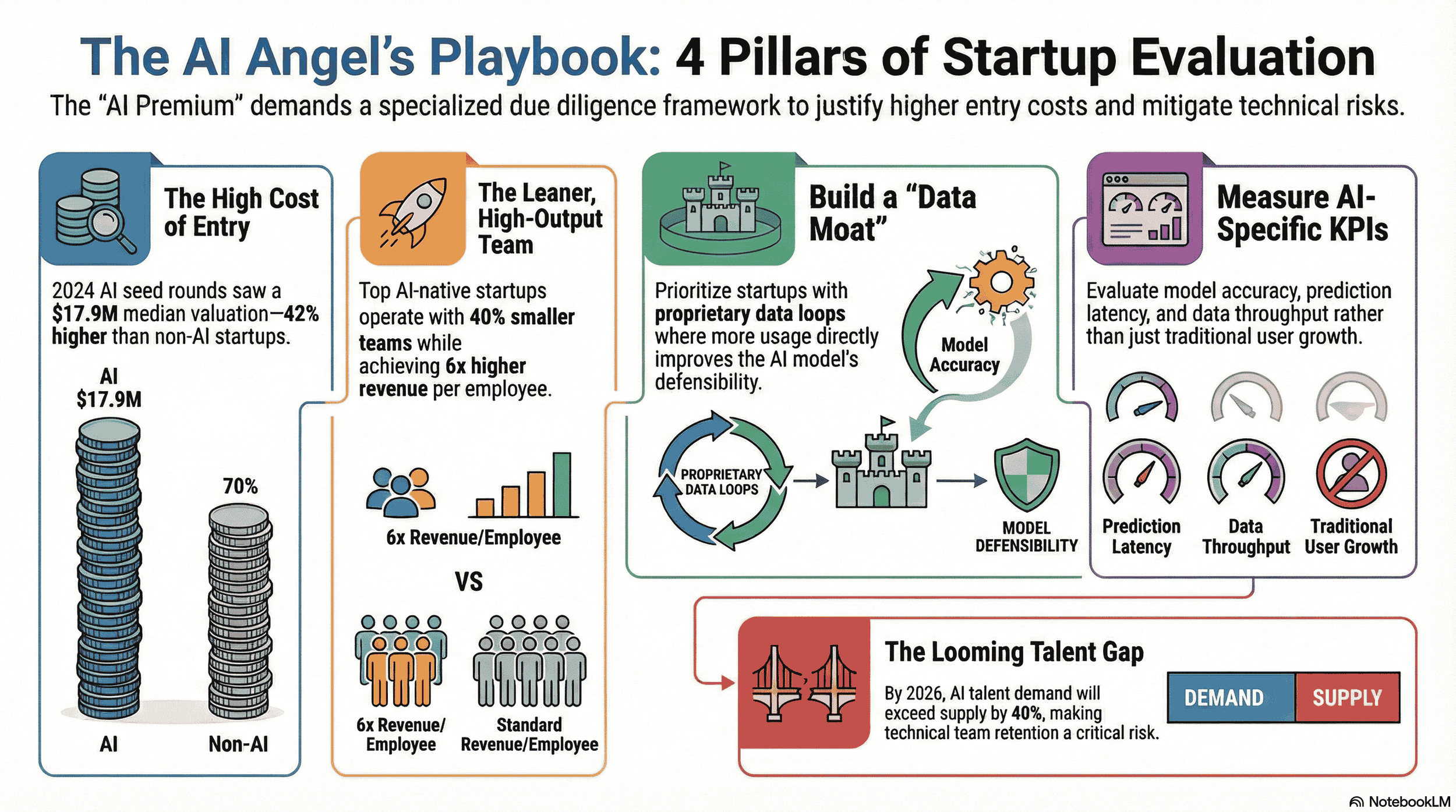
The distinct nature of AI startups renders traditional evaluation methods insufficient. Unlike conventional software or hardware companies, AI ventures often rely on complex, iterative development cycles, vast datasets for training, and emergent intellectual property. The "AI Premium" observed in recent funding rounds – where AI startups command significantly higher valuations than their non-AI counterparts – underscores this disparity. For instance, in 2024, the median pre-money valuation on seed rounds raised by AI startups was $17.9 million, a figure 42% higher than that of non-AI companies (source: Carta, 2025). This premium reflects the perceived future value and disruptive potential, but it also introduces a heightened risk of overvaluation if not properly assessed.
A specialized framework allows angel investors to look beyond surface-level metrics, delve into the core technology, assess data defensibility, and understand the nuances of AI-driven business models. It moves beyond simply asking "does it work?" to "how defensible is it, how scalable is it, and what is its true long-term impact?"
The Human-AI Synergy: Empowering Angel Investors with Data-Driven Insights
The rise of AI tools has transformed the investor's toolkit, enabling a powerful synergy between human intuition and data-driven analysis. AI can now act as an invaluable "co-pilot" for angel investors, automating repetitive tasks, processing vast datasets, and identifying patterns that might elude human observation. Tools can aid in deal sourcing by screening vast numbers of startups based on predefined criteria, enhance market and competitor analysis by processing market trends and news feeds, and even assist in flagging potential legal red flags within pitch documents and financial models.
This augmentation doesn't replace the investor's critical judgment; rather, it empowers it. By offloading the heavy lifting of data aggregation and preliminary analysis, AI allows angels to focus their invaluable human capital on strategic thinking, understanding founder vision, assessing team dynamics, and making nuanced qualitative judgments. The key lies in leveraging AI to enhance, not substitute, the fundamental art of early-stage investing, ensuring that every decision is informed by both deep qualitative insight and robust quantitative evidence.
For example, since 2022 at Allied Venture Partners, we have intentionally and continuously shifted toward becoming an AI-native venture capital firm by incorporating AI functionality into every aspect of our workflows—from deal sourcing, screening, and diligence to founder support, portfolio management, and investor communications. This AI enablement has allowed us to scale operations, see more high-quality deal flow, and better support our portfolio founders while increasing the likelihood of higher returns for LPs.
AI startup evaluation framework for angel investors covering team assessment, market opportunity, technology defensibility, valuation, and key metrics.
Understanding the Unique Landscape of AI Startup Investment
Navigating the AI investment landscape requires a nuanced understanding of its unique characteristics, which differentiate it significantly from traditional technology ventures. The rapid pace of technological advancement, the critical role of data, and the high potential for disruptive impact create a fertile ground for both exceptional returns and considerable risk. Angel investors must equip themselves with an awareness of these specific dynamics to effectively identify promising opportunities and avoid common pitfalls.
Differentiating AI from Traditional Tech Startups
While AI startups operate within the broader technology sector, they possess distinct attributes. Traditional tech startups might focus on software applications, hardware innovations, or platform development with more predictable product roadmaps and established market entry strategies.
AI startups, however, often build solutions around complex algorithms, machine learning models, and vast datasets. Their development is frequently iterative, requiring continuous refinement and adaptation based on performance and new data inputs.
Furthermore, the "intelligence" itself is often the core product or a critical differentiator, demanding specialized technical expertise in areas like neural networks, natural language processing, or computer vision. This distinction is crucial for evaluating technical feasibility, scalability, and the defensibility of the core technology.
Angel Investor Role: Higher Risk, Higher Reward, and Strategic Support
Angel investors occupy a critical position in the early-stage ecosystem, often providing the first external capital that AI startups receive. This "seed" or "pre-seed" funding comes with inherent risks; many startups will fail. However, the potential rewards for those that succeed are magnified, especially in the high-growth AI sector.
Beyond capital, angel investors bring invaluable expertise, industry connections, and mentorship. For AI startups, this strategic support is paramount. Angels can help founders navigate the complex journey of scaling technology, refining business models, recruiting specialized talent, and preparing for future venture rounds. Their experience can guide startups through the often-turbulent early phases, transforming promising ideas into sustainable businesses. This higher-risk, higher-reward profile, coupled with the opportunity for profound strategic influence, defines the angel investor's unique role in fostering AI innovation.
Pillar 1: The Visionary Team and Unmatched Domain Expertise
The foundation of any successful startup, especially in the complex field of AI, rests upon the strength of its team. While technology and market opportunity are vital, it is the founders and their collective capabilities that often determine a startup's trajectory. For angel investors, rigorously assessing the human element is not merely a formality; it is a critical determinant of long-term success.
Assessing the Management Team and Founders
When evaluating an AI startup, the caliber of the management team and founders is paramount. Angel investors should scrutinize their backgrounds, looking for a blend of technical prowess, business acumen, and a clear, compelling vision. Questions to consider include:
Do the founders possess a deep understanding of the AI technologies they are employing?
Have they successfully navigated complex challenges in previous ventures?
What is their commitment level, and how resilient are they in the face of inevitable obstacles?
Which team member is writing the code, and who is the AI specialist?
The ability to articulate a clear strategy, adapt to evolving market conditions, and inspire confidence is indispensable. The number of founders and the dynamics within the founding team are also important considerations, as are their complementary skill sets.
The Importance of AI-Specific Technical & Domain Expertise
AI is not a monolithic field; it encompasses a vast array of specialized disciplines. Therefore, assessing the team’s AI-specific technical and domain expertise is non-negotiable. A team's understanding of machine learning, neural networks, natural language processing, or other relevant AI subfields must be demonstrably deep.
Beyond pure technical skill, deep domain knowledge within the sector the startup aims to disrupt is equally crucial. For instance, an AI startup in healthcare needs founders with not only AI expertise but also a profound understanding of medical practices, regulations, and patient needs. This synergy between technical capability and industry insight allows the team to identify genuine problems, develop practical solutions, and navigate the complexities of their target market effectively.
The scarcity of top-tier AI talent also means that the quality and depth of expertise within the team become a significant competitive advantage. By the end of 2026, demand for AI experts is anticipated to exceed supply by a staggering 40%, with a projected global shortfall of nearly 1 million AI professionals (Source: UMU, 2026). This highlights the critical importance of a strong, well-rounded AI team for startups.
Founder Backstories, Resilience, and Execution Capabilities
A founder's journey is often as telling as their current capabilities. Angel investors should explore founder backstories, seeking evidence of resilience, perseverance, and a proven track record of execution.
Have they faced significant setbacks and learned from them?
Do they possess the tenacity to push through the inevitable challenges of building an AI company?
Have they demonstrated the ability to succeed in other aspects of life—whether academically, in sports, as service members, through volunteering, or in other areas?
The ability to pivot, adapt, and consistently deliver on milestones is a strong indicator of future success. At Allied VC, these are the types of founder traits we look for when deciding to invest.
Furthermore, the founding team's passion for their mission and their ability to attract and retain top talent are key qualitative indicators that investors should carefully evaluate. Their vision for the company's long-term impact and their understanding of how to achieve it are central to this assessment.
Pro tip: To learn more about our framework for assessing founders, see our complete guide How to Assess Founders During Due Diligence.
Building a Diverse and Scalable Team for AI Development
Beyond the founding team, the ability to build a diverse and scalable team is crucial for AI development and growth. AI projects often require a multidisciplinary approach, bringing together data scientists, machine learning engineers, software developers, domain experts, and business strategists. A diverse team, in terms of background, perspective, and skill sets, fosters innovation and provides a more robust approach to problem-solving.
Angel investors should look for a startup culture that encourages collaboration, continuous learning, and adaptability. The efficiency of AI-native startups is also noteworthy; between 2023 and 2024, top-performing AI-native startups operated with teams that were, on average, over 40% smaller than their peers from prior years, achieving 6x higher revenue per employee (Source: HubSpot, 2025). This suggests that a lean, highly skilled, and AI-leveraged team can be a significant competitive advantage.
Pillar 2: Market Opportunity and a Solvable, Pressing Problem
A brilliant AI technology is only valuable if it addresses a significant market need and can be effectively commercialized. Angel investors must rigorously evaluate the market opportunity, ensuring that the AI startup is solving a real, pressing problem for a sufficiently large and accessible audience. The sector and industries targeted are critical considerations in this assessment.
Identifying the Core Problem an AI Solution Addresses
The most compelling AI startups are those that identify a genuine pain point and offer a demonstrably superior solution. Angel investors should look beyond elegant algorithms to understand the fundamental problem the AI is designed to solve.
Is it a problem that affects a large number of users or businesses?
Is the current solution inadequate, inefficient, or prohibitively expensive?
A clear articulation of the problem, backed by evidence, is a prerequisite for evaluating any AI startup. The AI solution must provide a tangible benefit – increased efficiency, reduced costs, enhanced accuracy, or entirely new capabilities – that resonates with the target market. Understanding the impact of the solution on the user's workflow or business is key.
Defining the Target Market: Size, Growth, and Accessibility
A robust market opportunity is characterized by its size, growth potential, and accessibility. Angel investors need to assess the total addressable market (TAM), serviceable available market (SAM), and serviceable obtainable market (SOM) for the AI startup's solution.
Is the market large enough to support significant growth and future Venture Capital investment?
Is it a growing market, or is it stagnant?
Crucially, how accessible is this market?
Does the startup have a clear go-to-market strategy that outlines how it will reach and acquire customers within its target sector?
Understanding market trends is also vital; a startup tapping into a burgeoning industry driven by AI adoption has a higher probability of success.
Analyzing Market Signals and Competitive Landscape for AI
Evaluating the competitive landscape is essential for any investment. For AI startups, this involves not only identifying direct competitors but also understanding the broader ecosystem of existing solutions and potential future disruptions.
Angel investors should look for data-driven signals that validate the market need and the startup's potential to capture market share. This can include customer testimonials, early adoption rates, strategic partnerships, and the competitive positioning of the AI technology itself. A startup that clearly articulates its unique selling proposition and its competitive advantages – whether it's superior technology, a proprietary dataset, or a novel business model – is more attractive.
Anticipating Future Market Needs and Regulatory Impact
The AI landscape is constantly evolving, and the regulatory environment is also in flux. Angel investors must consider the startup's ability to anticipate future market needs and adapt to potential regulatory changes.
Will the AI solution remain relevant as technology advances and customer demands shift?
Are there any ethical considerations or potential regulatory hurdles that could impede adoption or scalability? For instance, concerns around data privacy, algorithmic bias, and AI explainability are becoming increasingly important.
Startups that proactively address these issues and demonstrate a commitment to responsible AI development are better positioned for long-term success and have a clearer path to broader market acceptance and avoiding issues that could stifle their impact.
Pillar 3: Disruptive AI Technology and Product Differentiation
The core of an AI startup lies in its technology. Angel investors must move beyond buzzwords to deeply evaluate the AI technologies being employed, their defensibility, and their practical application. Understanding what makes the technology proprietary, scalable, and genuinely valuable is crucial for assessing long-term viability.
Evaluating the Core AI Technology: Proprietary vs. Commodity
A critical distinction for angel investors is whether the AI technology is truly proprietary or based on readily available, commodity components. While many AI startups leverage open-source libraries, frameworks like TensorFlow or PyTorch, or pre-trained large language models (LLMs) and Generative AI models, true defensibility often comes from unique algorithms, proprietary datasets, or a novel application of existing technologies.
Investors should seek to understand the underlying innovation: Is it a unique architectural approach, a specialized data processing pipeline, or a highly optimized model tailored for a specific task? A startup relying solely on commodity AI tools without a unique differentiator faces significant competitive risks. The focus should be on the unique application and refinement of AI technologies.
Assessing Data Moats and Data Strategy
For many AI startups, data is their most valuable asset and a key source of competitive advantage, often referred to as a "data moat." Angel investors must scrutinize the startup's data strategy:
How is data collected, cleaned, labeled, and managed?
Is the data proprietary, or is it publicly available?
The quality, quantity, and uniqueness of the data used to train AI models directly impact their performance and accuracy. A startup with a defensible data moat – a continuous flow of proprietary data that improves the AI model over time, making it harder for competitors to replicate – has a significant advantage. This is particularly relevant for machine learning models that improve with more usage data.
The Strength of the Prototype and Product-Led Growth Potential
The stage of the AI product is also a key consideration. While early-stage companies may not have a fully polished product, a strong, functional prototype or Minimum Viable Product (MVP) is essential. Angel investors should assess the prototype's ability to demonstrate the core value proposition and its potential for product-led growth.
Does the product itself have the potential to drive adoption through user experience and demonstrable value, rather than relying solely on extensive sales efforts? This is particularly relevant for AI solutions like co-pilots or chat models that can offer immediate utility and a clear path to user engagement and value realization.
Technical Feasibility, Scalability, and Future-Proofing the AI Stack
Beyond the initial innovation, angel investors must evaluate the technical feasibility, scalability, and future-proofing of the AI stack.
Can the AI solution handle increasing volumes of data and users without performance degradation?
What is the underlying infrastructure, and is it cost-effective to scale?
Furthermore, AI technology is evolving at an unprecedented pace. Does the startup have a clear roadmap for updating its models, incorporating new advancements, and remaining competitive? Assessing the technical team's ability to build a robust, scalable, and adaptable AI infrastructure is critical for long-term success.
Beyond the Hype: Practical Application and User Value
It's imperative for angel investors to look beyond the hype surrounding AI and focus on practical application and tangible user value. While advanced AI concepts are exciting, the ultimate measure of success is whether the technology solves a real problem and delivers demonstrable value to its users. Are the AI applications, such as co-pilots or chat models, genuinely improving efficiency, enhancing decision-making, or creating new possibilities for the end-user? A startup that can clearly articulate and prove the practical utility and positive impact of its AI solution, rather than just its technical sophistication, is more likely to achieve sustainable market traction and customer loyalty.
Pillar 4: Business Model, Traction, and Scalability
Even the most groundbreaking AI technology requires a sound business strategy to translate innovation into sustainable value and financial returns. Angel investors must meticulously examine the startup's business model, its demonstrated traction, and its potential for scalable growth. This pillar bridges the gap between technical potential and commercial reality.
Analyzing the Revenue Model and Monetization Strategy
The viability of an AI startup hinges on its ability to generate revenue. Angel investors need to understand the proposed revenue model and monetization strategy.
Is it subscription-based (SaaS), usage-based, freemium, licensing, or a combination?
Does the model align with the value proposition of the AI solution and the willingness to pay of the target market?
A clear, well-defined, and potentially scalable revenue model is crucial. For AI solutions, pricing strategies might need to account for factors like computational costs, data processing volumes, and the level of AI sophistication delivered. Understanding how the company plans to capture value from its innovative technology is paramount. This is an integral part of assessing the overall investing opportunity.
Key Performance Indicators (KPIs) for AI Startups: Beyond Traditional Metrics
Traditional KPIs often fall short when evaluating AI startups. Angel investors need to look beyond basic metrics like user acquisition cost and customer lifetime value to incorporate AI-specific indicators. These might include:
Model accuracy
Prediction latency
Data processing throughput
User engagement with AI features
The rate of model improvement over time
Customer satisfaction with AI-driven outcomes
The ability of the startup to track and interpret these metrics effectively demonstrates a sophisticated understanding of its AI product's performance and its path to value creation. Data-driven insights are crucial here, as they inform the effectiveness of the AI and its adoption.
Customer Traction and Early Adoption (Product-Led Growth)
Demonstrated customer traction is a powerful validation of a startup's potential, and this is no different for AI startups. Angel investors should seek evidence of early adoption, customer retention, and positive feedback.
For AI solutions, product-led growth strategies can be particularly effective, where the product itself drives customer acquisition and expansion. This could manifest as users integrating AI features into their workflows, experiencing tangible benefits, and advocating for wider adoption within their organizations. Evidence of pilot programs converting into paying customers, strong engagement with AI features, and customer testimonials are invaluable indicators of market acceptance and the product's inherent value.
Scalability Potential: From Prototype to Enterprise-Grade Solution
The ultimate goal for angel investors is to back companies that can scale significantly. For AI startups, this involves assessing the scalability of both the technology and the business operations.
Can the AI infrastructure handle exponential growth in data and user demand without becoming prohibitively expensive or technically constrained?
Does the business model support scaling across geographies, customer segments, or industries?
A clear roadmap for scaling from a prototype or early-stage product to an enterprise-grade solution is essential. This often involves considerations for cloud infrastructure, data management, and the ability to adapt the AI solution to diverse client needs within a given sector. This aligns directly with venture capital expectations for high-growth potential.
Understanding Fundraising Potential and Path to Future Capital
A critical aspect of early-stage investing is the startup's potential for future funding. Angel investors provide crucial initial capital, but successful AI ventures will likely require substantial follow-on investment from venture funds and venture capitalists to achieve their ambitious goals. Angel investors should assess the startup's fundraising potential:
Does it have a clear path to securing future rounds of equity?
Are its metrics and traction strong enough to attract larger institutional investors?
Does the startup's target market have sufficient downstream investor interest, or is the company operating in an unattractive or traditionally difficult-to-fundraise sector?
A compelling narrative, demonstrable progress, and a large addressable market are key factors that influence future fundraising success. Understanding the startup's long-term capital strategy is an integral part of evaluating the overall valuation and potential return on investment.
AI-Specific Metrics for Deeper Due Diligence
Beyond the general pillars, a granular assessment of AI-specific metrics is crucial for due diligence. These metrics provide quantifiable evidence of the technology's performance, defensibility, and ethical considerations, offering deeper insights that traditional frameworks overlook.
Data Defensibility and Quality
The bedrock of most AI is data. Investors should probe the defensibility and quality of the data.
Is the data unique, proprietary, and difficult for competitors to acquire?
What is the process for data labeling, cleaning, and validation?
Poor data quality leads to poor AI performance. Metrics here could include: data accuracy rates, completeness scores, and the number of data sources. A startup that can demonstrate a robust, high-quality data pipeline has a significant advantage.
Model Performance and Efficacy
The core AI model's performance is paramount. Metrics will vary by AI type, but common considerations include:
Accuracy/Precision/Recall: For predictive models, how well does the AI perform its intended task?
Latency: How quickly does the AI provide results? This is critical for real-time applications.
Robustness: How well does the model perform under varying conditions or with noisy data?
Explainability: In certain applications (e.g., healthcare, finance), the ability to understand why an AI made a decision is crucial.
Intellectual Property (IP) and Algorithmic Moats
Angel investors should investigate the startup's intellectual property strategy and the strength of its algorithmic moats.
Does the company hold patents on its core AI technologies?
Are its algorithms truly unique and difficult to reverse-engineer or replicate?
Proprietary algorithms and a strong IP portfolio create significant barriers to entry for competitors, underpinning the startup's long-term defensibility and valuation.
Ethical AI and Responsible Development
As AI becomes more integrated into society, ethical considerations and responsible development are increasingly important. Investors should assess whether the startup has policies and processes in place to address potential biases in data and algorithms, ensure data privacy, and maintain transparency. A focus on ethical AI not only mitigates reputational and regulatory risks but also fosters trust and broader adoption, contributing positively to the company's overall impact.
Integration Capabilities and Ecosystem Compatibility
The ability of an AI solution to integrate seamlessly with existing systems and platforms is a key factor for customer adoption. Angel investors should evaluate how easily the AI can be integrated into a client's existing technology stack. Compatibility with common industry standards and APIs can significantly reduce implementation friction and accelerate adoption within target industries.
Pro tip: to learn more about our framework for analyzing a startups' competitive landscape, see our complete guide 5 Steps for Competitive Landscape Analysis.
Valuation Frameworks Tailored for Early-Stage AI Startups
Valuing early-stage AI startups presents unique challenges due to their often-pre-revenue status, rapid technological evolution, and the significant "AI premium." Angel investors must adapt traditional valuation methods or employ specialized approaches to arrive at a fair assessment.
Pro tip: to learn more about valuation, frameworks for early stage startups, see our complete guide How to Value Your Early-Stage Startup.
Adapting Scorecard Valuation for AI
The scorecard valuation method, which compares a startup to others in its industry based on key qualitative factors, can be adapted for AI. However, the scoring criteria must be weighted to emphasize AI-specific elements like the quality and depth of AI expertise on the team, the defensibility of the AI technology and data, and the clarity of the AI's impact. Traditional factors like market size and management team remain important, but their AI-relevant aspects need deeper scrutiny.
Pro tip: Learn more about startup valuation models by reading our complete guide Berkus Method vs. Other Valuation Models.
Berkus Method for Pre-Revenue AI
For pre-revenue AI startups, the Berkus Method, which assigns value based on five key elements (sound idea, prototype, quality management team, strategic relationships, and product rollout), can be a useful starting point. Angel investors can adjust the monetary values assigned to each element to reflect the higher potential and inherent risks associated with AI ventures. The emphasis on a sound idea and a quality management team aligns well with the fundamental requirements for any AI startup.
Pro tip: Try our free Berkus Method Startup Valuation Calculator.
Revenue Multiples in Nascent AI Markets
When AI startups do generate revenue, applying traditional revenue multiples requires caution. The rapid growth and speculative nature of AI markets can lead to inflated multiples. Investors should carefully analyze the growth trajectory, unit economics, and competitive positioning before applying multiples. Comparing against other AI companies within the same niche sector is often more insightful than broad market comparisons.
Valuation Caps and Discount Terms (SAFE)
Many early-stage investments, especially in the AI space, are made using instruments like SAFEs (Simple Agreement for Future Equity). Understanding the valuation caps and discount terms within these agreements is critical for angel investors. These terms define how the investor's stake will convert into equity at a future funding round, influencing their ultimate ownership percentage and potential returns. These mechanisms help mitigate the uncertainty inherent in early-stage investing.
Role of Syndicates and Co-Investors
Participating in angel syndicates or co-investing with experienced venture capitalists can provide significant advantages when valuing AI startups. Syndicates pool capital and expertise, allowing for more thorough due diligence and a shared understanding of complex AI technologies. Experienced co-investors can offer valuable insights into market valuations, technological viability, and the overall risk profile of an AI venture, helping to ensure a more informed and balanced investment decision.
Pro tip: Angel Investors can learn more about joining the Allied Venture Partners angel investor network at https://www.allied.vc/investors.
Leveraging AI Tools in Your Due Diligence (The Angel Co-Pilot)
The integration of AI tools into the angel investor's own due diligence process is no longer a novelty but a necessity. These tools can significantly enhance efficiency, deepen analysis, and provide a competitive edge in identifying promising AI startups.
Automating Deal Sourcing and Screening
AI-powered platforms can automate the laborious process of deal sourcing and initial screening. Tools can analyze vast databases like Crunchbase or LinkedIn, scan news feeds, and identify startups that align with an investor's specific criteria, such as sector, funding stage, or keywords related to AI. This allows angels to cast a wider net and focus their attention on the most relevant opportunities, optimizing dealflow management.
Enhancing Market/Competitor Analysis
AI tools excel at processing and synthesizing large volumes of market data, including industry reports, news articles, and competitor websites. This can provide angel investors with real-time insights into market trends, competitive landscapes, and emerging opportunities. Predictive models can even offer insights into future market shifts, helping investors identify companies poised for growth in evolving sectors.
Automated Red Flag Detection
Sophisticated AI algorithms can be trained to identify potential red flags in legal documents, pitch decks, and financial models. This might include inconsistencies in financial projections, unusual legal clauses, or warning signs within the language used. By automating the detection of these issues, angels can quickly prioritize startups that require deeper human review, streamlining the due diligence process.
Streamlining Pitch Deck/Financial Model Analysis
AI can assist in analyzing pitch decks for clarity, completeness, and consistency. Similarly, it can parse financial models, identify key assumptions, and even perform sensitivity analyses. While AI cannot replace a deep understanding of financial principles, it can significantly accelerate the review of these critical documents, highlighting areas that warrant further investor scrutiny.
The Balance: Trusting AI vs. Human Judgment
Crucially, the role of AI in due diligence is that of an augmentative tool – an "Angel Co-Pilot." It enhances, but does not replace, the angel investor's critical judgment, experience, and intuition. The human element remains indispensable for assessing founder vision, team dynamics, strategic fit, and the qualitative aspects of an investment opportunity. The art of successful angel investing lies in finding the optimal balance between leveraging AI-driven data insights and applying seasoned human discernment.
Pro tip: Ensure you have LLM training data disabled to avoid sharing sensitive company information.
Post-Investment: Supporting Your AI Portfolio Company
An angel investor's role extends far beyond the initial funding. For AI startups, strategic support is often as critical as capital. Angel investors can provide invaluable guidance and resources that accelerate development, mitigate risks, and position the company for future success.
Strategic Support Beyond Capital
Beyond financial investment, angels can offer a wealth of experience. This includes providing mentorship to founders, offering strategic advice on product development and go-to-market strategies, making introductions to potential customers, partners, and key talent, and assisting with future fundraising efforts. For AI startups, this strategic guidance is particularly vital in navigating the complex and rapidly changing technological and market landscape. Angels can help founders refine their vision, make critical strategic decisions, and connect with the right people and resources to scale their venture.
Pro tip: To learn more about how you as an Angel Investor can support your startup portfolio, see our complete guide How Angel Investors Support Early-Stage Startups.
Summary: Angel Investor AI Startup Evaluation Framework
The AI revolution presents a transformative landscape for angel investors, brimming with potential for significant returns. However, capitalizing on this opportunity demands a departure from traditional investment evaluation. This framework has outlined the critical pillars for assessing AI startups:
The strength of the visionary team and their domain expertise
The breadth and depth of the market opportunity
The disruptive power and defensibility of the AI technology
The robustness of the business model, traction, and scalability.
By delving into AI-specific metrics, adapting valuation approaches, and strategically leveraging AI tools for their own due diligence, angel investors can significantly enhance their ability to identify and back winning ventures.
The ultimate success of an AI startup hinges on a confluence of factors, where innovative technology meets a critical market need, driven by an exceptional team, and supported by astute investors. As AI continues to evolve, so too must the investor’s toolkit, ensuring that human insight and data-driven analysis work in synergy to navigate this dynamic frontier and unlock its profound potential. Angel investors who embrace this specialized approach are best positioned to not only mitigate risks but also to drive innovation and achieve exceptional outcomes in the age of Artificial Intelligence.
Frequently Asked Questions: Angel Investor AI Startup Evaluation Framework
What is an early stage investment framework, and why does it matter for AI startups?
An early stage investment framework is a structured methodology that guides investors through evaluating a startup's team, technology, market opportunity, and business model before committing capital. For AI startups specifically, a general framework is insufficient — you need one that accounts for the unique dynamics of machine learning models, data defensibility, and rapid technological change. The framework outlined in this article helps angel investors move beyond surface-level pitch decks to assess whether a company has genuine, lasting potential.
How does angel investment in AI startups differ from private equity or venture funds?
Angel investment typically occurs at the earliest stages — pre-seed or seed — before venture funds or private equity firms get involved. Angels provide the first external capital and often take on the highest risk in exchange for the possibility of outsized returns. Venture capitalists and private equity firms generally invest at later stages when there is more traction and de-risked technology. In the AI startup ecosystem, angel investment plays a foundational role by funding companies before they have the metrics that institutional investors require.
What valuation methods are most appropriate for early-stage AI startups?
Several approaches apply depending on the startup's stage. The scorecard valuation approach compares a startup against similar companies in the same sector, weighting AI-specific factors like team expertise and data defensibility. The Berkus Method works well for pre-revenue companies by assigning value to qualitative milestones. When a startup has revenue, investors use revenue multiples, though comparables must be drawn from within the same AI niche to avoid distorted benchmarks. Understanding both pre-money valuation and post-money valuation is essential, as these figures determine how much ownership an investor receives relative to the capital they deploy.
What is a SAFE, and how is it used in AI angel investment?
A SAFE (Simple Agreement for Future Equity) is one of the most common convertible securities used in early-stage angel investment. Rather than purchasing equity directly, the investor receives the right to convert their investment into shares at a future funding round, typically at a discount or with a valuation cap. SAFEs are popular in AI deals because they allow founders to raise capital quickly without immediately setting a fixed valuation — which can be difficult given the speculative nature of early AI companies. Investors should carefully review the details of valuation caps and discount rates before signing.
How can angel investors find AI startup deal flow?
There are several channels worth exploring. Platforms like AngelList allow investors to browse startups, participate in syndicates, and deploy capital through special purpose vehicles that pool multiple investors into a single deal. Angel Squad is another community-based option that connects investors with curated deal flow and education. Demo days hosted by accelerators are also a valuable source, as they showcase vetted early-stage companies to a room of seed investors and venture capitalists simultaneously. VC scout programs can also surface early opportunities, as scouts are often embedded in startup communities and flag promising companies before they raise formal rounds.
What AI-specific metrics should investors focus on during the investment process?
Beyond standard business metrics, the investment process for AI companies should include evaluation of model accuracy, prediction latency, data pipeline quality, and the rate of model improvement over time. Investors should also examine how the startup uses large language models or other foundation models, whether it is building proprietary technology on top of generative AI, and how autonomous agents or other advanced AI capabilities factor into the product roadmap. These technical details reveal whether the company has durable competitive advantages or is simply wrapping commodity tools in a new interface.
Why is data such a critical factor in AI startup screening?
Data is often the most defensible asset an AI company has. During AI startup screening, investors should determine whether the startup's training data is proprietary, how it is collected and maintained, and whether competitors could easily replicate it. A startup with a self-reinforcing data flywheel — where more usage generates better data, which improves the model — is significantly more defensible than one relying on publicly available datasets. This "data moat" concept is central to long-term competitive positioning.
How should investors think about the role of AI chips and infrastructure costs?
AI chips — the specialized hardware used to train and run large models — represent a significant and often underestimated cost factor. Investors should understand what compute infrastructure the startup relies on, whether it is cloud-based or proprietary, and how costs will scale with growth. A startup with an efficient, cost-effective infrastructure strategy is better positioned for sustainable unit economics than one burning through compute budget without a clear path to optimization. This is particularly relevant as models grow in complexity.
How do limited partners fit into the AI investment ecosystem?
Limited partners are the institutional or high-net-worth individuals who provide capital to venture funds and angel syndicates. While individual angel investors deploy their own capital directly, many participate in fund structures where limited partners supply the investment capital and general partners manage deployment and portfolio decisions. Understanding this structure matters for angel investors exploring co-investment opportunities or joining syndicates, as management fees and carried interest terms affect net returns for limited partners. For AI-focused funds, limited partners are increasingly paying attention to how AI capabilities are used not just in portfolio companies but in the fund's own operations.
What are the liquidity options for angel investors in AI startups?
Liquidity options in early-stage investing are limited and typically long-dated. The most common exit paths include an acquisition by a larger company, an IPO, or a secondary sale of shares. In the AI sector, acquisitions by large technology companies are frequent, particularly for startups with proprietary data or specialized models. Some angel investors also pursue secondary market transactions through platforms that facilitate the sale of private company shares before a formal exit. Investors should enter any angel investment with the expectation of a multi-year holding period and plan their portfolio accordingly.
What emerging trends should angel investors watch in the AI startup space?
Several emerging trends are reshaping AI investment sectors. The rise of generative AI has created entirely new product categories, from content creation tools to enterprise automation platforms. Autonomous agents capable of executing multi-step tasks are moving from research into commercial deployment. Domain-specific AI applications in healthcare, legal, and financial services are attracting significant capital as companies demonstrate regulatory compliance and genuine performance gains. Investors who stay current on these emerging trends — and can distinguish real breakthroughs from hype — are best positioned to identify the next generation of unicorns before the broader market recognizes their potential.
When should I request additional information from a founder during due diligence?
You should feel confident making a request for any technical, financial, or operational information that is unclear from the pitch deck or initial meetings. This includes detailed model performance benchmarks, customer contract terms, data sourcing agreements, and cap table information. Transparent founders who welcome this level of scrutiny are generally a positive signal. The goal of due diligence is not to find reasons to pass, but to build conviction — and that requires thorough information gathering, particularly when evaluating complex AI technology where surface-level claims can be difficult to verify without deeper review.
How does human judgment factor into AI-assisted due diligence?
While AI tools can automate deal sourcing, flag red flags, and synthesize market data, human judgment remains irreplaceable in early-stage investing. Assessing a founder's resilience, evaluating team dynamics, understanding the cultural fit between investor and company, and making nuanced calls about market timing all require experienced human discernment. The most effective approach treats AI as a co-pilot that enhances analytical capacity, while reserving final investment decisions for the investor's own seasoned judgment. This balance is what separates sophisticated capital raising strategies from purely algorithm-driven approaches.
How can I get involved in angel investment within the AI startup ecosystem?
There are several pathways into the startup ecosystem as an angel. Platforms like AngelList and communities like Angel Squad offer structured entry points with access to curated deal flow, syndicate participation, and educational resources. Connecting with existing seed investors, attending demo days, and joining VC scout programs can also accelerate your learning curve and deal access. For those newer to the space, co-investing alongside experienced angels or participating in special purpose vehicles is a practical way to build exposure while developing the pattern recognition needed to evaluate AI companies independently.