How to Write Tech Startup Job Descriptions That Attract Top Talent (and Avoid Bad Hires)
In the hyper-competitive world of tech startups, your most critical asset isn’t your code, your product, or your funding—it’s your people. The battle for top talent is fierce, and your first line of offense is a document that is too often treated as an afterthought: the job description.
For fast-growing companies, a poorly crafted job description isn’t just a missed opportunity; it’s a strategic liability. It fails to attract the high-impact individuals who can accelerate your growth and, worse, it actively invites mismatched candidates who can drain resources, time, and morale.
This guide moves beyond generic templates and buzzword-filled advice. It provides a strategic framework for writing tech startup job descriptions that act as both a magnet for elite talent and a filter against bad hires. We will deconstruct every component of the job description, transforming it from a passive checklist into an active, compelling extension of your company’s brand, vision, and culture.
Key Takeaways
Your job description is your first interview. It's not just a checklist—it's a strategic document that simultaneously attracts elite talent and filters out misaligned candidates before they ever apply.
Top tech talent prioritizes impact over perks. The best engineers, product managers, and sales professionals seek ownership, technical challenges, clear growth trajectories, and meaningful missions—not just competitive salaries and benefits.
Lead with "why," not just "what." Transform generic task lists into compelling narratives by connecting daily responsibilities to larger business impact. Show candidates how their work will directly influence products, customers, and company success.
Radical transparency is your filtering mechanism. Include an "Anti-JD" section that honestly describes startup realities—ambiguity, shifting priorities, building from scratch. This attracts resilient candidates while deterring those seeking highly structured environments.
Precision in language prevents misalignment. Vague descriptions attract vague candidates. Be specific about technologies, methodologies, and collaborative behaviors you require. Detail matters—it helps the right people self-select in and the wrong people self-select out.
Structure qualifications as "must-haves" and "nice-to-haves." Focus on core competencies rather than arbitrary credentials. This approach widens your talent pool while maintaining high standards and signals what candidates can grow into.
Compensation transparency saves time and builds trust. List salary ranges when possible and clearly explain your equity structure. Detail the benefits that matter most to tech professionals: flexibility, professional development, healthcare quality, and unique perks.
Optimize for discoverability with SEO best practices. Use standard job titles, incorporate relevant keywords naturally, specify location clearly, and structure content for readability. A brilliant job description is worthless if no one sees it.
Showcase authentic culture, not clichés. Move beyond generic statements and show what your values look like in practice. Include team introductions, employee quotes, and links to authentic content like blog posts or team videos.
Treat job descriptions as living documents. Continuously iterate based on data and feedback. Track application quality, gather insights from new hires and interviewers, and refine your approach for each new role you post.
The Strategic Imperative of Your Tech Startup's Job Description
Beyond a Checklist: Your Job Description as Your First Interview
Think of your job description not as a static document, but as the first, asynchronous stage of your interview process. Before a candidate ever speaks to a recruiter or hiring manager, they are interviewing your company through this text. It’s their initial glimpse into your culture, your ambition, and the significance of the position you’re trying to fill.
A generic, uninspired job description signals a generic, uninspired company. It suggests you haven't invested the time to think deeply about the role, the team, or the kind of people you need to succeed. Conversely, a thoughtful, precise, and compelling description communicates intentionality. It tells the best candidates that you value their time, respect their skills, and offer an opportunity worthy of their talent. This document is your opening pitch, setting the tone for the entire relationship.
The High Stakes of Tech Talent Acquisition: Attracting Top Performers and Filtering Out Misfits
For a startup, the cost of a bad hire is catastrophic. It’s not just the wasted salary and recruitment fees; it’s the lost productivity, the negative impact on team morale, and the critical time squandered. In an environment where every single person must contribute disproportionately to the business's success, one misaligned team member can derail a product launch or poison a collaborative culture.
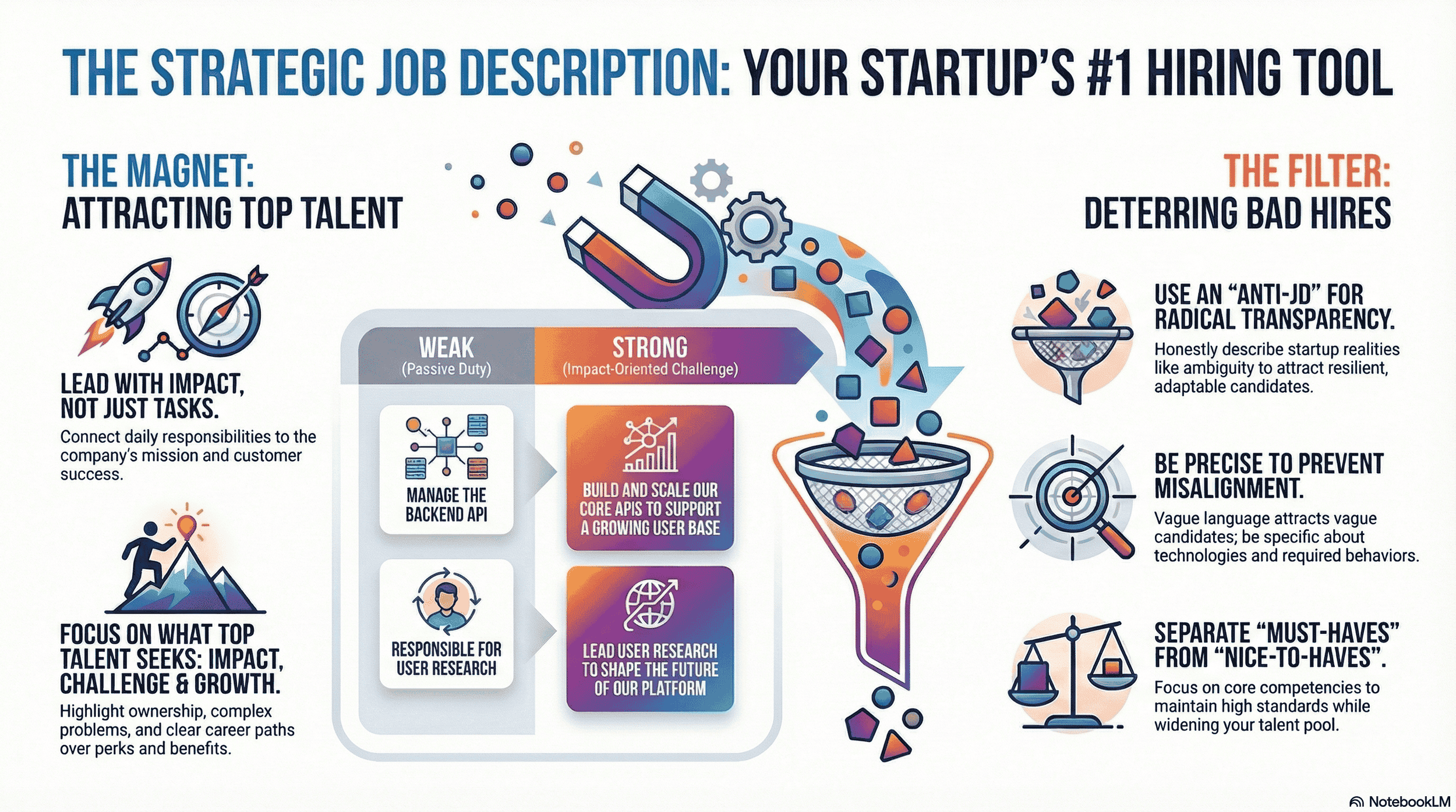
Your job description is the gatekeeper. Its primary function is twofold: to create a powerful magnetic pull for the right people and to establish an effective filter that encourages the wrong people to self-select out. Attracting top performers requires speaking their language—a language of impact, challenge, growth, and ownership. At the same time, filtering out misfits requires radical honesty about the demands of the job, the realities of a startup environment, and the specific skills required to thrive. Getting this balance right is not just a hiring function; it's a fundamental business strategy that underpins sustainable growth.
Section 1: Understanding Your Audience – What Top Tech Talent Truly Seeks
The Tech Candidate Mindset: Beyond Compensation and Perks
While competitive compensation and benefits are table stakes in the tech industry, they are rarely the primary motivators for A-plus players. The most sought-after professionals are driven by a deeper set of needs. They are builders, problem-solvers, and learners. Their career decisions are guided by a desire to work on interesting problems with smart people and to see the tangible impact of their work.
Top candidates scrutinize opportunities for several key factors:
Impact and Ownership: They want to know that their contributions will directly influence the product, the business, and the customer experience. They seek roles where they can own projects from inception to completion.
Technical Challenge: The best engineers and product minds are drawn to complex problems that push the boundaries of their skills. They want to work with modern technologies and learn from a talented team.
Growth Trajectory: A stagnant position is a career killer. They look for companies that offer clear paths for professional and personal growth, whether through mentorship, increased responsibility, or the chance to learn new domains.
Mission and Vision: Talented people want to invest their time in something they believe in. A compelling company mission can be a powerful differentiator, turning a job into a calling.
The "Why": Articulating Your Startup's Vision and Impact
Your job description must transcend a simple list of duties. It must sell the "why." Why should a brilliant engineer, who could work at any number of established firms, choose your startup? The answer lies in your vision.
Start by crisply articulating the problem your company is solving and why it matters. Frame the narrative around the impact your product has on its users, the industry, or even the world. This narrative context transforms the position from a set of tasks into a meaningful role in a larger story. Instead of saying, "You will build new features for our SaaS platform," say, "You will build the core features that help thousands of small businesses save time and compete with industry giants." This shift in framing connects the day-to-day work to a purpose-driven outcome, which is a powerful motivator for the type of candidate who thrives in a startup environment.
Section 2: Crafting the "Magnet" – Strategies to Attract Elite Tech Professionals
The Engaging Job Title and Opening Hook
The job title is your headline. It needs to be clear, conventional, and optimized for search. Avoid quirky or internal-only titles like "Code Ninja" or "Growth Hacker." Use standard industry terms like "Senior Software Engineer (React & Node.js)" or "Product Manager, B2B SaaS." This ensures your job appears in the right searches when candidates are looking for their next career move.
Your opening paragraph is the hook. It should be a concise and energetic summary of the company's mission and the role's purpose. This is your 30-second elevator pitch. It should immediately answer the candidate’s primary questions: "What does this company do?" and "Why is this position important?" Capture their attention by leading with the most exciting aspects of the opportunity—the impact they will have, the problems they will solve, or the growth they will be a part of.
Story-Driven Role Summary: Painting a Picture of Impact
The role summary should expand on the opening hook, painting a vivid picture of what success looks like in this position. Instead of a dry overview, tell a story. Describe a typical day or week, the team they’ll collaborate with, and the key challenges they will tackle. Use this section to connect their work directly to the product and business goals.
For example, rather than say, "This role is responsible for managing our marketing automation platform," try: "As our Marketing Operations Lead, you will be the architect of our customer journey. You'll own our marketing technology stack from the ground up, designing and implementing the systems that turn curious prospects into loyal advocates for our product. Your work will be the engine that powers our company's growth." This narrative approach helps the candidate visualize themselves in the role and understand its strategic importance.
Responsibilities That Challenge and Inspire
The responsibilities section is often a tedious laundry list. To make it compelling, frame each bullet point as an outcome-oriented challenge, not a passive duty. Start each line with a strong action verb (e.g., Build, Design, Own, Lead, Scale, Optimize) and focus on the impact of the task.
Weak: "Manage the backend API."
Strong: "Build and scale our core RESTful APIs, ensuring high availability and performance to support our rapidly growing mobile user base."
Weak: "Responsible for user research."
Strong: "Lead the full lifecycle of user research, translating qualitative and quantitative insights into actionable product requirements that shape the future of our platform."
This approach communicates high expectations and attracts people who are motivated by achievement, not just task completion. It clearly defines what the job entails while also inspiring the candidate with the scope of their potential contributions.
Qualifications: Focusing on Competence Over Credentials
This section is where many companies inadvertently filter out great, non-traditional candidates. Avoid creating an impossible wish list of credentials. Instead, focus on the core competencies required to succeed. A great way to structure this is to split it into two categories: "What You'll Need" and "Nice to Haves."
What You'll Need: This should be a concise list of the absolute must-have skills and experiences. Be specific about required technologies (e.g., "3+ years of professional experience with Python and Django") or necessary industry knowledge (e.g., "Deep understanding of payment processing in an e-commerce environment").
Nice to Haves: This is where you can list desirable but non-essential qualifications. It signals what skills the candidate could grow into and allows people with different but equally valuable backgrounds to feel confident applying.
Focus on demonstrable skills over arbitrary requirements like a specific degree or years of experience. This widens your talent pool and emphasizes what truly matters: the candidate’s ability to do the job.
The Compensation & Benefits Package That Speaks to Tech Talent
Transparency is key. If you can, list a competitive salary range. This practice saves time for everyone and signals that you value fairness. If you can't list a range, be explicit about your compensation philosophy.
Beyond salary, highlight the benefits that matter most to tech professionals. This includes:
Equity: For startups, this is a critical component. Briefly explain the type of equity (e.g., ISOs) and its potential for long-term value creation.
Healthcare: Clearly state the quality of your health, dental, and vision insurance offers.
Flexibility: Mention your policies on remote work, flexible hours, and paid time off. This is a major selling point in the modern work landscape.
Professional Growth: Detail your budget for conferences, courses, books, and other learning opportunities.
Other Perks: Include unique benefits like wellness stipends, parental leave policies, or team offsites.
A well-articulated benefits package shows you invest in your people's well-being and career development.
Showcasing Your Unique Tech Culture and Team
Culture is more than just ping-pong tables and free snacks. It’s about how your team works together, makes decisions, and solves problems. Use this section to give the candidate a genuine feel for your work environment.
Describe your team: Briefly introduce the team the person will be joining. Mention its size, its expertise, and its collaborative style.
Articulate your values: Don't just list words like "Integrity" and "Innovation." Explain what those values look like in practice. For example, "We value transparency, which means our roadmap, financials, and board meeting notes are open to the entire company."
Show, don't just tell: Include a link to your company's blog, a video of the team, or quotes from current employees. This provides authentic social proof and helps the candidate envision being part of your team. This is your chance to showcase what makes your startup a uniquely compelling place to work.
Section 3: Building the "Filter" – Strategies to Deter Bad Hires Early
Setting Realistic Expectations: The "Anti-JD" Section
One of the most powerful filtering techniques is radical transparency. While it's tempting to paint a perfect picture of your startup, this can attract candidates who are unprepared for the reality of early-stage business challenges. Dedicate a small section to honestly describe the less glamorous aspects of the job.
This "Anti-JD" might include statements like:
"We are an early-stage startup, which means priorities can shift quickly. You'll need to be comfortable with ambiguity and context-switching."
"This role requires building processes from scratch. If you're looking for a highly structured environment with established playbooks, this might not be the right fit."
"You'll be working on a small team, so you'll often need to wear multiple hats and contribute outside your core responsibilities."
This honesty doesn't scare away the right people; it attracts them. It signals that you trust candidates with the truth and are looking for resilient, adaptable team members who are energized by the startup journey.
Precision in Language: Filtering Out Misalignment
The words you choose have a significant filtering effect. Vague language attracts vague candidates. Be relentlessly precise in your descriptions of skills, responsibilities, and expectations.
For instance, instead of asking for a "team player," describe the specific collaborative behaviors you need. "You'll succeed here if you thrive on giving and receiving direct, constructive feedback and are comfortable pair-programming to solve tough problems."
Similarly, be specific about the technologies and methodologies you use. If your team is deeply committed to Test-Driven Development (TDD), state it explicitly in the qualifications. A candidate who dislikes TDD will self-select out, saving everyone time. This level of detail ensures that you attract people who not only have the right skills but also align with your team's specific ways of working.
Red Flag Indicators: What to Avoid in Your Own JD
Just as you look for red flags in a candidate’s resume, candidates look for them in your job description. Avoid these common pitfalls that can deter top talent:
Exaggerated Superlatives: Using terms like "rockstar," "ninja," or "guru" can come across as unprofessional and may signal a culture of burnout.
Unrealistic "Must-Haves": A list of ten different programming languages for a junior role or demanding 5 years of experience with a technology that is only 3 years old shows a disconnect from reality.
Vague Cultural Clichés: Phrases like "work hard, play hard" or "we're a family" can be red flags for poor work-life balance and a lack of professional boundaries.
Focus on Perks Over Substance: If your job description spends more time talking about the free lunch than the technical challenges, serious candidates will question the substance of the role.
Your job description is a reflection of your company. By avoiding these red flags, you signal professionalism, realism, and a focus on what truly matters: building a great product and a great business.
Section 4: Optimizing Your JD for Discoverability and Candidate Experience
SEO Best Practices for Tech Job Boards and Your Company Website
A brilliant job description is useless if no one sees it. To maximize visibility, you need to think like a search engine.
Use Standard Job Titles: As mentioned earlier, use clear, searchable titles. A candidate is searching for "Software Engineer," not "Code Wizard."
Incorporate Keywords Naturally: Weave relevant keywords throughout the text. This includes specific programming languages, frameworks, methodologies (e.g., Agile, Scrum), and industry terms (e.g., FinTech, SaaS, AI).
Location Specificity: If the role is not fully remote, be sure to include the city and state to capture location-based searches.
Structure for Readability: Use clear headings, bullet points, and bold text. This not only improves the reader's experience but also helps job board algorithms parse and rank your listing effectively.
These simple SEO tactics will significantly increase the chances that your position lands in front of the right candidate at the right time.
Streamlining the Application and Candidate Journey
The job description is the entry point to the candidate journey. Don't let a clunky application process undermine the positive impression you've just made.
Keep it Simple: The application should be quick and easy to complete. Avoid asking for redundant information or requiring candidates to create a complex profile. A simple resume upload should suffice for the initial step.
Set Clear Expectations: At the end of your job description, briefly outline the next steps in the hiring process (e.g., "Our process typically includes a brief recruiter screen, a technical interview with the team, and a final conversation with the founder.").
Be Responsive: Acknowledge every application with an automated email. Even a simple confirmation shows respect for the candidate's time and effort.
A seamless application experience reinforces the message that your company is professional, efficient, and values people.
Conclusion: Your JD as the Cornerstone of Strategic Talent Acquisition
Continuous Improvement: Iterate, Analyze, and Refine
Your job description should not be a "set it and forget it" document. Treat it as a living product that requires continuous iteration. After you post a job, pay close attention to the data. Are you getting enough applicants? More importantly, are you getting the right applicants?
Gather feedback from multiple sources. Ask new hires what attracted them to the role and what parts of the job description resonated most. Ask your interviewers if candidates seem to have a clear and accurate understanding of the position based on the description. Use this qualitative and quantitative feedback to refine your descriptions for future roles. The small amount of time invested in this feedback loop pays enormous dividends in the quality of your talent pipeline.
The Lasting Impact of a Well-Crafted Job Description
Ultimately, a job description is far more than a recruitment tool. It is an artifact of your company's culture, a declaration of your standards, and a promise to prospective team members. It’s a strategic document that, when crafted with care, sets in motion a virtuous cycle. It attracts people who are aligned with your mission, energized by your challenges, and capable of driving your business forward. It deters those who are not, saving invaluable time and preventing the cultural debt that comes from bad hires.
By investing the thought and effort to get this right, you are not just filling a position; you are laying the foundation for a high-performing team, a stronger product, and the long-term success of your startup. Your next great hire is out there—make sure your job description is compelling enough to find them.
Frequently Asked Questions (FAQ)
General Questions About Job Descriptions for Startups
How should a startup company approach writing job descriptions differently than an established corporation?
A startup needs to emphasize impact, ownership, and growth potential over stability and structure. Your job descriptions should honestly communicate the reality of working in an early-stage environment—including ambiguity, rapid priority shifts, and the need to wear multiple hats. This transparency helps attract candidates who thrive in dynamic settings while filtering out those seeking highly structured roles. Focus on the "why" behind your business idea and mission, as this resonates strongly with candidates who want meaningful work.
Should we mention our venture capital backing or funding stage in job descriptions?
Yes, mentioning that you're a startup or highlighting your venture capital partnerships can be valuable context. It signals financial stability and growth trajectory to candidates. However, don't lead with funding—lead with your mission and impact. You might include this information in a company overview section, noting something like "backed by a leading venture capital fund" or "recently closed our Series B to scale our platform globally."
How can we write job descriptions that work for remote employees as well as in-office positions?
Be explicit about your remote work policy upfront. For remote employees, emphasize your asynchronous communication practices, collaboration tools, and how you maintain company culture across distributed teams. Include location requirements clearly (fully remote, specific time zones, hybrid options). Describe how remote team members stay connected through virtual offsites, regular video check-ins, or your talent blog and internal communication channels. This clarity helps candidates self-select based on their work style preferences.
Role-Specific Questions
What's the best way to write a job description for a product manager that stands out?
For a product manager role, use story-driven job posts that illustrate the product lifecycle they'll own. Instead of listing generic duties, describe specific challenges: "You'll lead the transformation of our user onboarding funnel, using market analysis and A/B tests to reduce time-to-value by 50%." Highlight their influence on platform strategy and how they'll work cross-functionally with the Chief Technology Officer, sales team, and engineering to drive MVP features from concept to launch. Emphasize data-driven decision making and ownership of key metrics.
How should we structure a job description for a sales team position that attracts high performers?
Frame sales roles around impact and achievement. Instead of "manage leads," write "own the entire sales funnel from prospecting to deal execution, directly contributing to our path to profitability." Be specific about the tools they'll use (mention if you have AI SDR tools), the GTM (go-to-market) strategy they'll execute, and the target customer segments. Include concrete metrics about quota, average deal size, and sales cycle length. High-performing salespeople want to understand the market need, your competitive positioning, and realistic earning potential through transparent pay and benefits information.
What should we include when hiring for technical roles like full stack engineers or backend systems developers?
Be extremely specific about your technology stack and methodologies. State clearly: "You'll build scalable backend systems using Python, Django, and PostgreSQL" or "As a full stack developer, you'll work across React, Node.js, and AWS infrastructure." Mention your commitment to practices like Test-Driven Development, code reviews, or pair programming. Describe the technical challenges (scaling to millions of users, optimizing query performance, building real-time features) and the collaboration with your Chief Technology Officer or engineering leadership. This precision attracts aligned candidates and encourages self-selection.
Strategy and Best Practices
How do we balance being honest about challenges while still attracting top talent?
Use an "Anti-JD" section that candidly describes the realities of your environment. This radical transparency—acknowledging management issues you're actively solving, the ambiguity of shifting priorities, or the need to build processes from scratch—actually attracts resilient, startup-minded candidates while filtering out poor fits. Top talent appreciates honesty and is often energized by challenges. Follow this with strong support systems: mentorship programs, clear promotion time expectations, and resources for professional development.
Should we use an AI tool to write or optimize our job descriptions?
An AI tool can help with initial drafts, search optimization, and checking for bias filters in your language, but it shouldn't replace strategic thinking. Use AI to ensure you're using neutral language, standard job titles for discoverability, and incorporating relevant keywords. However, the compelling narrative—your mission, the specific impact of the role, your unique company culture—requires human insight and authenticity. AI can enhance your recruiting processes, but your voice and vision must shine through.
How do we make our job descriptions improve our employer brand?
Every job description is a branding opportunity. Treat them as content marketing pieces that extend your employer brand. Use story-driven job posts that reflect your authentic company culture, diversity, and values in action. Link to your talent blog, podcast platform, articles, or videos featuring your team. Include quotes from current employees and partners. For portfolio company relationships, you might mention partnerships or customers that validate your market position and customer success. Think of each posting as content marketers would—as a piece of your recruitment marketing strategy that builds your reputation in the talent market network.
What's the difference between "nice to have" and "must have" qualifications?
"Must haves" are the core competencies required for day-one success—specific technical skills, domain knowledge, or experience levels that are non-negotiable. "Nice to haves" are skills the candidate could grow into or adjacent experiences that would be valuable but not essential. This structure is particularly important for growth roles where you might hire for potential. For example, for post-MBA associates or career-switchers, you might require analytical skills and business acumen (must have) while listing specific industry experience as nice to have.
Optimization and Performance
How do we optimize job ads for search engines and job boards?
Apply search optimization best practices: use standard industry job titles (not "Code Ninja"), incorporate relevant keywords naturally throughout the text (programming languages, methodologies, industry terms), and specify location clearly. Structure content with clear headings and bullet points for both readability and algorithmic parsing. Job ads should be treated like any other content requiring SEO—think about what terms your ideal candidate is searching for on job-search firm websites or LinkedIn, and ensure those appear in your description.
How can we improve our recruiting processes based on job description performance?
Treat job descriptions as products requiring iteration. Track metrics: application volume, quality of applicants, offer acceptance rates, and time-to-hire. Gather qualitative feedback from new hires about what attracted them and from interviewers about candidate preparedness. If you're getting a high volume of jobseekers, but low quality, add more specific requirements and honest challenges. If you're getting too few applicants, broaden "nice to have" qualifications or enhance your compensation transparency. Use this data to refine your approach continuously.
What should we include about compensation and benefits for competitive roles?
Be transparent. List salary ranges when possible—this saves time and signals fairness. Detail your employee ownership structure (ISOs, equity percentage ranges) and explain the potential value. Beyond money and benefits basics, highlight what matters to tech talent: health care quality, flexibility for remote work, professional development budgets, parental leave, and unique perks. For later-stage companies, mention your promotion time framework and education support. This transparency builds trust and helps candidates self-assess fit before applying.
Special Considerations
How do we write job descriptions for executive roles like Chief Technology Officer?
Executive descriptions require a different approach. Lead with the strategic context: your company's stage, market position, and technology vision. For a Chief Technology Officer, describe the platform strategy they'll define, the team they'll build (current size and growth plans), and the technical challenges at scale. Be explicit about board-level responsibilities, collaboration with the CEO, and influence on company direction. Include information about vendor management, finance/budget authority, and decision-making autonomy. Executive candidates evaluate the business opportunity as much as the role itself.
Should we mention specific channels or strategies in marketing role descriptions?
Yes. For content marketers, specify the organic channels they'll own (SEO, content strategy, email, social media). For growth roles, detail the user onboarding funnel optimization, A/B tests they'll run, and the analytics tools they'll use. For demand generation, describe the sales funnel stages they'll influence and how they'll collaborate with the sales team to drive revenue growth. This specificity attracts candidates with directly relevant experience and helps them envision their day-to-day work. Remember, generic marketing descriptions attract generic candidates.
How often should we update our job descriptions?
Review and update descriptions quarterly or whenever the role evolves significantly. As your startup company grows from pre-product to Series B and beyond, roles change dramatically. A product manager position at MVP stage looks very different from one at scale. Your employer brand evolves, your company culture matures, and market need shifts. Each time you repost a role, incorporate lessons learned from previous hiring cycles. This continuous improvement approach ensures your job application process remains aligned with your current reality and needs.
Popular Guides