Mastering Angel Investing Due Diligence
Key Takeaways:
Angels who invest at least 20 hours in due diligence per deal see average returns of 5.9x, compared to just 1.1x for those who invest less, according to Wiltbank and Boeker's research for the Kauffman Foundation.
Strong founder evaluation goes beyond likability, using a founder assessment framework that probes whether a founder has truly mapped the "Idea Maze" or is simply pattern-matching investor language.
The TAM-SAM-SOM model shifts focus away from inflated total addressable market claims toward a realistic, bottom-up Serviceable Obtainable Market, the number that actually drives near-term returns.
Watch for startup red flags like rising CAC alongside flat churn, hiring ahead of product validation, and Net Revenue Retention below 80% at Series A, all signs of premature scaling.
Clean IP assignment and proactive legal review aren't optional; unresolved contractor agreements or narrow patent claims are among the top reasons deals fail in technical due diligence.
Portfolio construction matters as much as individual deal selection: most models suggest 20+ investments are needed to reach a statistically meaningful shot at a breakout, power-law return.
Syndicates like Allied Venture Partners apply venture capital mental models and pooled operator expertise to extend an individual angel's diligence capacity, without membership fees on either side of the table.
The Correlation Between Diligence Hours and Venture Alpha
Angels who spend at least 20 hours on due diligence see an average return of 5.9x — compared to just 1.1x for those who spend less, according to research by Wiltbank and Boeker for the Kauffman Foundation. This single data point reframes angel investing due diligence from a procedural checkbox into a significant driver of realized returns.
The "spray and pray" approach: writing small checks across dozens of deals with minimal analysis assumes that portfolio volume compensates for a lack of conviction. In practice, that model often produces median outcomes: a few modest winners offset by a long tail of write-offs. High-conviction investing, by contrast, concentrates effort before capital is deployed, not after.
The 20-hour threshold has emerged as a professional standard because early-stage software companies lack the historical financial data that makes later-stage diligence tractable. At Seed and Series A, investors are evaluating signals (e.g., team depth, market structure, product insight) rather than audited revenue trends. That demands more interpretive work, not less.
This challenge is compounded by information asymmetry: founders typically know far more about their technology, competitive landscape, and customer conversations than any outside investor can access in a short call. Structured diligence is the mechanism for closing that gap. Allied Venture Partners addresses this directly through a data-driven evaluation approach that helps accredited investors assess early-stage software opportunities with greater analytical rigor.
Understanding what that rigor looks like in practice starts with the person building the company.
Evaluating the Founder: Navigating the 'Idea Maze'
A common mistake due diligence investors make is confusing likability with competency; two traits that often look identical in a 30-minute pitch meeting but predict very different outcomes.
Moving past surface-level impressions means probing for industry obsession: the kind of deep, lived familiarity that comes from years inside a specific problem space. A founder who can articulate exactly why three predecessors failed (and what asymmetric insight they hold that those teams didn't) is demonstrating something far more valuable than confidence.
"When you're investing in a seed-stage company, you're not investing in the product, you're investing in the founder's ability to navigate the 'Idea Maze'." — Balaji Srinivasan (via Andreessen Horowitz)
The Idea Maze mental model offers a new perspective on founder evaluation. It asks: has this person mapped the dead ends? Do they know where the market has already punished overconfidence? A founder who's genuinely earned their insight will answer those questions with specificity, not optimism.
In software specifically, a common pattern is that outsized returns cluster around founders who combine technical depth with sales velocity. They can build the product and close early customers without a full team behind them. That rare pairing signals execution range.
To pressure-test founder quality, experienced angel investors use structured questions during reference and interview stages:
"Who else tried to solve this problem, and why did they fall short?"
"Walk me through the moment you knew this was the right approach. What changed?"
"What do you know about this market that someone reading industry reports wouldn't?"
These questions don't just surface knowledge, they reveal whether a founder has earned their conviction through real exposure or borrowed it from a pitch deck. That distinction matters enormously before committing capital.
Understanding founder quality is only one layer of early-stage evaluation. The next equally revealing test is the market itself, and whether the opportunity is as large as claimed.
Market Sizing: Moving Beyond Vanity TAM
A "billion-dollar market" claim in a pitch deck isn't a signal of ambition; it's often a signal of unfocused thinking. For anyone serious about angel investing startups, the ability to stress-test market size is one of the fastest ways to separate a disciplined founder from one who's pattern-matching investor vocabulary without the underlying analysis.
The standard framework here is TAM-SAM-SOM, as defined by the Corporate Finance Institute:
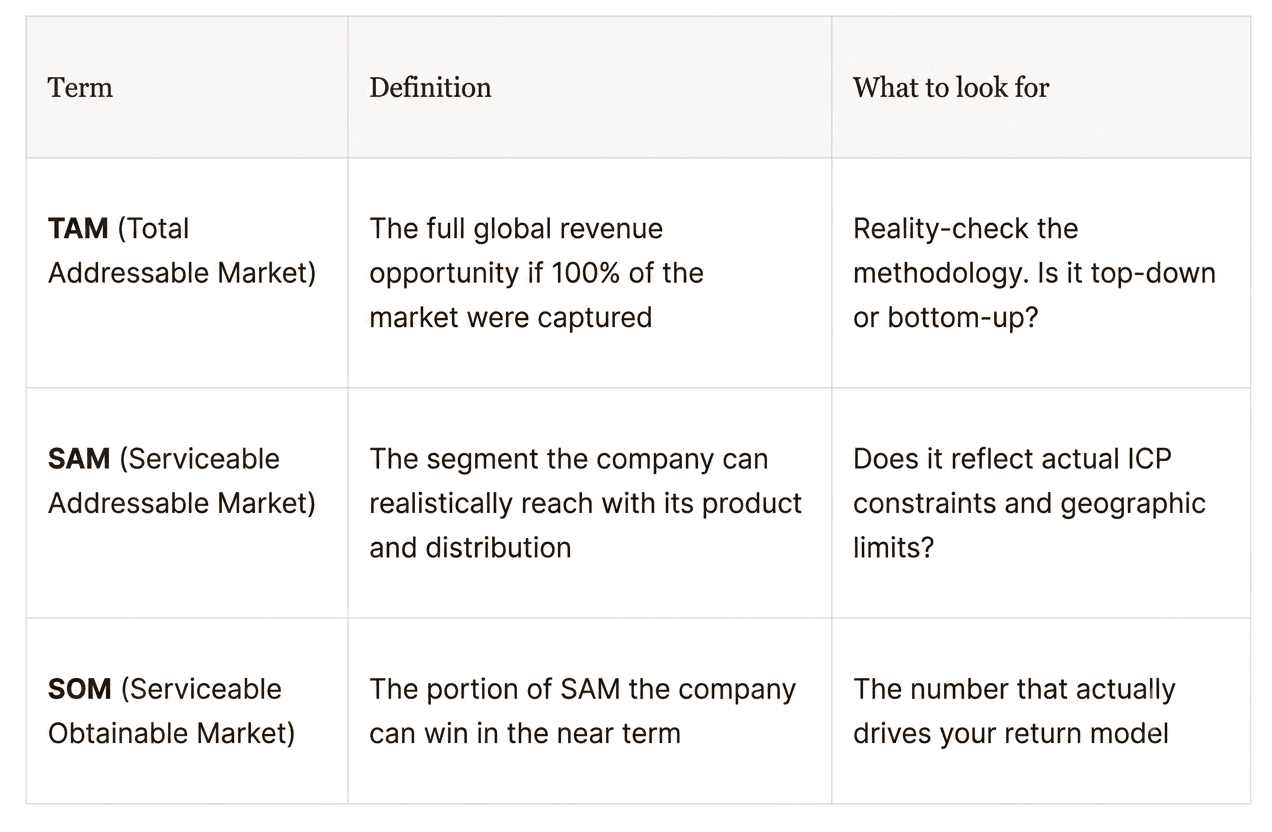
The SOM is the number that matters most in the first 18 months. A founder who can articulate a credible SOM (backed by pricing assumptions, sales cycle data, and channel capacity) demonstrates operational clarity that top-line TAM figures simply can't provide.
Beyond the framework itself, evaluate whether the market has genuine tailwinds. Regulatory shifts, infrastructure adoption curves, and demographic changes can accelerate a SOM dramatically. Headwind risks (e.g., incumbent lock-in, commoditization pressure, or shrinking buyer budgets) deserve equal scrutiny. A realistic founder will acknowledge both sides rather than presenting a frictionless growth curve.
Once you've validated the market narrative, the next question becomes whether the company's operational decisions actually match it; and that's where red flags tend to surface.
The Red Flag Audit: Spotting Premature Scaling
Premature scaling is the single most common way well-funded startups collapse, and it's often invisible until the damage is done. At its core, the angel investing definition of premature scaling is straightforward: a company burns capital on growth motions before the underlying product has earned the right to grow. The Startup Genome Report found that a significant portion of startup failures stem from premature scaling, making it a critical pattern to identify during diligence.
Marketing spend masking poor product-market fit is an early warning sign. If a SaaS company is acquiring customers cheaply but churning them quickly, paid acquisition looks like traction until you pull the retention data. Ask for cohort-level churn broken down by acquisition channel. A healthy signal is improving retention across cohorts over time. A red flag is flat or worsening churn despite increased ad spend.
The hiring plan reveals intent more than the pitch deck does. Growth-led hiring looks like: one sales hire after the first three referenceable customers close. Ego-led hiring looks like a VP of Marketing at pre-revenue or a Chief of Staff before the product has 10 users. Review the org chart trajectory alongside the cash runway. If headcount is expanding faster than revenue per employee, that's a structural problem, not a temporary one.
Customer retention data is a key signal that cuts through every narrative a founder builds. Net Revenue Retention (NRR) above 100% in SaaS indicates customers are expanding — a green flag. NRR below 80% at Series A signals the product isn't delivering enough value to hold accounts. Review this metric before forming any view on the growth story. You can find a practical framework for contextualizing these numbers alongside valuation inputs in this early-stage valuation guide.
Red flags and green flags side by side:
🚩 CAC is rising while churn stays flat or worsens
✅ CAC declining as word-of-mouth referrals increase
🚩 Hiring ahead of product validation milestones
✅ Hiring tied directly to signed customer commitments
🚩 Gross margin compression masked by top-line growth
✅ Improving unit economics quarter over quarter
Once the commercial health of a company is stress-tested, the next layer of diligence shifts to the infrastructure underneath it. Specifically, whether the technical and legal foundations are clean enough to survive institutional scrutiny.
Technical and Legal Scrutiny for Angel Groups
Legal and IP risk can quietly kill a deal that looks clean on every other dimension, and applying venture capital mental models to this layer is what separates disciplined angel groups from those who get surprised post-close.
Clean IP assignment isn't optional; it's foundational. Every founder and contractor who contributed to the codebase must have executed a proper IP assignment agreement before a term sheet is signed. In practice, contractor-built MVPs are a common source of ownership gaps, and unresolved assignments can render the company's core asset legally contested.
Patent pitfalls tend to cluster around timing and scope. Filing too late risks losing novelty protection, while claims drafted too narrowly leave competitors with an easy workaround. According to Angel Capital Association best practice guidance, mismanaged "willfulness" exposure and narrow legal claim scope are among the top reasons deals fail in technical due diligence — a finding that underscores the need for qualified IP counsel, not just a founder's self-assessment.
Angel groups also carry their own legal exposure if they proceed after discovering potential infringement without escalating the issue. Standardizing a legal due diligence checklist across the group reduces this "willfulness" risk and creates a defensible process for every deal reviewed.
The lead investor's role in coordinating technical deep dives is critical here. A designated lead who owns the IP and legal review (i.e., engaging external counsel when warranted) protects the broader syndicate from gaps that individual investors might miss when reviewing independently.
Getting the legal structure right sets the conditions for something equally important: how you construct a portfolio that can actually absorb the inevitable losses and still generate outsized returns.
Portfolio Construction: The Math of Angel Diversification
Single-deal angel investing isn't a strategy; it's a lottery ticket. The math of venture returns demands a portfolio approach, and understanding why changes how you evaluate every individual opportunity.
Successful VCs build around the Power Law principle: one outlier investment should be capable of returning the entire fund. For angels, that same logic means you need enough shots on goal for the math to work in your favor. In practice, most portfolio models suggest 20+ deals as the minimum threshold to reach a statistically meaningful probability of landing that breakout return. Below that number, you're relying on luck more than process.
Sector balance and time diversification matter as much as volume. A concentrated bet on a single vertical amplifies both the upside and the exposure to sector-specific startup red flags (e.g., regulatory shifts, talent crunches, or technology cycles that can compress an entire cohort simultaneously). A more resilient approach mixes conviction-based sector plays with opportunistic software investments where the fundamentals are strong regardless of vertical. Moreover, time diversification (or vintage diversification) ensures you don’t deploy all of your capital within a brief, hype-driven window. Instead, by gradually deploying capital each quarter over a 3-5 year period, you’ll diversify your investments across various technology trends and market cycles.
Pro-rata rights are often undervalued at the seed stage. Securing the right to participate in follow-on rounds lets you double down on your winners — the exact deals where capital allocation matters most. Missing that option in early term sheet negotiations is a structural disadvantage that compounds over time.
This is where syndicated investing becomes a genuine portfolio accelerator. By co-investing through a syndicate, angels can spread capital across more deals, access shared diligence, and preserve bandwidth for deeper evaluation; all without traditional membership fees creating friction before a single check clears. The mechanics of how that syndicated model actually curates deal flow, and what it means for your signal-to-noise ratio, is worth examining directly.
The Allied Approach: Leveraging Syndicated Intelligence
Solo due diligence has a structural ceiling: one investor's network, one lens, one founder assessment framework applied to every deal. Syndicates exist precisely to break that ceiling.
Allied Venture Partners operates as a venture syndicate, which means the diligence work behind each deal draws on a diverse operator network rather than a single analyst's judgment. When a software company enters the pipeline, it isn't evaluated in isolation; it's pressure-tested by people who've built, scaled, and sold companies across North America. That collective intelligence is the edge that individual angels struggle to replicate on their own.
The model also removes two common friction points that slow capital deployment. First, there are no membership fees: investors can focus their dollars on high-growth software opportunities rather than overhead. Second, founders enter a fee-free pitching process, which means the network attracts serious, motivated teams rather than those simply shopping for any check available. The result is curated deal flow that's already been filtered for signal before it reaches an investor's inbox.
What this means in practice: angels who join the syndicate aren't just co-investing; they're accessing a layer of technical and market diligence that typically requires an entire venture firm to produce. For early-stage software founders, the flip side is equally valuable. Connecting with a North American network of operators means feedback, introductions, and capital arrive through one coordinated channel. As you build toward your own checklist of non-negotiables, the next section distills everything covered here into the actions that move the needle most.
The Bottom Line: Your Due Diligence Checklist
Rigorous due diligence isn't optional; it's the single most reliable mechanism for separating high-conviction investments from expensive guesses.
The research is consistent: investors who commit at least 20 hours per deal see average returns jump from roughly 1.1x to 5.9x. That time investment has a structure. Use it deliberately across these five checkpoints:
Verify the Idea Maze. Ask the founder to explain why every prior attempt in the space failed. A convincing answer signals genuine market understanding; a vague one signals a blind spot.
Audit for premature scaling. Compare marketing spend against customer retention curves. High acquisition burn alongside weak cohort retention is a structural warning sign, not a timing issue.
Apply the TAM-SAM-SOM model. Filter out inflated total addressable market claims by requiring the founder to map their realistic market capture bottom-up. Realistic SOM figures beat optimistic TAM slides every time.
Assess founder resilience directly. As Allied Venture Partners' investment strategy confirms, rigorous due diligence is the only consistent way to identify founders with the resilience to navigate early-stage pivots.
Join a syndicate to multiply your edge. Collective intelligence compounds individual research. A network like Allied Venture Partners layers operator expertise, curated deal flow, and fee-free access across a portfolio (without requiring membership fees).
The compounding insight: process discipline is the actual alpha. Solo intuition has a ceiling. Systematic evaluation (applied deal after deal) is what builds a portfolio capable of generating venture-scale returns. The next section pulls these threads together into a framework for fully professionalizing your approach to the asset class.
Summary: Professionalizing the Angel Asset Class
Rigorous due diligence is what separates an informed angel investor from one who simply got lucky, and the 20-hour commitment explored throughout this article is the practical threshold that makes that separation real.
The shift from intuition-based to evidence-based investing isn't about eliminating judgment. It's about grounding judgment in verified data (e.g., market sizing, team track records, legal structure, competitive positioning, and cohort metrics) so that pattern recognition works with the evidence instead of in spite of it. As research from the Angel Capital Association confirms, investors who complete structured due diligence consistently achieve stronger outcomes than those who rely on gut instinct alone.
For founders, this level of scrutiny isn't a hurdle; it's a signal. Investors who ask hard questions, request detailed financials, and conduct thorough reference checks are the ones who add genuine value post-investment. Preparing for rigorous diligence strengthens your narrative, stress-tests your assumptions, and ultimately makes your company more fundable. You can explore how Allied Venture Partners evaluates opportunities to understand exactly what that process looks like in practice.
Allied is built on the conviction that "diversifying Canada's funding ecosystem" requires a commitment to rigorous standards and high-quality deal flow (on both sides of the table). That means founders who come prepared and investors who do the work.
If you're a founder ready for that standard, submit your pitch through our no-fee portal. If you're an accredited investor seeking curated deal flow, join the Allied Venture Partners syndicate to access high-conviction early-stage software opportunities without membership fees.
FAQ: Due Diligence for Angel Investors
What is angel investing due diligence, and why does it matter so much?
Angel investing due diligence is the structured process of evaluating a startup's founder, market, financials, and legal standing before committing capital. Research from Wiltbank and Boeker shows investors who spend at least 20 hours on this process see average returns of 5.9x, compared to just 1.1x for those who don't, making it one of the few controllable factors in early-stage returns.
What is the basic angel investing definition, and how does it differ from venture capital?
Angel investing is the practice of individual accredited investors deploying personal capital into early-stage, typically pre-revenue or early-revenue, private companies in exchange for equity or convertible instruments like SAFEs. Unlike institutional VC, which manages pooled fund capital, angels often invest their own money directly, though syndicates like Allied Venture Partners now let angels access institutional-style diligence and deal flow.
What is a founder assessment framework, and what should it include?
A founder assessment framework is a structured set of questions and criteria used to evaluate whether a founder has genuine command of their market, also known as navigating the "Idea Maze." This includes probing why prior attempts in the space failed, what asymmetric insight the founder holds, and whether their conviction comes from lived experience or borrowed pitch-deck language.
What venture capital mental models are most useful for angel investors?
Beyond the Idea Maze, useful venture capital mental models include the TAM-SAM-SOM framework for market sizing, the Power Law principle for portfolio construction, and cohort-based retention analysis for spotting premature scaling. These models help investors move from gut-feel impressions to evidence-based conclusions.
What are the most common startup red flags to watch for during diligence?
Key startup red flags include rising customer acquisition costs alongside flat or worsening churn, hiring ahead of product validation (such as a VP of Marketing before meaningful revenue), Net Revenue Retention below 80% at Series A, and gross margin compression hidden behind top-line growth. Each signals that a company may be scaling before it has earned the right to.
How many hours should due diligence investors realistically budget per deal?
The professional standard is roughly 20 hours per deal, covering founder reference calls, market sizing validation, financial and legal review, and cohort-level retention analysis. Syndicates can compress this individual time commitment by pooling collective diligence work across an operator network.
Why do due diligence investors emphasize portfolio construction alongside individual deal analysis?
Even rigorous single-deal diligence can't overcome the math of venture outcomes, since most early-stage companies fail. Most portfolio models suggest 20 or more deals as the minimum threshold for a statistically meaningful chance at a breakout return, which is why disciplined investors pair deep diligence with broad, diversified deal flow.
How does joining a syndicate change the due diligence process for angel investors?
Syndicates like Allied Venture Partners pool diligence work across a network of operators who've built and scaled companies themselves, rather than relying on a single investor's judgment. This collective intelligence model, combined with no membership fees and a fee-free pitching process for founders, gives angels access to curated, pre-filtered deal flow without sacrificing analytical rigor.
Disclaimer: This article is provided for general informational and educational purposes only and does not constitute legal, financial, investment, tax, or professional advice of any kind. Allied Venture Partners LLC makes no representations or warranties regarding the accuracy, completeness, or currentness of this information, which is subject to change without notice. To the fullest extent permitted by law, Allied Venture Partners LLC, its affiliates, officers, directors, employees, and agents expressly disclaim all liability for any direct, indirect, incidental, consequential, special, or punitive damages arising from your use of or reliance on this content, including but not limited to any securities offerings, capital raises, regulatory compliance issues, enforcement actions, financial losses, or business damages. Securities laws are complex, fact-specific, and vary by jurisdiction. You are solely responsible for ensuring compliance with all applicable federal and state securities laws and should consult with qualified legal counsel, financial advisors, and tax professionals licensed in your jurisdiction before making any decisions or taking any actions based on this information. By accessing or using this article, you acknowledge that you have read and understood this disclaimer, assume all risks associated with your use of this information, and agree to indemnify and hold harmless Allied Venture Partners LLC from any claims arising from your use of this content.